
ON Semiconductor: Strategic Expansion, Integration Gambit, and the Stakes of Electrification Leadership
ON Semiconductor’s operational momentum is colliding with a transformative M&A agenda, as the company leverages its power and sensing technology leadership for automotive and AI megatrends—while facing execution and integration risks from the Synaptics merger and ambitious portfolio expansion.
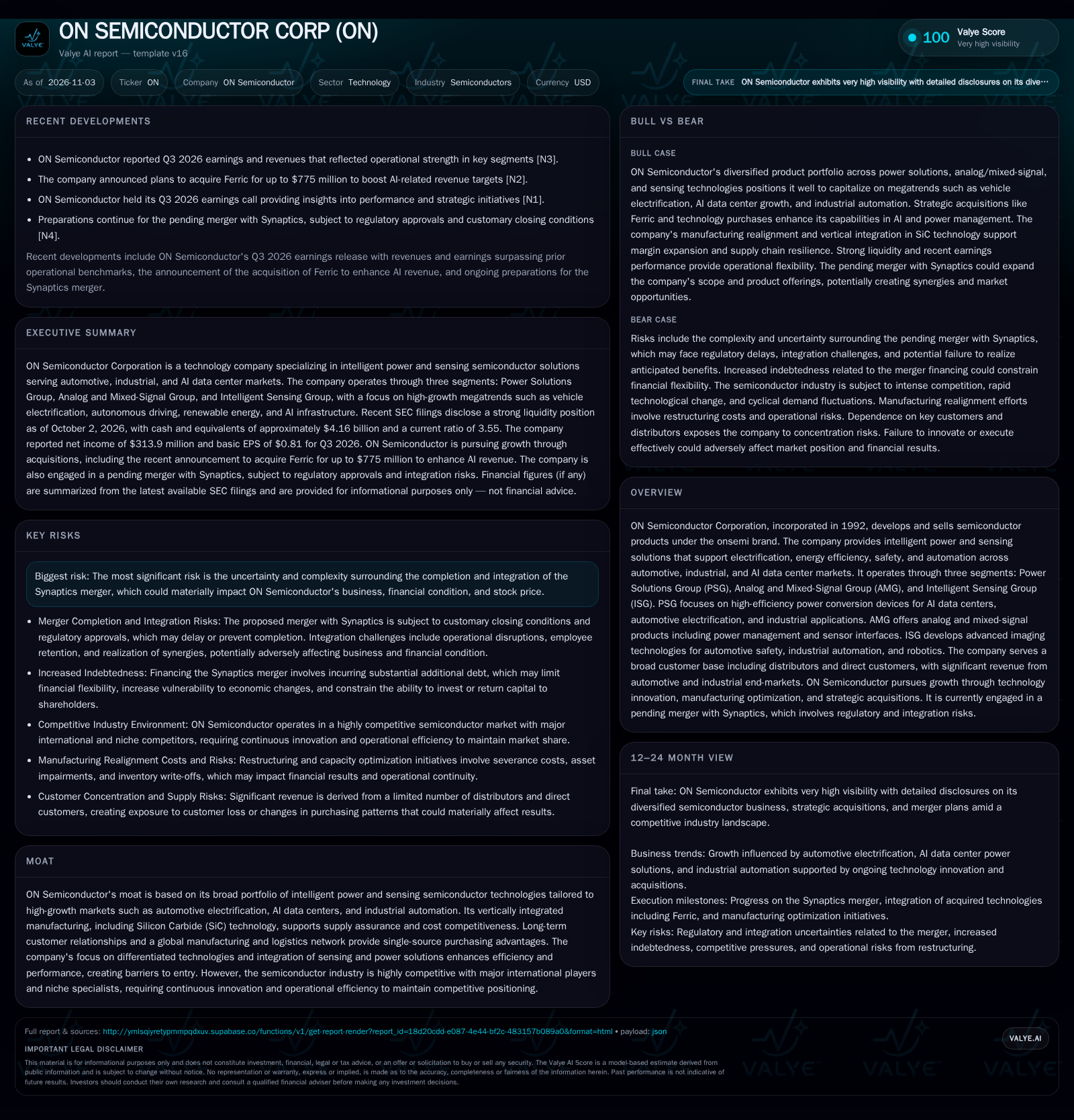
ON Semiconductor is pursuing high-growth markets in automotive electrification, AI, and industrial automation, underpinned by recent acquisitions and a strong Q3 2026 performance. However, the pending Synaptics merger introduces substantial integration and financial risks, and success will depend on the company’s ability to realize synergies, contain restructuring costs, and defend its position against intense competition. The next 12-18 months will be shaped by merger progress and execution in high-margin, differentiated technologies. [S2] [N1] [N3]
ON Semiconductor stands at a pivotal intersection of operational execution and strategic transformation. With over half its revenue coming from automotive markets and a growing presence in industrial and AI applications, the company’s differentiated power and sensing portfolio positions it to ride electrification and automation megatrends. Yet, the pending Synaptics merger and recent AI-focused acquisitions introduce new integration, competitive, and financial risks. As ON Semiconductor seeks to optimize manufacturing and expand its technology base, its ability to deliver profitable growth will hinge on navigating merger complexities, realizing synergies, and defending against intensifying competition in a rapidly evolving semiconductor landscape. [S2] [N3]
Recent Results, M&A Gambit, and Financial Position: The Current Landscape
ON Semiconductor reported Q3 2026 net income of $313.9 million, with basic EPS of $0.81, and maintained a cash and equivalents balance of $4.16 billion as of October 2, 2026. Short-term investments and a current ratio of 3.55 further underline near-term balance sheet strength. However, this strong position is set against the backdrop of substantial change: the company has executed acquisitions such as Ferric (up to $775 million) to bolster AI power management capabilities, and it is preparing for a transformative merger with Synaptics, supported by a $2.45 billion debt financing commitment. The merger, targeted for mid-2027 completion, involves significant operational, financial, and integration risks, including the possibility of increased competition and uncertain synergy realization. Meanwhile, manufacturing realignment continues, with the goal of improving gross margins but at the cost of restructuring complexity. [S2] [N3]
How ON Semiconductor Seeks Profitable Growth: Revenue Mix, Margin Drivers, and Capital Demands
ON Semiconductor’s economics hinge on its ability to deliver differentiated power and sensing solutions into high-value, high-growth end-markets. In 2025, its revenue mix was roughly 51% automotive, 28% industrial, and 21% other segments (including AI data centers and computing), highlighting a heavy exposure to electrification, ADAS, and automation cycles. The company’s business model balances volume sales to distributors (54% of revenue) with strategic direct customer relationships (46%), which can support design wins in long product cycles but also expose ON to customer concentration risks.
Gross margin expansion is a central strategic focus, pursued through manufacturing realignment, vertical integration (notably in Silicon Carbide technology), and product mix shift toward higher-margin, differentiated applications. Recent acquisitions—such as Ferric and Vcore power technologies—are intended to accelerate this shift, particularly in AI and power management markets where product lifecycles are longer and pricing can be more resilient. However, the pending Synaptics merger will increase capital intensity and leverage, as integration costs and potential debt servicing will absorb some of the current balance-sheet strength. The company’s ability to generate operating leverage will depend on successful execution of both manufacturing optimization and post-merger integration, as well as maintaining R&D intensity to stay ahead of rapid technological shifts.
Defending Share in a Crowded, Rapidly Evolving Semiconductor Arena
ON Semiconductor operates in a highly competitive environment, facing major international semiconductor companies and smaller, specialized players across its core verticals. Its competitive position is underpinned by a broad, vertically integrated portfolio in power and sensing, with deep exposure to automotive electrification, ADAS, and AI data center growth. Vertical integration in Silicon Carbide (SiC) and investments in differentiated analog/mixed-signal and imaging technologies provide some barriers to entry—particularly where automotive and industrial customers value supply chain resilience and single-sourcing.
However, the semiconductor industry is marked by rapid innovation cycles, pricing pressure, and customer demands for continuous performance improvements. The Synaptics merger could expand ON’s addressable market and deepen its portfolio, but also brings new competitors—especially in the human-machine interface and connectivity segments where Synaptics operates. Manufacturing realignment and R&D investments are necessary to preserve cost competitiveness and technology leadership, but success will require continuous execution and the ability to translate innovation into sticky customer relationships and design wins. The risk of commoditization and margin compression remains acute, especially if integration or execution falters.
If Integration and Electrification Tailwinds Align: The Case for Margin Expansion and Market Share Gains
The most favorable outcome for ON Semiconductor would result from successful execution across three fronts: (1) smooth integration of Synaptics that delivers cost and revenue synergies, (2) rapid ramp and design-win capture in automotive electrification, ADAS, and AI data center segments, and (3) margin expansion driven by manufacturing optimization and a richer product mix. If ON can leverage Synaptics’ technology to cross-sell or bundle solutions—particularly in automotive and industrial markets—while maintaining operational discipline, the combined entity could capture outsized share of high-growth applications and defend pricing power.
Confirmation of this scenario would come from sustained gross margin improvement, above-market revenue growth in automotive and AI segments, and early evidence of cross-selling or new customer wins attributed to the expanded portfolio. Announcements of major design wins, customer renewals, or new long-term supply agreements post-merger would further support the upside case. A successful integration would also be reflected in operating expense containment and rapid realization of targeted cost synergies.
What Steady Execution Looks Like: Gradual Progress Amid Integration and Market Uncertainty
The most likely near-term scenario is one of incremental progress accompanied by periodic disruption. ON Semiconductor is positioned to grow in line with end-market adoption of EVs, ADAS, and industrial automation, with modest gross margin improvement as manufacturing realignment and product mix initiatives take hold. The Synaptics merger proceeds, but synergy realization is slower and integration costs higher than initially projected, muting the immediate financial benefit and absorbing management attention.
In this scenario, ON maintains its competitive position but does not materially outpace sector growth. Financial performance reflects a mix of solid underlying demand and periodic headwinds from restructuring costs or customer/program churn. Evidence would include stable or gradually rising margins, continued R&D investment, and timely delivery of integration milestones, but without transformational financial or operational outcomes in the first 12-18 months.
When Complexity Overwhelms: Merger, Execution, and Market Risk Converge
The primary downside scenario centers on merger execution failure and adverse market conditions. If the Synaptics integration proves disruptive—resulting in talent loss, customer attrition, operational missteps, or inability to realize planned synergies—ON could see both top-line and margin erosion. Increased indebtedness from the merger financing would reduce potential financial flexibility, potentially constraining R&D investment or leading to cost-cutting that undermines long-term competitiveness.
This risk is amplified if automotive or AI end-markets soften, or if competitive intensity forces ON to lower prices or accept less profitable business to defend share. Evidence supporting the downside would include integration delays, cost overruns, missed synergy targets, margin compression, customer loss, or negative revisions to revenue and earnings guidance. Any regulatory or operational setbacks in completing the Synaptics merger would further pressure the company’s outlook.
Milestones and Metrics That Will Determine ON Semiconductor’s Strategic Trajectory
Progress on closing the Synaptics merger, including regulatory approvals and timely achievement of integration milestones.
Realization and disclosure of cost and revenue synergies post-merger—especially in the first 12-18 months.
Quarterly gross margin trends, particularly as manufacturing realignment and new technology integrations are executed.
R&D expense as a percentage of revenue—if disclosed—as a signal of continued innovation and technology leadership.
Revenue growth rates in automotive and AI data center segments, with attention to new design wins or customer contracts.
Customer concentration trends and distributor mix, as shifts could indicate changing competitive dynamics or risk exposure.
Indebtedness levels and debt covenant compliance as the Synaptics financing is deployed and integrated.
Disclaimer: This is research-only, informational analysis and not investment advice. It may include AI-generated interpretation and general industry context. Always verify important details using primary sources.

Comments