
Ally Financial: Credit Cycles, Used Car Price Trends, and Digital Advances in Auto Finance
Ally Financial’s latest results highlight the complex interplay between credit risk management, shifting used vehicle markets, and the ongoing digital transformation of automotive lending. As profitability rebounds on lower credit loss provisions and higher consumer loan yields, the sustainability of these gains will depend on remarketing outcomes, interest-rate dynamics, and operational discipline.
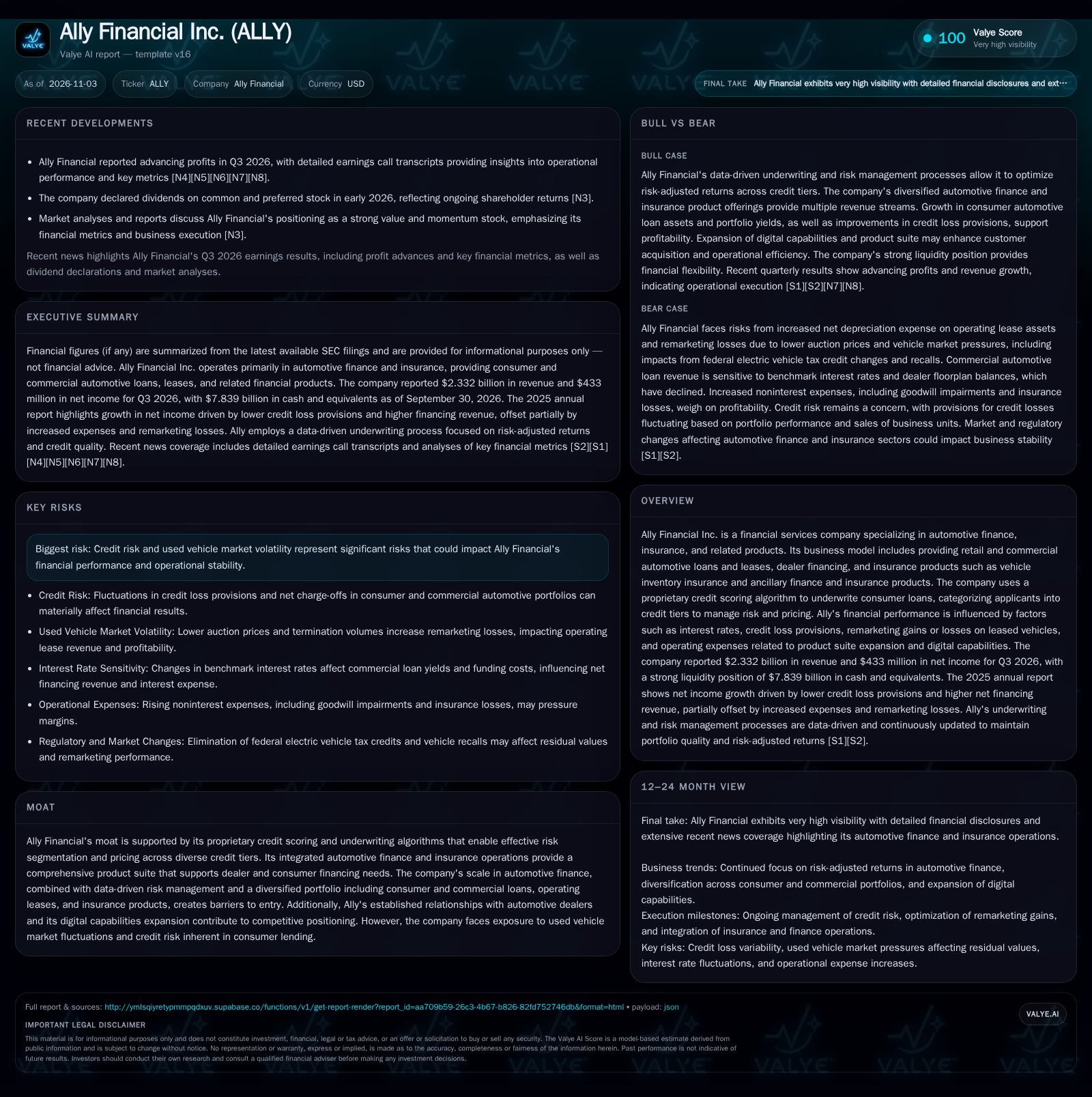
Ally Financial’s Q3 2026 results show a rebound in profitability, driven by reduced credit loss provisions and higher net financing revenue, even as remarketing losses from used vehicle sales rise and commercial loan revenue softens. The company's ability to balance risk-adjusted growth in consumer lending with disciplined expense management and adapt to used car market swings will shape its future earnings trajectory and resilience. [S1] [S2] [N4] [N5] [N6] [N7] [N8]
Ally Financial’s recent performance underscores the nuanced economics of automotive lending in a period marked by shifting used car prices, evolving credit risk, and the rise of digital platforms. While Q3 2026 profits rebounded on lower credit loss provisions and buoyant consumer loan yields, headwinds such as rising remarketing losses and increased noninterest expenses temper the outlook. The company’s ability to maintain risk-adjusted margins, adapt to changing vehicle values, and manage operational costs will be critical as the auto finance landscape continues to evolve.
Recent Earnings Show Profit Recovery Amid Ongoing Market Challenges
For Q3 2026, Ally Financial reported net income of $433 million and revenue of $2.332 billion, underscoring a substantial profit advance compared to prior periods. This improvement was primarily attributed to lower credit loss provisions and higher net financing revenue from consumer automotive loans, reflecting both improved portfolio performance and a favorable yield environment. However, the company also faced increased net remarketing losses due to lower used vehicle auction prices, highlighting its exposure to ongoing volatility in the used car market. [S1] [S2] [N4] [N5] [N6] [N7] [N8]
Revenue Drivers: Yield Management and Risk in Auto Finance Operations
Ally’s core economics are grounded in originating and servicing automotive loans and leases for both consumers and dealers. Revenue is generated via interest income on retail and commercial loans, lease payments (including residual value realization at lease end), and insurance premiums. The company’s proprietary, tiered credit scoring system enables granular risk segmentation and pricing, allowing for risk-adjusted returns across a broad spectrum of credit profiles. On the consumer side, higher average assets and portfolio yields have recently driven revenue growth, while the commercial side has been pressured by lower benchmark rates and shrinking floorplan balances, which are sensitive to dealer inventory trends and interest rate cycles.
Operating expenses are a mix of fixed (technology, compliance, infrastructure) and variable (credit losses, insurance claims, remarketing costs). Operating leverage can be achieved if loan growth and stable credit quality enable revenue to outpace expense growth, but this dynamic is vulnerable to swings in used car values and credit cycles. The company’s capital needs are substantial, as automotive lending and leasing require both regulatory capital and liquidity buffers to manage portfolio risk and fund ongoing originations. Rising noninterest expenses—such as goodwill impairments from business unit sales and insurance losses—can weigh on margins, particularly if not offset by revenue growth or credit improvements.
Competitive Landscape: Leveraging Scale and Data in the Auto Lending Sector
Ally operates in a competitive landscape that includes traditional banks, captive auto finance arms, fintech lenders, and digital-first platforms. Its proprietary underwriting algorithms and integrated automotive finance/insurance suite provide some differentiation, especially in risk segmentation and dealer relationship management. The company’s scale in auto finance—spanning consumer, commercial, and insurance products—creates operational efficiencies and cross-selling opportunities that smaller entrants may struggle to match.
However, the barriers to entry are not insurmountable. Fintechs and digital banks are increasingly using advanced analytics, direct-to-consumer channels, and agile technology stacks to target both prime and subprime borrowers. Captive finance units tied to OEMs may also have pricing or relationship advantages in certain segments, especially as electric vehicle (EV) adoption and manufacturer incentives evolve. Ally’s exposure to used vehicle price swings and credit risk is a persistent vulnerability, while the ongoing shift to digital origination and servicing offers both opportunities (lower cost, broader reach) and challenges (tech investment, increased competition).
Margin Growth Potential Linked to Data-Driven Underwriting and Used Car Market Stability
A favorable scenario would see Ally’s data-driven underwriting continue to deliver lower-than-expected credit losses, allowing the company to grow its consumer loan book profitably even as broader credit conditions fluctuate. If used car prices stabilize or recover—limiting further remarketing losses—operating lease revenue could rebound, supporting both top-line and margin expansion. Continued investment in digital origination and servicing could drive cost efficiencies and improve customer retention, while cross-selling of insurance and ancillary products deepens wallet share.
Evidence for this scenario would include sustained low net charge-offs and credit loss provisions relative to peers, positive trends in auction prices and lease termination volumes, and visible operating leverage in the form of flat or declining noninterest expense ratios. Confirmation would also come from growing digital loan originations and improved customer acquisition costs, if disclosed.
Most Likely Outcome: Continued Profitability with Uneven Growth Trajectory
The most plausible outcome is that Ally maintains profitability through disciplined risk-adjusted lending, but with modest growth as sector headwinds and expense pressures persist. Consumer loan yields may remain elevated, but further growth could be tempered by competitive pricing and normalization of credit trends. Used vehicle market volatility is likely to continue, resulting in fluctuating remarketing results and periodic pressure on lease-related revenue.
Noninterest expenses are expected to remain elevated due to ongoing tech investments, insurance losses, and integration costs from past business unit sales. While digital initiatives may gradually improve efficiency, any meaningful margin expansion will likely depend on stable credit quality and a more predictable used car market. Evidence for this scenario would be continued positive net income, stable or slightly improving credit metrics, and expense growth in line with revenue rather than outpacing it.
Earnings Pressure Risks from Declining Used Vehicle Prices and Rising Credit Losses
An adverse scenario would materialize if used car prices decline further, leading to greater-than-expected remarketing losses and higher net depreciation expenses on operating leases. At the same time, a deterioration in consumer credit—due to macro shocks, rising unemployment, or aggressive loan growth into weaker credit tiers—could drive up charge-offs and credit loss provisions.
If noninterest expenses continue to climb (due to further insurance losses, litigation, or technology spending that does not deliver corresponding efficiencies), margin compression could accelerate. The risk is compounded if commercial loan revenue remains soft due to low rates or contracting dealer inventories. Evidence of this scenario would be rising net charge-offs, a spike in provision for credit losses, worsening expense ratios, and declining net income or even net losses in quarterly reports.
Factors Influencing the Durability of Ally’s Profitability and Growth
Quarterly net charge-off rates and provision for credit losses—rising metrics would signal deteriorating portfolio quality and pressure on earnings.
Used vehicle auction price trends and net remarketing gains/losses—continued weakness would threaten lease profitability and residual value assumptions.
Consumer loan origination volume and average portfolio yield—if disclosed, these would help gauge Ally’s ability to grow risk-adjusted lending and maintain pricing power.
Commercial loan and floorplan balances—declines here may indicate sustained headwinds in dealer financing and reduced diversification.
Noninterest expense growth versus revenue—persistent expense pressure without offsetting revenue gains would squeeze margins.
Digital loan origination and servicing adoption rates—if disclosed, improvement here would indicate progress in cost efficiency and customer reach.
Insurance loss ratios and claims trends—rising losses could further erode segment profitability, especially given recent increases from vehicle inventory insurance.
Disclaimer: This is research-only, informational analysis and not investment advice. It may include AI-generated interpretation and general industry context. Always verify important details using primary sources.

Comments