
Advanced Energy Industries: Margin Expansion, Data Center Tailwinds, and the Stakes of Semiconductor Cyclicality
Advanced Energy Industries has delivered a significant operating margin improvement and robust Q3 2026 earnings, underpinned by heightened data center demand and reported liquidity position. The company’s prospects now hinge on its ability to sustain operational gains amid intense competition and the inherent volatility of semiconductor end markets.
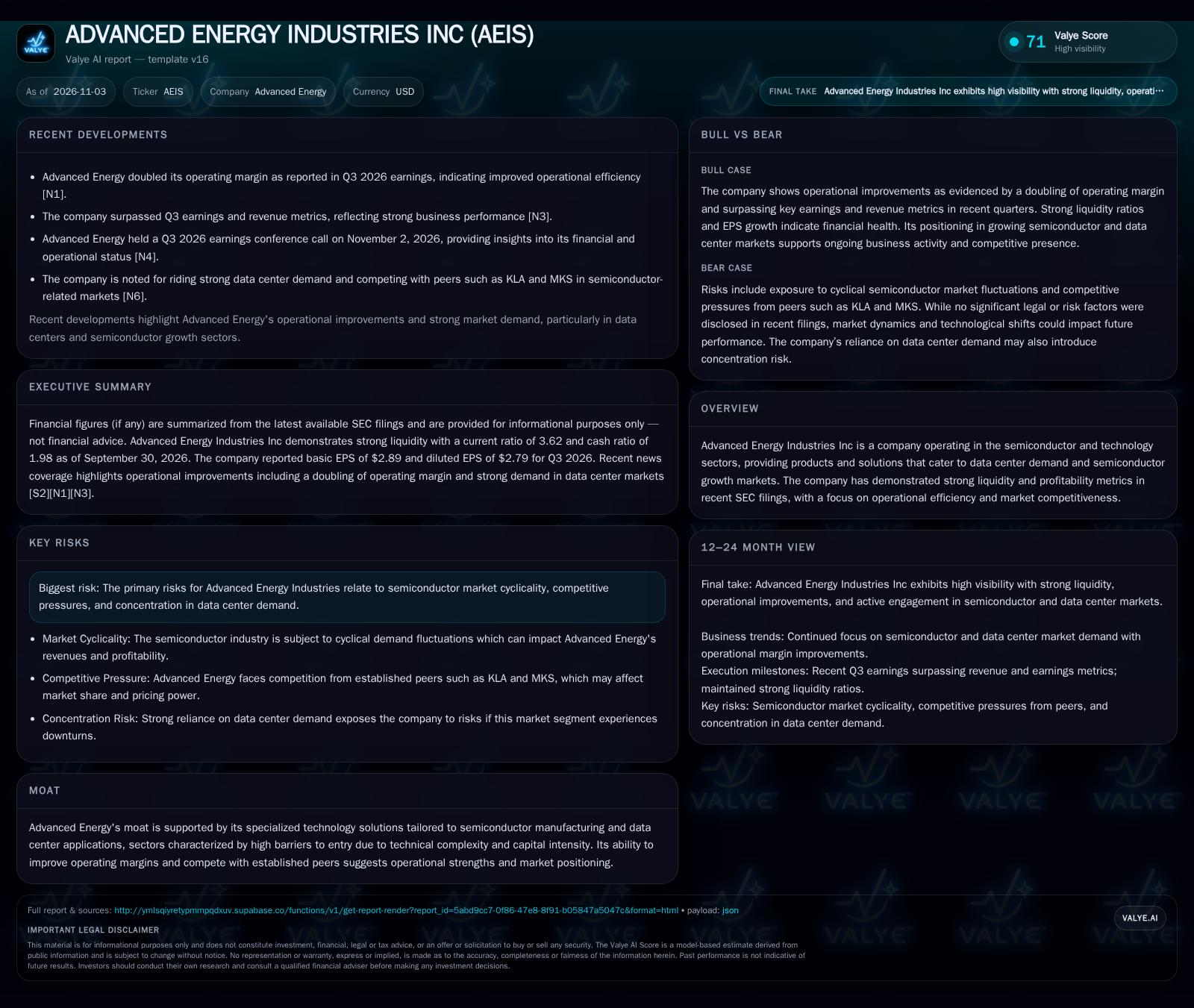
Advanced Energy Industries doubled its operating margin and surpassed Q3 2026 revenue and earnings expectations, buoyed by data center sector demand and reported liquidity position. However, continued momentum will depend on maintaining efficiency improvements and navigating the cyclical and competitive dynamics of the semiconductor industry. [S2] [N1] [N3]
Advanced Energy Industries’ latest quarter marks a pivotal moment, with the company delivering a dramatic operating margin expansion and outperforming revenue and earnings benchmarks. These results are primarily attributed to robust demand in the data center sector—a segment known for both rapid growth and volatility. While the company sits on a sizable liquidity cushion and has demonstrated improved operational execution, its future trajectory will be shaped by how effectively it can defend its gains against fierce competition and the unpredictable swings of the semiconductor cycle.
Recent Margin Gains and Financial Strength Define the Current Landscape
The most material recent development for Advanced Energy Industries is the doubling of its operating margin in Q3 2026, a performance that coincided with the company surpassing consensus earnings and revenue estimates [N1] [N3]. This operational leap signals meaningful cost or efficiency improvements and suggests management has executed on strategic or operational initiatives beyond mere top-line growth. As of September 30, 2026, Advanced Energy reported $1.42 billion in cash and equivalents, with a current ratio of 3.62 and a cash ratio of 1.98, highlighting a reported liquidity position [S2]. The company’s Q3 basic and diluted EPS were $2.89 and $2.79, respectively [S2]. These results are contextualized by strong demand from the data center sector, which has been a significant growth vector for the company in this period [N6].
How Advanced Energy’s Business Model Converts Demand into Profitability
Advanced Energy’s core business revolves around supplying power conversion and control products for semiconductor manufacturing and data center applications. This market orientation exposes the company to both high-value, technology-driven demand and pronounced cyclicality. Revenue generation likely depends on a mix of equipment sales (often capital-intensive, with lumpy order cycles from semiconductor fabs and hyperscale data centers) and potential service or upgrade revenue, though the exact mix is not specified in current disclosures. Pricing power in these markets is typically limited by competitive intensity and customer concentration, but technical differentiation—such as higher reliability, efficiency, or integration—can create pockets of premium pricing.
The recent doubling of operating margin suggests that Advanced Energy has achieved a step-change in cost structure, perhaps through scale efficiencies, supply chain improvements, or successful product mix shifts toward higher-margin offerings [N1]. Because much of the company’s cost base is likely fixed (R&D, manufacturing overhead), incremental volume growth from strong end-market demand can drive substantial operating leverage. However, this leverage also works in reverse during downturns. The company reported cash and liquidity metrics for the period; these figures do not by themselves establish operating runway, investment capacity, financial flexibility, or financing capacity.
Competing in a High-Barrier, Rapidly Evolving Technology Arena
Advanced Energy operates in a segment marked by high technical complexity and capital intensity, with KLA and MKS identified as principal peer competitors [N6]. Barriers to entry include the need for deep engineering expertise, long validation cycles with leading semiconductor and data center customers, and significant upfront investment in R&D and manufacturing capacity. While the company’s recent operating margin gains suggest it is executing well relative to peers, the competitive landscape remains unforgiving: established players vie for design wins, and switching costs, while present, are not insurmountable for large customers if technology leadership falters.
Further, the risk of substitution from alternative power management and control technologies is real, especially as customers seek improved efficiency, integration, or cost savings. The company’s competitive moat may be reinforced by its ability to rapidly innovate and align product development with emerging customer needs, but any erosion in this lead could quickly translate to lost share or compressed margins.
Sustained Data Center and Semiconductor Upswing Extends Margin Expansion
The most favorable scenario for Advanced Energy is one in which data center and semiconductor capital spending remain elevated for several years, allowing the company to capitalize on both volume growth and its improved cost structure. In this environment, the combination of operating leverage and continued product innovation could drive persistent margin expansion and robust EPS growth. Confirmation would come from several quarters of above-industry revenue growth, further margin improvement, and evidence that new products or customer wins are expanding the company’s addressable market.
This scenario could be reinforced if Advanced Energy successfully leverages its cash reserves for targeted R&D or bolt-on acquisitions that accelerate technology leadership. A falsification of this upside would be visible in stagnating revenue despite strong end-market growth, margin compression, or a rise in customer churn—indicating competitive pressures are overwhelming recent gains.
Operational Gains Hold but Industry Cyclicality Tempers Growth
The most plausible trajectory is that Advanced Energy maintains its recent operational improvements, but growth moderates as semiconductor and data center demand normalizes after a period of outsized expansion. The company could see revenue and margin trends stabilize at higher levels than in prior cycles, reflecting the structural efficiency gains realized in 2026. However, periodic soft patches in customer capital spending (due to inventory digestion, macro headwinds, or technology transitions) are likely to cause quarter-to-quarter volatility.
Signs of a more adverse outcome would include sharp declines in order intake, margin erosion, or evidence that competitors are gaining share in core product areas.
Semiconductor Downturn or Competitive Displacement Erodes Recent Gains
A negative scenario could unfold if there is a sharp, cyclical downturn in semiconductor or data center capital spending, resulting in revenue contraction and rapid margin compression due to high fixed costs. Alternatively, if competitors such as KLA or MKS introduce disruptive technologies or win key customer contracts, Advanced Energy could lose share and pricing power. Either dynamic would quickly expose the limitations of recent operational improvements, especially if cost reductions were tied to volume assumptions that no longer hold.
Evidence for this scenario would be a sudden drop in quarterly revenues, a reversal of margin gains, or disclosures of major lost orders or pricing concessions.
Signals That Will Shape Advanced Energy’s Competitive and Financial Trajectory
Quarterly operating margin trends, to assess whether recent improvements are durable or at risk of reversal.
Revenue growth relative to overall semiconductor and data center capital expenditure cycles, which would clarify if Advanced Energy is gaining or losing share.
Order backlog or book-to-bill ratio, if disclosed, as a leading indicator of demand momentum and near-term revenue visibility.
R&D expenditure levels and the cadence of new product launches, which would signal ongoing investment in technology leadership.
Customer concentration metrics and major design wins or losses, to evaluate exposure to single large accounts and competitive displacement risk.
Cash flow from operations and changes in working capital, to gauge the quality of earnings and underlying business resilience.
Any disclosed changes in competitive dynamics—such as new product introductions by peers or pricing shifts in key markets.
Management commentary on end-market trends or guidance revisions, offering insight into the company’s near-term demand outlook.
Disclaimer: This is research-only, informational analysis and not investment advice. It may include AI-generated interpretation and general industry context. Always verify important details using primary sources.

Comments