
Williams Companies: Expansion Bets, Regulatory Hurdles, and the Stakes for U.S. Gas Infrastructure Returns
Williams Companies is deploying capital into major pipeline and storage expansion projects as U.S. natural gas demand evolves, but faces persistent regulatory, commodity, and capital structure headwinds. The next phase will test whether infrastructure scale and contracting can offset cyclical and structural risks in a market increasingly shaped by decarbonization pressures and volatile supply/demand dynamics.
Williams Companies is in the midst of a multi-year buildout of its natural gas pipeline and storage network, with regulatory approvals secured for several large projects slated to come online through 2030. Execution on project timelines and ability to secure long-term contracts will be pivotal to maintaining financial stability and supporting future growth. [S2] [N1] [N2]
Williams Companies stands at a pivotal juncture, executing one of the most ambitious infrastructure expansion programs in the U.S. natural gas midstream sector. With billions committed to new pipelines, storage, and power generation projects stretching into the next decade, the company is betting that demand for natural gas and LNG will remain robust enough to justify long-term capital deployment. However, this growth strategy comes at a time of intensifying regulatory scrutiny, evolving energy policy, and notable short-term liquidity pressure. The company’s ability to secure stable returns from its new assets—amid commodity volatility and rising competition from alternative energies—will determine whether its scale translates into durable shareholder value or exposes it to heightened cyclical and structural risks.
Expansion Projects and Financial Performance Define Williams' Present Challenge
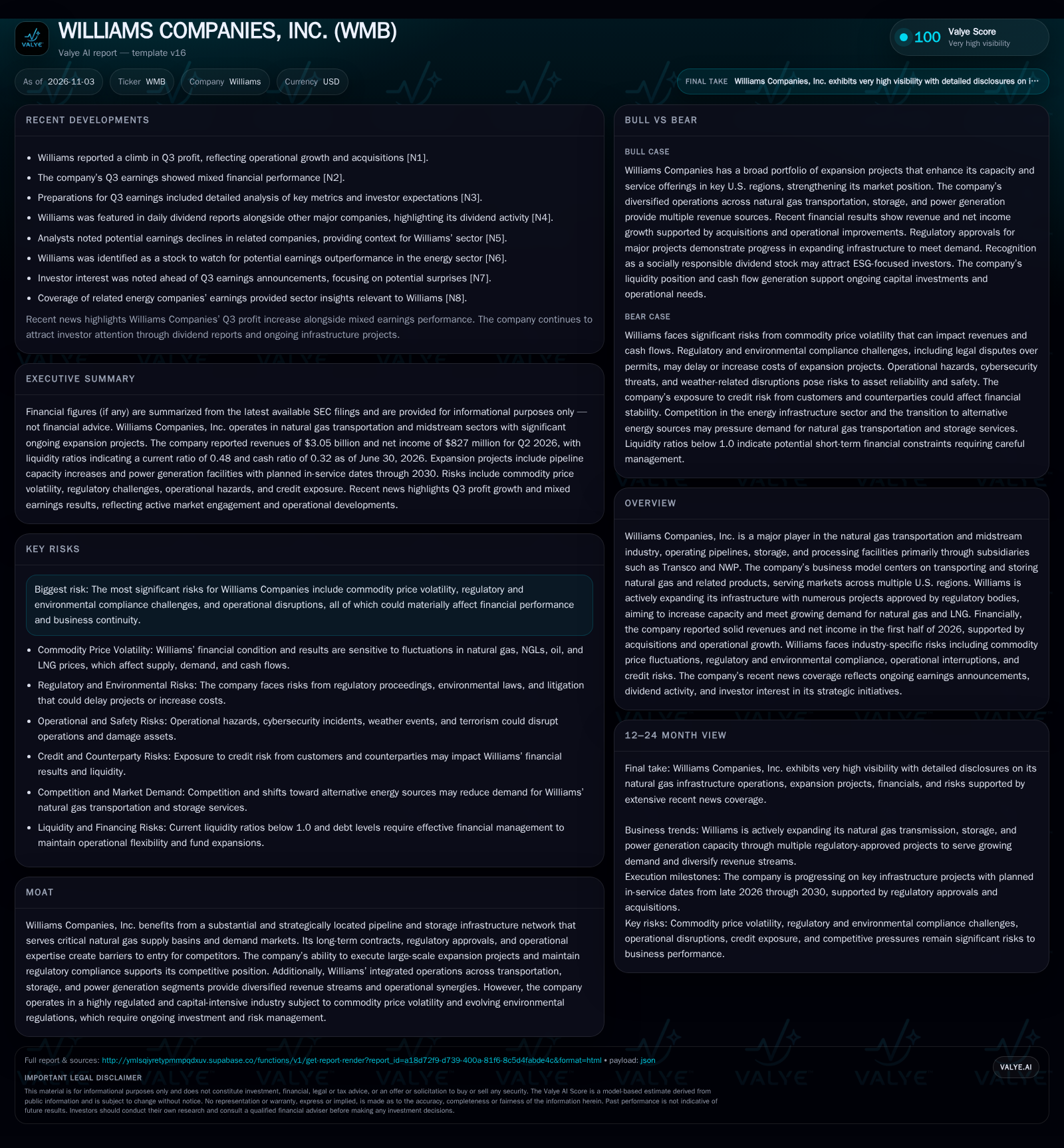
Williams Companies reported Q2 2026 revenues of approximately $3.05 billion and net income of $827 million, reflecting a recent trend of profit growth driven by acquisitions and the incremental contribution of expansion projects. These financial results underscore the company’s ongoing push to scale up its core pipeline and storage operations. The company’s current ratio of 0.48 and cash ratio of 0.32 as of June 30, 2026, highlight a significant mismatch between short-term assets and liabilities, emphasizing the need for disciplined cash management as capital expenditures accelerate. Major expansion projects—including Southeast Supply Enhancement, Northeast Supply Enhancement, and multiple storage and power generation initiatives—have received regulatory approvals and are scheduled for staged completion between late 2026 and 2030. Yet, several projects face regulatory and legal headwinds, such as the NJDEP Clean Water Act certification remand, which threaten to delay in-service dates and escalate costs. [S2] [N1] [N2]
How Williams Monetizes Pipeline Scale and Navigates Capital Demands
Williams’ core business model is predicated on long-haul natural gas transportation, storage, and processing, generating revenue primarily through regulated tariffs and, where possible, long-term contracts. This model offers a degree of volume and cash flow visibility, especially when underpinned by take-or-pay or ship-or-pay agreements common in the midstream sector. However, the economics of these operations are highly capital-intensive: expansion projects require substantial upfront investment and ongoing maintenance, with payback periods often stretching over decades. Fixed costs dominate the cost structure, so incremental throughput can deliver strong operating leverage—if capacity is utilized and contracts are secured.
Recent increases in service revenues have been driven by acquisitions and capacity additions, but operating expenses have also risen due to higher employee, acquisition, and depreciation costs. The company has realized gains from asset sales and equity earnings, but these have been partially offset by increased interest expense, a consequence of new debt issuances to fund expansion. If expansion projects meet demand expectations, Williams could realize attractive returns on invested capital; if not, the risk of stranded assets or underutilized capacity rises.
Infrastructure Footprint and Contracting as Defenses—But for How Long?
Williams enjoys formidable barriers to entry due to its vast, strategically located pipeline and storage network, with assets serving critical supply basins and end markets. The company’s ability to secure regulatory approvals and execute complex projects further supports its competitive position, as does its presence across multiple revenue streams—including power generation initiatives. Long-term contracts, where present, provide some insulation from short-term commodity swings and can lock in high-value customers.
However, these advantages are not absolute. The midstream sector remains highly competitive, with rival operators vying for major supply and demand center linkages. Williams also faces substitution risk from both competing pipelines and the broader energy transition: as renewables and electrification advance, long-term demand for incremental gas infrastructure may become less certain. Regulatory and political scrutiny of fossil fuel infrastructure is intensifying, and environmental opposition can delay or derail projects. In the absence of robust long-term contracting, the company’s ability to fill new capacity at attractive rates will be tested, especially if gas demand growth underperforms optimistic scenarios.
What If Expansion Pays Off? Pathways to Outsized Returns
The most favorable scenario for Williams sees its major expansion projects come online on schedule and on budget, with regulatory and legal hurdles resolved without material delay. In this case, new capacity is quickly absorbed by growing demand from LNG export facilities, gas-fired power generation, and industrial users—sectors where U.S. natural gas maintains a cost and reliability edge. If long-term, fixed-fee contracts are secured for this new capacity, Williams could lock in stable, inflation-protected cash flows and realize strong incremental margins due to the fixed-cost nature of its asset base.
Confirmation of this scenario would come from public disclosure of high contracted utilization rates for new projects, rising backlog or forward contracted revenues, and evidence of successful regulatory navigation.
Incremental Growth and Capital Discipline Remain the Most Likely Outcome
The most plausible path for Williams is a mix of steady, incremental revenue growth from phased project completions and ongoing exposure to regulatory and market frictions. Some expansion projects may experience delays or budget overruns, but most are likely to reach completion given sunk regulatory and capital commitments. Utilization rates could be solid but not fully optimized, as regional demand growth for gas continues at a moderate pace—supported by LNG exports and power market needs, but partially offset by efficiency gains and renewables penetration.
Falsification would come from repeated project delays, cost overruns, or evidence of declining demand for new capacity.
When Expansion Meets Headwinds: Delays, Cost Overruns, and Demand Shortfalls
The bear case for Williams stems from a convergence of adverse forces: regulatory or legal setbacks delay key projects, driving up costs and eroding returns; commodity price volatility or policy shifts reduce demand for incremental natural gas infrastructure; and competitive or policy-driven customer losses lead to underutilized assets. In this scenario, high capital spending combines with lower cash generation, stressing liquidity and potentially forcing asset sales, dividend cuts, or dilutive equity/debt issuance.
Evidence for this scenario would include project in-service date slippages, escalating capex disclosures, negative working capital trends, customer contract cancellations, or rating agency downgrades. A persistent decline in contracted backlog or the need to renegotiate debt covenants would also signal material downside risk.
Milestones and Metrics That Will Reveal Williams' Expansion Payoff
Progress updates on the in-service timing and budget status for major expansion projects, especially Southeast and Northeast Supply Enhancement, would help test execution risk.
If disclosed, the proportion of new capacity under long-term, fixed-fee contracts versus spot or short-term arrangements would clarify revenue visibility.
Quarterly trends in contracted backlog and forward revenue commitments would indicate future cash flow stability.
Operating cash flow and free cash flow after capital expenditures, particularly in quarters with peak project spending, would reveal funding adequacy.
Net debt to EBITDA and interest coverage ratios will show whether capital structure risk is increasing as expansion accelerates.
Disclosures of regulatory or legal setbacks, such as permit remands or litigation outcomes, would directly affect project timelines and risk profile.
If available, regional demand/throughput trends in key served markets (e.g., LNG export terminals, power generation customers) would provide early indication of utilization risk.
Disclaimer: This is research-only, informational analysis and not investment advice. It may include AI-generated interpretation and general industry context. Always verify important details using primary sources.

Comments