
Sabra Health Care REIT: Navigating Healthcare Real Estate’s Demographic Tailwinds and Structural Risks
Sabra Health Care REIT’s Q3 2026 results exceeded expectations, underscoring consistent income from its portfolio of senior housing and skilled nursing facilities. As demographic forces support long-term demand, the REIT’s fortunes remain closely tied to regulatory shifts, operator health, and the dynamics of healthcare reimbursement.
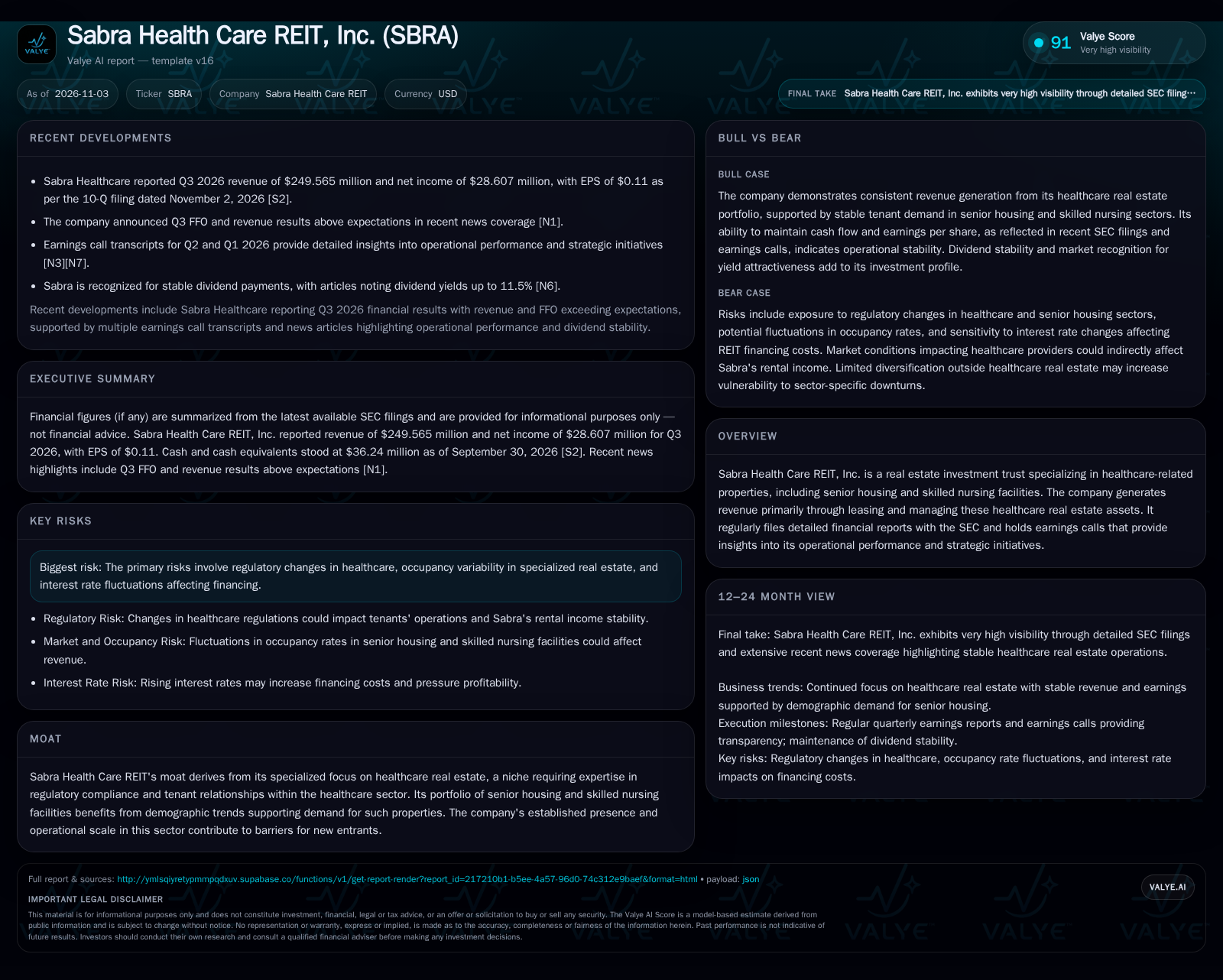
Sabra Health Care REIT reported Q3 2026 revenue of $249.6 million and net income of $28.6 million, with results above expectations. The company’s focus on leasing senior housing and skilled nursing properties offers stable income, but exposes it to regulatory, tenant, and interest rate risks. Sabra’s performance will hinge on its ability to maintain occupancy, manage operator partnerships, and navigate sector-specific headwinds and opportunities.
Sabra Health Care REIT, Inc. stands at the intersection of demographic inevitability and structural complexity. Its Q3 2026 financials—revenue of $249.6 million and net income of $28.6 million—demonstrate the resilience of healthcare real estate amid broader market uncertainty [S2] [N1]. But this stability is underpinned by a business model that is acutely sensitive to regulatory changes, operator health, and funding conditions. As the U.S. population ages and demand for senior care intensifies, Sabra’s long-term opportunity is clear—yet so are the pressures of sector-specific risks and the ongoing challenge of maintaining occupancy and rental streams in a tightly regulated environment.
Recent Results Highlight Income Stability and Sector Outperformance
Sabra Health Care REIT reported Q3 2026 revenue of $249.565 million and net income of $28.607 million, translating to $0.11 per share [S2]. This performance was above consensus expectations, as noted in recent news coverage [N1]. The company’s balance sheet showed $36.24 million in cash and cash equivalents at quarter-end [S2]. These results reinforce Sabra’s reputation for stable cash generation from its healthcare real estate portfolio, even as sector headwinds persist.
The outperformance relative to expectations suggests resilience in tenant payments, occupancy rates, or both—though the underlying drivers are not fully detailed in the available evidence. With regular quarterly earnings calls and transparent reporting, Sabra offers investors visibility into its operational trajectory, but its fortunes remain intertwined with the broader health and regulatory environment of U.S. senior housing and skilled nursing.
How Sabra’s Healthcare Real Estate Model Turns Rent into Cash Flow
Sabra’s core economics are driven by leasing healthcare facilities—primarily senior housing and skilled nursing—to operators under long-term agreements. The primary revenue stream is rental income, typically structured as triple-net leases, which place responsibility for property expenses on the tenant. This model can produce high operating margins and predictable cash flows when tenants are stable and properties are well-occupied.
Fixed costs are relatively low at the REIT level, with most property-level expenses borne by operators. This enables significant operating leverage: incremental rental income flows disproportionately to the bottom line once fixed administrative costs are covered. However, leverage works both ways—should occupancy or rent coverage fall, the impact on earnings can be sharp.
Capital needs center on property acquisitions, redevelopment, and periodic refinancing. Because REITs are required to distribute most taxable income as dividends, Sabra must regularly access debt and equity markets to fund growth. Interest rate movements directly affect both the cost of new capital and the value of existing properties, introducing sensitivity to macroeconomic cycles.
The triple-net lease structure, while advantageous for cash flow stability, also means Sabra’s income is indirectly dependent on the operators’ ability to manage property-level costs efficiently. If operators face rising labor or compliance expenses that outpace reimbursement growth, they may seek rent concessions or face solvency challenges, thereby impacting Sabra’s rental collection. Additionally, the long-term nature of leases can create lag effects where rent escalations do not immediately reflect current market conditions or operator financial health, introducing potential mismatches between Sabra’s revenue and underlying property performance. Therefore, monitoring lease terms and escalation clauses is critical for anticipating income variability.
Specialization as Strength—But Exposure to Operator and Regulatory Risks
Sabra’s competitive advantage lies in its specialized focus on healthcare real estate, particularly senior housing and skilled nursing. This niche requires expertise in navigating healthcare regulations, understanding reimbursement frameworks, and maintaining strong relationships with operators. Barriers to entry for new competitors include regulatory complexity, operator due diligence, and the need for scale to diversify tenant and geographic risk.
However, Sabra’s specialization also concentrates risk. The company is exposed to the financial health of its operator partners—if a major tenant encounters distress, rental streams can be disrupted. Furthermore, reimbursement rates for skilled nursing and senior care are heavily influenced by government policy, making Sabra’s underlying cash flows vulnerable to regulatory shifts.
Competition comes from other healthcare REITs, diversified property REITs with healthcare exposure, and private capital. The sector’s long-term demand is supported by demographic trends, but near-term performance can diverge sharply based on operator quality, property location, and regulatory developments.
Demographic Momentum and Operator Stability Drive Sustained Growth
The most favorable scenario for Sabra is one in which the aging U.S. population continues to drive increased demand for senior housing and skilled nursing, supporting high occupancy and strong rent coverage across its portfolio. If operators remain financially healthy and reimbursement levels are stable or improve, Sabra could see steady growth in rental income and distributable cash flow.
Upside would be confirmed by evidence of rising occupancy rates, increasing same-property net operating income, and consistent or growing dividend payouts. Announcements of accretive acquisitions or successful refinancing at favorable rates would also reinforce the thesis. If disclosed, improvements in tenant credit quality and diversification would further support a bullish case.
Sector Resilience Balanced by Persistent Headwinds
The most plausible trajectory for Sabra involves moderate, steady revenue growth supported by demographic tailwinds, offset by periodic challenges in occupancy, operator health, and reimbursement rates. The REIT is likely to maintain its current income profile, with incremental gains from rent escalators, selective acquisitions, and disciplined cost management.
This scenario would be confirmed by stable or gradually improving FFO (funds from operations), consistent occupancy rates, and ongoing ability to cover dividends from operating cash flow. Earnings call commentary emphasizing risk management, operator support, and prudent capital allocation would further validate the base case. Conversely, a sudden spike in operator defaults, significant regulatory changes, or a sharp increase in interest rates would challenge this outlook.
Operator Distress or Regulatory Shock Undermines Rental Streams
The adverse scenario centers on a confluence of negative events: a major tenant or group of operators facing financial distress (due to reimbursement cuts, cost inflation, or mismanagement), leading to rent deferrals or defaults; a regulatory change that reduces Medicare/Medicaid funding for skilled nursing or senior housing; or a sharp, sustained rise in interest rates that squeezes refinancing capacity and property values.
Downside would be evident in rising receivables, declining occupancy, lower FFO, and potential dividend reductions. If disclosed, a spike in lease renegotiations, asset sales under duress, or negative credit rating actions would further confirm a deteriorating scenario for the REIT.
What Will Shape Sabra’s Trajectory in Healthcare Real Estate?
Occupancy rates across senior housing and skilled nursing facilities—if disclosed—would provide a direct gauge of tenant demand and portfolio health.
Trends in same-property net operating income growth, as reported in earnings calls or filings, would clarify underlying performance versus headline revenue changes.
Operator concentration risk: updates on tenant diversification or major operator exposure would help assess vulnerability to tenant-specific shocks.
Changes in government reimbursement policy for skilled nursing and senior care—tracked via regulatory updates or management commentary—could materially alter cash flow visibility.
Interest expense trends and refinancing activity: new debt issuance rates and maturities, if disclosed, would reveal sensitivity to macro cycles.
Dividend coverage ratio (dividends paid versus FFO or cash flow from operations) would help test the sustainability of Sabra’s yield.
Asset acquisition or disposition activity: announcements of major portfolio moves could signal shifting strategy or capital needs.
Credit rating changes or covenant disclosures—if any—would flag emerging financial stress or improved flexibility.
Disclaimer: This is research-only, informational analysis and not investment advice. It may include AI-generated interpretation and general industry context. Always verify important details using primary sources.

Comments