
First Bancorp /NC/: Asset Quality, Deposit Growth, and the Stakes for Regional Bank Resilience
First Bancorp /NC/ continues to post strong asset quality and organic deposit growth, but faces a shifting risk landscape as credit conditions, interest rates, and natural disaster exposures evolve. The next phase will test its ability to sustain earnings momentum and defend margins amidst sector-wide headwinds.
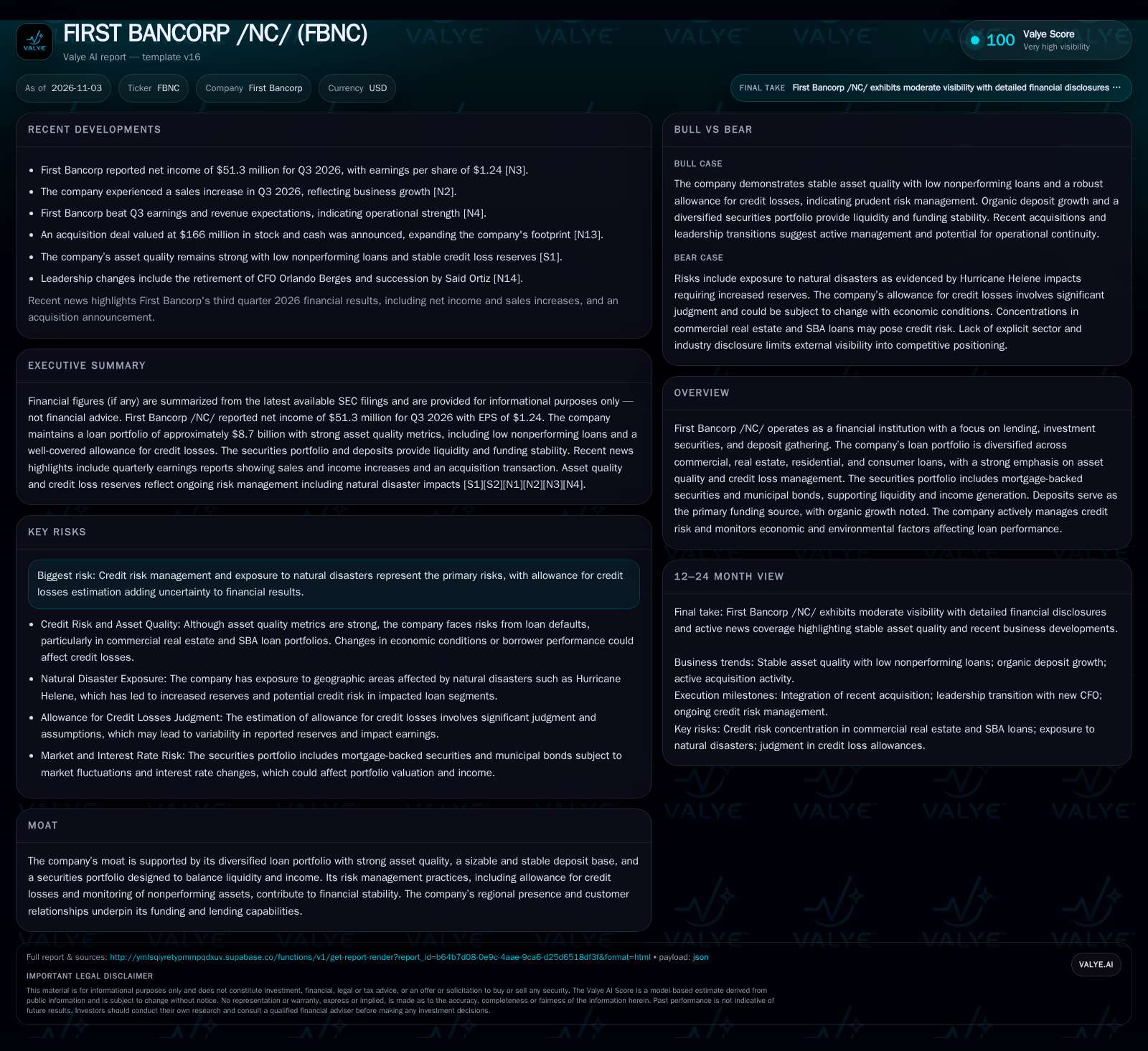
First Bancorp /NC/ reported Q3 2026 net income of $51.3 million, with low nonperforming loans and a robust $123.6 million credit loss reserve. The loan portfolio totals $8.7 billion, and deposits reached $10.7 billion as of year-end 2025. The company beat Q3 expectations, but future performance will hinge on credit risk management, deposit retention, and navigating interest rate volatility. [S1] [S2] [N3] [N4]
First Bancorp /NC/ enters late 2026 with a track record of stable asset quality, healthy deposit growth, and a recent earnings beat that underscores operational discipline. With $8.7 billion in loans, a well-diversified securities portfolio, and a $123.6 million reserve for credit losses, the bank appears well-positioned to weather moderate shocks. However, persistent sector challenges—ranging from credit risk concentration in commercial real estate to rising competition for deposits and exposure to natural disasters—raise questions about the durability of its current performance. The coming quarters will reveal whether First Bancorp can maintain its margin and risk discipline as the external environment grows more complex. [S1] [S2] [N3] [N4]
Earnings Momentum and Asset Quality Define the Current Landscape
First Bancorp /NC/ reported net income of $51.3 million for Q3 2026, translating to basic and diluted EPS of $1.24, and surpassed consensus expectations for both earnings and revenue. Nonperforming loans remain low at 0.42% of total loans, and the allowance for credit losses stands at $123.6 million, or 1.42% of the $8.7 billion loan portfolio [S1] [S2] [N3] [N4]. Deposits, the bank’s primary funding source, totaled $10.7 billion at the end of 2025, bolstered by organic growth. These outcomes reflect disciplined credit risk management and a stable funding base, but the sustainability of these metrics will be tested as sector headwinds persist.
How First Bancorp Converts Lending and Deposits into Earnings
The core business model is classic regional banking: aggregate low-cost retail and commercial deposits and deploy them into a diversified loan book and a sizable securities portfolio. Net interest income—driven by the spread between asset yields (loans and securities) and funding costs (primarily deposits)—is the primary earnings engine. The $8.7 billion loan portfolio is diversified across commercial, real estate, residential, and consumer segments. The $2.56 billion securities book, which includes mortgage-backed securities and municipal bonds, provides both liquidity and an additional income stream, but introduces market and interest rate risk [S1].
Operating leverage is a function of both balance-sheet growth and expense discipline. With a robust deposit base and organic growth, First Bancorp may benefit from scale in non-interest expense management, though competitive deposit markets could pressure funding costs. Credit loss provisions, at $123.6 million, represent a meaningful buffer, but are subject to judgment and may swing earnings in stressed scenarios. Capital needs are moderate for a regional bank of this size, but persistent deposit competition or unexpected credit events could increase funding requirements or constrain growth ambitions.
Defending Market Share in a Crowded Regional Banking Arena
First Bancorp’s competitive moat relies on a diversified loan book with strong asset quality, a stable and growing deposit base, and a securities portfolio designed for both liquidity and yield. In the regional banking landscape, competition centers on deposit pricing, loan rates, and customer relationships. Larger banks may offer greater product breadth or digital convenience, while fintechs and neobanks continue to pressure fee income and customer retention.
The company’s asset quality metrics—low nonperforming loans and a well-provisioned allowance—suggest prudent underwriting and risk controls, which may provide a reputational edge in tighter credit environments. However, concentrations in commercial real estate and SBA loans expose the bank to sector-specific downturns. The ability to maintain deposit growth without resorting to aggressive rate competition is a key differentiator. Ultimately, switching frictions in retail banking are moderate: customer inertia is real, but rate sensitivity rises as market competition intensifies.
Operational Discipline and Favorable Credit Cycles Could Extend Outperformance
If First Bancorp continues its disciplined underwriting, preserves low nonperforming loan ratios, and capitalizes on organic deposit growth, it could maintain or expand net interest margins—even as industry funding costs rise. A benign credit environment, combined with stable or improving asset quality, would likely keep credit loss provisions in check, supporting earnings growth. The securities portfolio, if managed adeptly through interest rate cycles, could add incremental income without exposing the balance sheet to excessive duration or credit risk.
Evidence supporting this scenario would include sustained low charge-off and nonperforming loan ratios, continued above-peer deposit growth, and margin stability or expansion despite sector-wide funding cost pressures. If the bank can also integrate recent leadership changes smoothly and leverage acquisitions for scale, the path for durable earnings growth is plausible.
Stable Performance Amid Sector Headwinds and Cyclical Risks
The most plausible near-term trajectory is for First Bancorp to sustain its current asset quality and earnings profile, but with limited margin expansion. Deposit growth is likely to moderate as competition for funding intensifies and customers become more rate-sensitive. Credit quality may remain favorable barring a sharp macroeconomic downturn, but incremental increases in nonperforming loans or credit loss provisions are possible as commercial real estate and consumer portfolios season.
Confirmation of this scenario would be continued, but slowing, deposit growth; modest increases in credit loss allowances; and stable, but not widening, net interest margins. Falsification would come from a meaningful deterioration in asset quality, a spike in funding costs that compresses margins, or a sharp reversal in deposit trends.
Credit Events, Deposit Outflows, or Natural Disasters Could Pressure Earnings
A negative scenario would involve a confluence of adverse credit events—such as a downturn in commercial real estate or small business lending—leading to a spike in nonperforming assets and charge-offs. If deposit competition accelerates, First Bancorp may be forced to raise rates to retain funding, compressing net interest margins. Exposure to natural disasters, as evidenced by the need for specific reserve allocations for events like Hurricane Helene, could trigger unexpected provisioning and capital deployment, further eroding profitability [S1].
This scenario would be confirmed by rising nonperforming loan and charge-off metrics, a sharp increase in credit loss allowances, or a material decline in deposit balances. Additional warning signs would include negative operating leverage (expenses outpacing revenue growth) or abrupt management changes disrupting strategic continuity.
Thesis Tests: Metrics and External Forces That Will Shape First Bancorp’s Next Chapter
Trends in nonperforming loan ratios and net charge-offs; a sustained increase would indicate credit deterioration.
Quarterly changes in net interest margin, especially relative to peer banks and sector funding cost trends.
Organic deposit growth rates versus competitors; a reversal or slowdown could signal rising funding pressures.
Allowance for credit losses as a percentage of total loans; material increases or decreases could reflect shifts in risk outlook or actual credit events.
Impact of natural disasters or other environmental events on loan performance and reserve allocations.
Integration progress and operational stability following recent leadership changes, particularly in the CFO role.
Mix and duration profile of the securities portfolio; shifts toward longer duration or lower-quality assets would increase interest rate and credit risk.
Expense trends relative to revenue growth; operating leverage will be key to defending or expanding profitability.
Disclaimer: This is research-only, informational analysis and not investment advice. It may include AI-generated interpretation and general industry context. Always verify important details using primary sources.

Comments