
Neurocrine Biosciences: Commercial Expansion Anchors Growth as Pipeline Bets Intensify Uncertainty
Neurocrine Biosciences leverages established specialty drugs and a U.S.-focused commercial model to drive revenue, but faces intensifying R&D investment risks and competitive pressures as its late-stage neuroscience pipeline advances. The interplay between current product momentum and the unpredictable outcomes of clinical development will determine whether Neurocrine can sustain its upward trajectory or encounter volatility.
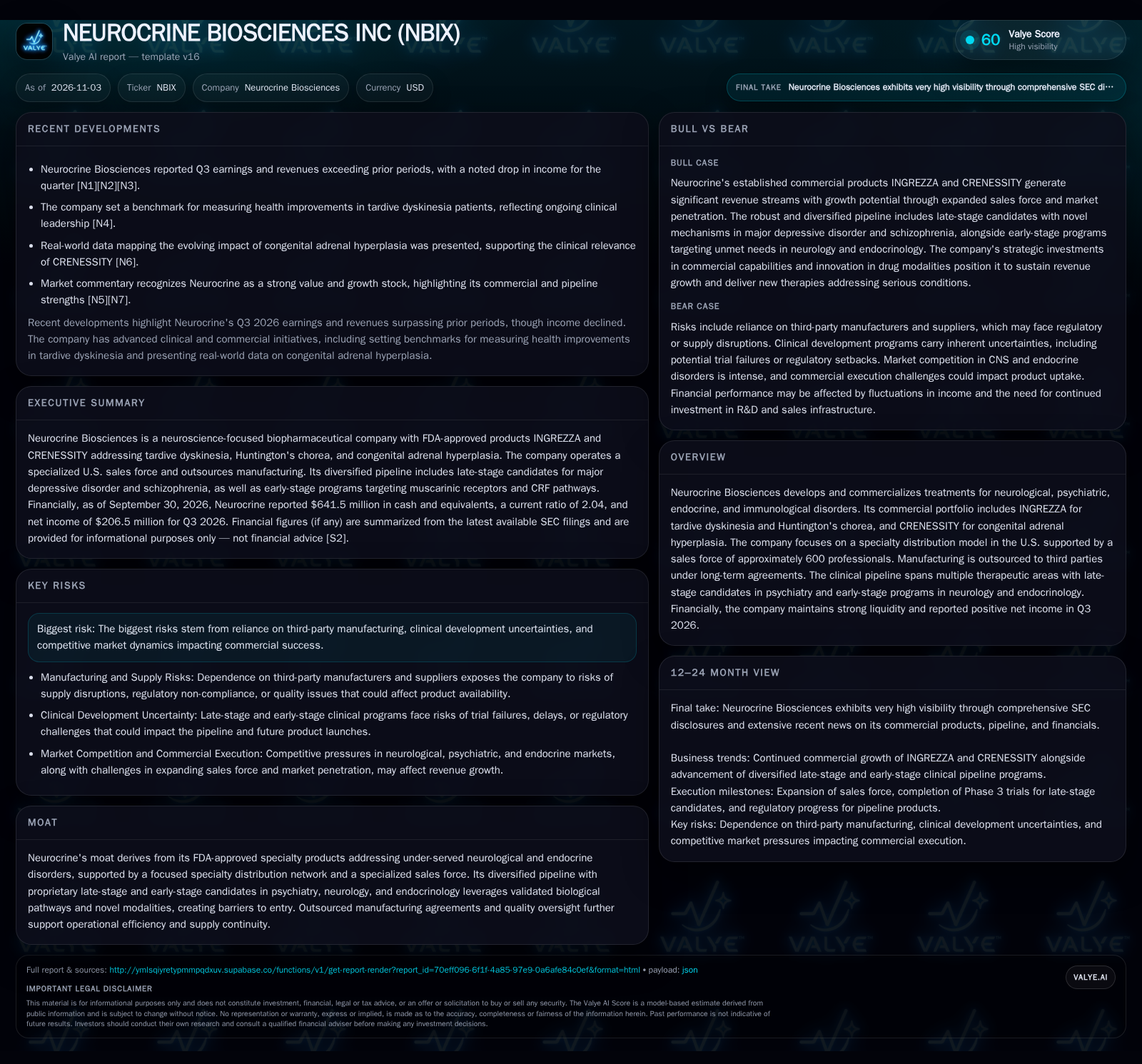
Neurocrine Biosciences' Q3 2026 results show strong commercial performance with INGREZZA and CRENESSITY, but income volatility and heavy reliance on outsourced manufacturing highlight operational and strategic risks. The company's late-stage pipeline in psychiatry and early-stage neurology programs promise future growth but also increase exposure to clinical and regulatory setbacks. Execution in sales expansion, regulatory progress, and pipeline advancement are central to the 12-24 month outlook. [S2] [N1] [N3]
Neurocrine Biosciences stands at a pivotal juncture: its established commercial drugs, INGREZZA and CRENESSITY, continue to generate robust revenues and support an expanding U.S. specialty sales operation, yet Q3 2026 income volatility and a deepening reliance on external manufacturing partners reveal underlying operational risks. With a pipeline spanning late-stage psychiatric indications and early-stage neurology and endocrinology programs, Neurocrine’s growth prospects are balanced by the inherent unpredictability of clinical development and intensifying competition in CNS and endocrine markets. The company’s near-term trajectory will be shaped by its ability to execute on commercial expansion, achieve regulatory milestones, and navigate the risks tied to its evolving product portfolio. [S2] [N1] [N3]
Recent Financial and Clinical Milestones Define the Risk-Reward Equation
Neurocrine reported Q3 2026 revenues that surpassed previous periods, but net income for the quarter declined, illustrating that topline momentum does not automatically translate to profit stability. This income drop, despite revenue gains, suggests a mix of increased investment, cost pressures, or changing product mix. [N1] [N2] [N3]
The company’s commercial focus remains on INGREZZA (for tardive dyskinesia and Huntington’s chorea) and CRENESSITY (for congenital adrenal hyperplasia). Both products are supported by a U.S.-based specialty sales force of about 600 professionals and distributed through specialty channels, reinforcing a high-touch, targeted commercial model. [S2]
Neurocrine recently set a benchmark for health improvements in tardive dyskinesia and presented real-world data on congenital adrenal hyperplasia, underlining its clinical leadership and the ongoing relevance of its marketed products. [N4] [N6]
The company reported cash and liquidity metrics for the period; these figures do not by themselves establish operating runway, investment capacity, financial flexibility, or financing capacity. [S2]
How Neurocrine’s Specialty Model and Pipeline Ambitions Shape Its Financial Profile
Neurocrine’s revenue is currently anchored by its two commercial drugs, both targeting under-served CNS and endocrine disorders. These specialty drugs typically command premium pricing and are dispensed through specialty pharmacies, supporting higher gross margins relative to primary-care pharmaceuticals—if payor access and reimbursement remain favorable.
The company’s U.S.-centric specialty sales force allows for focused physician engagement and potentially higher share-of-voice in niche indications. However, scaling sales in rare or complex diseases can require significant ongoing investment in field force, education, and patient support, raising fixed costs.
Manufacturing is outsourced to third parties under long-term agreements, which converts much of Neurocrine’s production cost structure from fixed to variable. This model reduces the need for heavy capital investment but introduces exposure to supply chain risks and potential cost inflation if contract terms change or suppliers face disruptions.
Operating leverage could improve if pipeline products succeed and are commercialized through the existing sales infrastructure, but each failed clinical program or regulatory setback represents a sunk R&D cost. The need to continuously invest in late-stage trials and commercial readiness creates a tension between near-term profitability and long-term growth ambitions.
Defending a Niche: Barriers and Threats in Neuro and Endocrine Markets
Neurocrine’s competitive edge currently stems from its FDA-approved therapies targeting diseases with limited alternatives, such as tardive dyskinesia and congenital adrenal hyperplasia. These indications are characterized by high unmet need, which can foster strong prescriber loyalty and patient retention if clinical benefit is sustained.
The company’s focused specialty distribution and dedicated sales force create some friction for new entrants, as effective commercialization in these conditions requires significant disease education and patient management expertise.
However, the CNS and endocrine drug markets are intensely competitive, with both large pharmaceutical companies and nimble biotechs pursuing overlapping indications. The risk of new entrants launching competing drugs—possibly with improved efficacy, safety, or convenience—remains ever-present.
Pipeline differentiation is critical: Neurocrine’s late-stage assets in major depressive disorder and schizophrenia must offer clear advantages over entrenched therapies to secure reimbursement and prescriber adoption. Early-stage programs targeting muscarinic receptors and CRF pathways face both scientific and commercial hurdles, as many have failed in these mechanisms historically.
Pipeline Maturation and Commercial Leverage Unlock New Growth Vectors
The most constructive scenario for Neurocrine is one where late-stage pipeline assets for major depressive disorder and schizophrenia yield positive Phase 3 results and achieve timely regulatory approvals. With the existing specialty sales force and distribution network, Neurocrine could rapidly commercialize these assets, leveraging fixed commercial infrastructure for incremental revenue and margin expansion.
Further penetration of INGREZZA and CRENESSITY into their target populations—driven by new clinical benchmarks, expanded payer coverage, or real-world evidence—could extend the lifecycle of these franchises and support double-digit top-line growth.
If the company successfully manages manufacturing relationships and avoids major supply disruptions, cost stability could further support earnings growth.
Evidence that would confirm this scenario includes accelerated sales growth from new or existing products, successful pivotal trial readouts, regulatory approvals, and stable or improving gross margins despite higher R&D or SG&A investment.
Commercial Stability with Episodic Volatility as Pipeline Bets Play Out
The most probable outcome is that Neurocrine maintains steady commercial growth from INGREZZA and CRENESSITY, with incremental gains from ongoing sales force expansion and continued clinical leadership in its core indications.
Pipeline progress will be mixed: some late-stage assets may encounter delays, inconclusive data, or regulatory pushback, resulting in episodic volatility in both R&D expense and investor sentiment. Early-stage programs will likely remain a source of optionality but not near-term revenue.
Outsourced manufacturing and specialty distribution will continue to provide operational flexibility, but periodic supply or quality hiccups are plausible, especially as product volume or portfolio complexity increases.
Supporting evidence would include modest revenue and net income growth, steady SG&A and R&D investment, and a lack of major pipeline breakthroughs or failures over the next 12-24 months. Signs of commercial execution—such as stable market share, payer coverage, and prescriber retention—would further reinforce this scenario.
Clinical Setbacks and Supply Chain Disruptions Expose Profitability to Sharp Downturns
A negative turn could occur if one or more late-stage clinical programs fail to meet primary endpoints, resulting in sunk R&D costs and a diminished growth runway. In parallel, a major disruption at a third-party manufacturer—due to regulatory, quality, or operational issues—could constrain supply of INGREZZA or CRENESSITY, leading to lost sales and reputational harm.
Intensifying competition from new entrants, or the introduction of generics or biosimilars into core markets, could erode pricing power and compress margins, especially if payers respond with formulary restrictions or demand greater rebates.
This scenario would be confirmed by clinical trial failures, major supply interruptions, a sharp decline in product sales, significant margin compression, or evidence of payer pushback and prescriber attrition.
Milestones and Metrics That Will Determine Neurocrine’s Next Chapter
Top-line sales growth and prescription volume trends for INGREZZA and CRENESSITY, especially in relation to recent sales force expansion efforts.
Progress and readouts from late-stage clinical trials in major depressive disorder and schizophrenia, including regulatory submission timelines and outcomes.
Any reported supply chain or quality disruptions in outsourced manufacturing, as these could impact product availability and margins.
SG&A and R&D spending trends, especially in relation to revenue growth, to assess whether investments are driving proportional returns.
Gross margin evolution as the product mix shifts between mature and pipeline assets, and as manufacturing dynamics evolve.
Payer coverage changes, formulary status, and real-world evidence supporting further uptake or reimbursement of core products.
Competitive developments in CNS and endocrine markets, including new product launches or generic/biosimilar threats.
Cash flow from operations and changes in liquidity, as ongoing R&D and commercial investments could pressure the balance sheet over time.
Disclaimer: This is research-only, informational analysis and not investment advice. It may include AI-generated interpretation and general industry context. Always verify important details using primary sources.

Comments