
Pagaya Technologies: AI-Driven Credit Infrastructure Scales, But Execution and Regulatory Hurdles Loom
Pagaya’s record Q3 2026 earnings and surging network volumes underscore the scaling potential of its AI-powered lending platform. The core question for investors is whether its product-led growth and deep financial institution integration can sustain outperformance amid intensifying fintech competition and evolving regulatory demands.
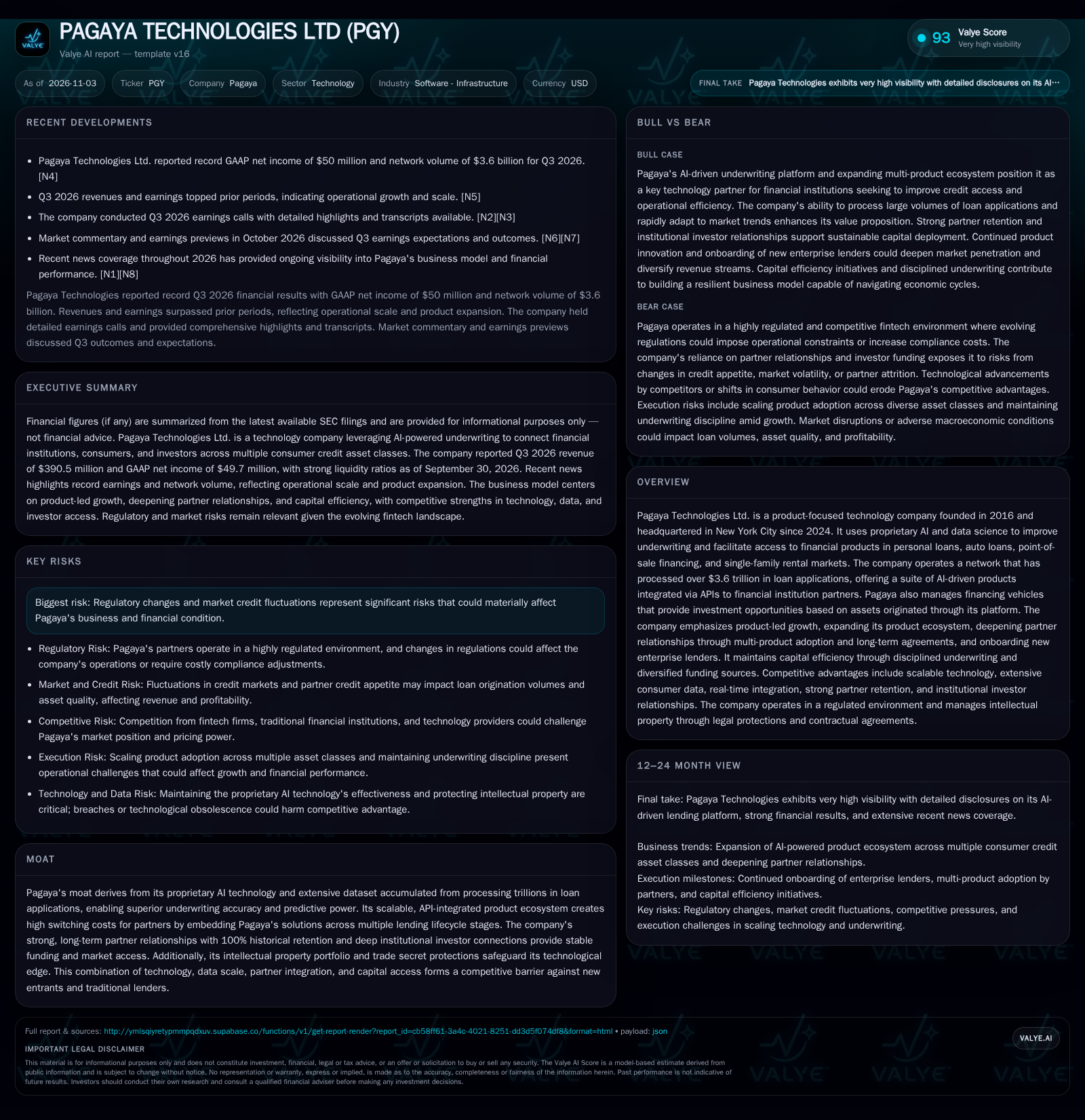
Pagaya Technologies reported record Q3 2026 GAAP net income and network volumes, driven by its AI-enabled underwriting platform serving U.S. consumer credit markets. The company’s expanding product suite and strong institutional relationships highlight its growth ambitions. However, future performance will hinge on continued partner adoption, disciplined risk management, and the ability to navigate regulatory and competitive pressures. [S2] [N4] [N5]
Pagaya Technologies’ Q3 2026 results highlight the company’s accelerating scale in the U.S. consumer credit ecosystem, leveraging proprietary AI and data science to optimize underwriting and connect capital providers with borrowers. Record network volumes and net income validate the traction of its platform-driven model, but as Pagaya deepens its product suite and entrenches itself with financial partners, the path forward will require deft execution—balancing growth, risk, and compliance in a sector marked by rapid innovation and regulatory flux.
Recent Performance Validates Platform Scale, But Raises Strategic Stakes
Pagaya reported a record GAAP net income of $50 million and network volumes of $3.6 billion for Q3 2026, with revenues and earnings exceeding prior periods. As of September 30, 2026, the company’s cash and equivalents stood at $247.1 million, supported by a current ratio of 1.42 and a cash ratio of 0.97. These results highlight both operational momentum and a reported liquidity position snapshot. The company’s AI-powered network has now processed over $3.6 trillion in loan applications—underscoring significant penetration in U.S. consumer credit asset classes. The issuance and partial repurchase of $500 million in 8.875% senior notes, alongside refinancing of its revolving credit facility, reflect a proactive approach to capital structure management. [S2] [N4] [N5]
How Pagaya Turns AI and Data Into Scalable Revenue Streams
Pagaya’s economic engine is built around its proprietary AI and data-driven underwriting platform, which intermediates between lenders, borrowers, and institutional investors. The company monetizes its technology by facilitating the origination, funding, and securitization of consumer credit assets (personal loans, auto, POS, SFR), extracting fees from partners for access to its decisioning and data infrastructure. Revenue growth is thus a function of network loan volume, partner adoption, and product breadth.
The product suite—ranging from Decline Monetization to FastPass—enables partners to improve approval rates, reduce risk, and capture incremental borrowers, often via API-driven integrations. This creates opportunities for multi-product cross-sell and deeper enterprise relationships, potentially increasing Pagaya’s share of wallet with each partner.
On the funding side, Pagaya’s model blends capital-light technology fees with some balance-sheet exposure via its managed funds and securitization vehicles. The upfront funding model can optimize investor returns and facilitate rapid scaling, but also requires disciplined underwriting to avoid adverse selection and credit risk. Operating leverage may arise as fixed technology costs are spread over a growing volume base, but the company’s exposure to asset quality and capital markets cyclicality means revenue and margin expansion are not guaranteed.
Capital efficiency is a stated focus, with diversified funding sources (ABS, forward flow, private placements) helping to balance growth against risk. However, the durability of these economics will depend on sustained demand from institutional investors and the company’s ability to maintain low partner acquisition and integration costs. [S1]
Competitive Moats and Erosion Risks in a Crowded Fintech Arena
Pagaya’s competitive strengths stem from its scalable, proprietary AI technology, deep U.S. consumer data, and embedded API integrations with lending partners. Its network effects are reinforced by high partner retention and institutional investor relationships, which together create switching frictions for both banks and capital providers. The company’s ability to process vast loan volumes and offer real-time decisioning is a meaningful differentiator in speed and accuracy.
However, the competitive landscape is dynamic. Pagaya faces pressure from fintech lenders, traditional banks investing in digital transformation, second-look and alternative financing providers, and vertical software platforms building their own credit tools. As AI and data analytics become more democratized, the durability of Pagaya’s technology moat could be tested unless it continuously innovates and expands its product ecosystem.
Regulatory scrutiny is a double-edged sword: while it can raise barriers to entry for new players, it also exposes Pagaya to compliance costs and operational constraints, particularly as it scales into new asset classes or geographies. The company’s intellectual property protections (trade secrets, pending patents) help defend its position, but technological leapfrogging or regulatory-driven business model changes remain ongoing threats. [S1]
If Product-Led Expansion and Partner Deepening Accelerate
In a favorable scenario, Pagaya’s product-led growth strategy yields rapid adoption of its multi-product suite across a growing base of enterprise lenders. As partners embed more of Pagaya’s AI-driven tools into their workflows, switching costs rise and the company captures a larger share of origination and servicing economics. Strong partner retention, coupled with onboarding of new institutional lenders, could fuel compounding network effects and drive volume growth beyond current trends.
If Pagaya’s disciplined underwriting and capital efficiency persist, margins could expand as fixed technology costs are leveraged over higher throughput. The continued appetite from institutional investors for asset-backed securities and forward-flow arrangements would reinforce funding stability and enable scalable expansion.
Evidence confirming this scenario would include accelerating network volume and revenue growth, rising multi-product adoption metrics (if disclosed), extension or expansion of long-term partner agreements, and improving operating margins. Conversely, stagnating volume growth, partner churn, or declining take rates would challenge the thesis.
Sustaining Growth Amid Competitive and Regulatory Headwinds
The most plausible intermediate outcome is that Pagaya continues to grow network volumes and revenue, but at a more measured pace as competitive intensity and regulatory complexity increase. The company deepens its integration with key partners and maintains a solid core of recurring technology fees, while selectively expanding its product set.
Margins remain healthy but do not accelerate meaningfully, as incremental revenue is offset by investments in compliance, technology upgrades, and partner support. The funding environment for asset-backed securities remains stable but does not dramatically improve, keeping capital efficiency intact but not transformative.
This scenario would be confirmed by consistent but not accelerating network volume and revenue growth, stable or slightly improving partner retention, and steady operating margins. Any signs of rising compliance costs, slower onboarding of new lenders, or increased credit losses would indicate risk to even this steady-state outlook.
Execution Missteps or Regulatory Shocks Disrupt Momentum
In an adverse scenario, Pagaya faces execution challenges in scaling its platform and maintaining underwriting standards. Partner attrition or reduced investor appetite for securitized assets could sharply curtail network volume and revenue growth. If regulatory changes impose new compliance requirements or restrict certain credit products, the company may incur higher costs or lose access to key markets.
Competition from nimble fintechs or well-capitalized incumbents could erode Pagaya’s value proposition, especially if alternative AI underwriting tools become commoditized. Margin compression would follow as the company is forced to compete on price or invest heavily in product upgrades and compliance.
Evidence for this downside would include a sharp deceleration in network volume, rising partner churn, material increases in compliance or credit costs, or adverse regulatory developments affecting Pagaya’s business model. Failure to maintain funding relationships or a deterioration in ABS market conditions would further stress financial performance.
Milestones and Metrics That Will Determine Pagaya’s Long-Term Advantage
Network volume growth rate, especially across new and existing asset classes, as a leading indicator of platform adoption and scalability.
Multi-product adoption rates among current and new partners (if disclosed), to assess the depth of integration and cross-sell success.
Renewal and extension of long-term partner agreements, which would signal high switching costs and durable relationships.
Operating margin trends, particularly as product and compliance investments scale—improving margins would support the leverage thesis.
Credit performance and asset quality metrics across originated loans, as these directly affect funding costs and investor confidence.
Cost of funding and ongoing access to ABS and forward-flow markets, as disruptions here could constrain growth.
Regulatory developments impacting partner operations or Pagaya’s own compliance obligations, which could materially affect the business model.
Partner churn or attrition rates (if disclosed), to monitor the stickiness of Pagaya’s value proposition and competitive threats.
Disclaimer: This is research-only, informational analysis and not investment advice. It may include AI-generated interpretation and general industry context. Always verify important details using primary sources.

Comments