
GAIA, INC: Streaming Platform Economics Under Strain as Retention Initiatives Confront Liquidity Pressures
GAIA, INC’s persistent operating losses and subpar liquidity ratios highlight mounting financial pressure, even as the company pursues streaming revenue growth through AI-driven engagement and community features. The next phase hinges on whether these digital initiatives can materially improve retention and monetization before financial constraints force more drastic action.
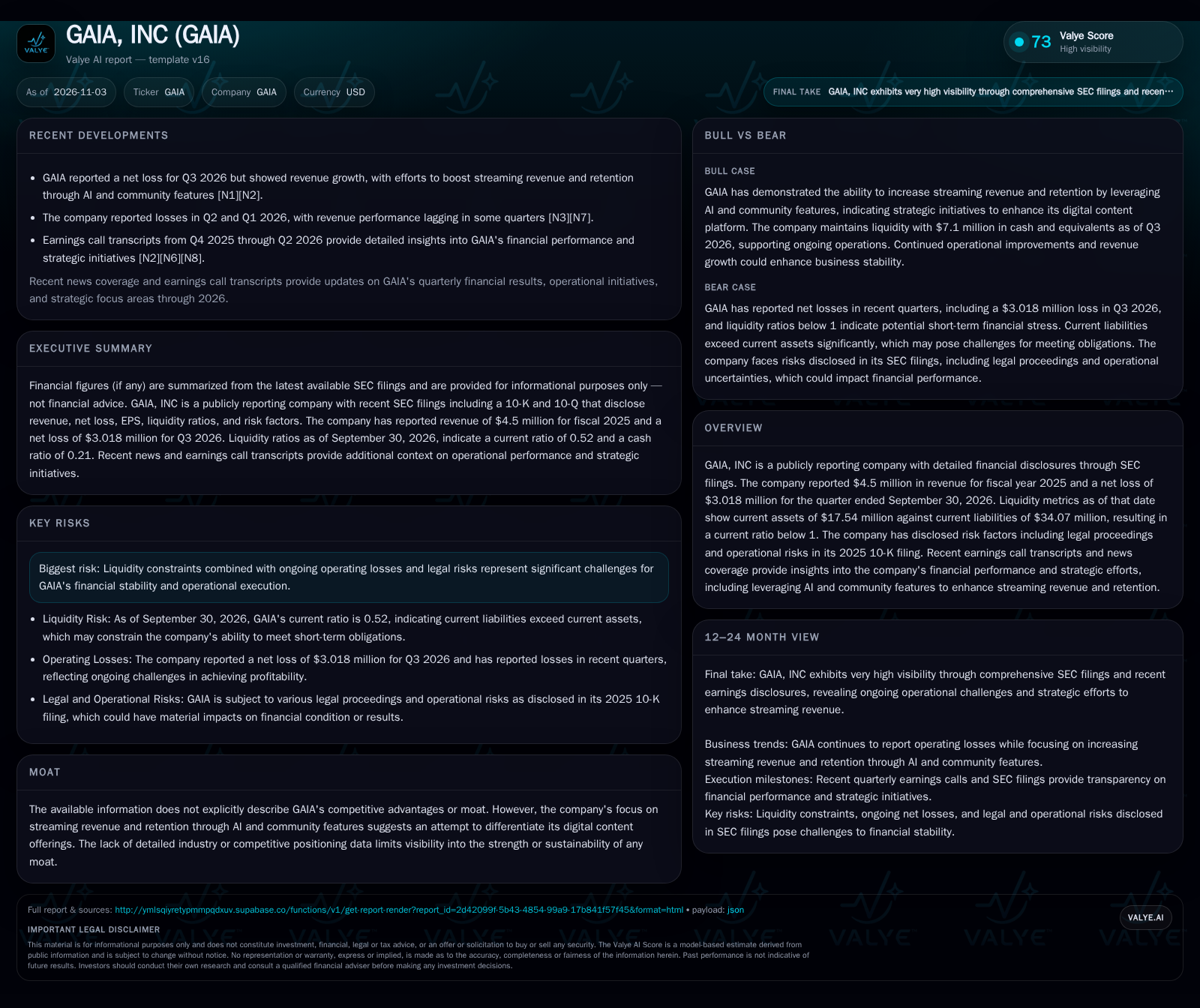
GAIA, INC continues to report operating losses and liquidity ratios well below 1, signaling acute financial pressure. While management is prioritizing AI and community features to drive streaming revenue and retention, the company’s ability to convert these initiatives into sustainable cash flow remains unproven. The near-term outlook turns on whether digital engagement strategies can stem losses quickly enough to avert further financial or operational retrenchment. [S2] [N1] [N2]
GAIA, INC’s recent results reveal a business in transition but under acute financial strain. Despite ongoing investment in AI and community-driven features to enhance streaming revenue and subscriber retention, the company’s losses have continued and liquidity has deteriorated. With a current ratio well below 1 and cash resources limited relative to obligations, GAIA’s near-term future depends on whether its digital engagement initiatives can quickly translate into revenue growth and cost discipline—or whether mounting financial pressure will force more aggressive restructuring or capital-raising.
Liquidity Constraints and Persistent Losses Shape the Immediate Outlook
GAIA, INC reported revenue of $4.5 million for the fiscal year ended December 31, 2025, but this topline was not sufficient to offset operating expenses, resulting in a net loss of $3.018 million for the quarter ended September 30, 2026. As of that date, the company’s current assets stood at $17.54 million, while current liabilities totaled $34.07 million, yielding a current ratio of just 0.52 and a cash ratio of 0.21. These metrics indicate that the company’s liquid resources are insufficient to cover near-term obligations, raising the stakes for a rapid improvement in cash generation. Management’s strategic focus on streaming revenue and retention via AI and community features is intended to drive a turnaround, but the effectiveness of these initiatives has yet to be demonstrated in the company’s reported financials. Legal proceedings and operational risk disclosures in the 2025 10-K further add to the uncertainty. [S1] [S2] [N1] [N2]
Digital Content Economics: High Fixed Costs, Unproven Monetization, and the Search for Retention Leverage
Streaming platforms like GAIA typically operate with high fixed costs—content acquisition, platform development, and customer support—while variable costs per subscriber are relatively low. The business model’s potential for operating leverage depends on achieving sufficient scale and retention to spread fixed costs over a large, engaged subscriber base. GAIA’s reported losses and modest revenue base suggest that it has not yet reached this critical mass. The company’s recent emphasis on AI and community features may be aimed at reducing churn and increasing average revenue per user (ARPU), but without visibility into subscriber counts, churn rates, or ARPU, it is unclear whether these investments are delivering incremental returns. If the company can materially increase retention and engagement, the incremental gross margin from new or retained subscribers could be high, but the risk is that fixed cost absorption remains weak and cash burn continues. Capital needs are acute given the current liquidity position, and the company may require external funding or cost rationalization if operating losses persist. [S2] [N1] [N2]
Competing for Attention: Niche Streaming, Platform Differentiation, and the Threat of Substitutes
GAIA operates in a crowded digital content landscape, competing against both niche streaming platforms and larger, generalist players. The company’s strategy centers on differentiating its offering through specialized content and technology-enabled engagement (AI recommendations, community features), which could, in theory, create higher switching costs and foster a loyal user base. However, larger platforms benefit from greater content libraries, marketing budgets, and economies of scale, making it difficult for smaller players to retain subscribers in the face of abundant substitutes. The degree to which GAIA’s AI and community features actually drive meaningful differentiation—and whether this translates into improved retention or pricing power—remains untested in the reported results. The absence of explicit evidence of a strong moat or unique value proposition suggests that competitive pressures remain intense, and the company’s ability to defend or expand its share of wallet is uncertain.
If Digital Engagement Pays Off: Rapid Retention Gains Could Drive Operating Leverage
The most favorable scenario for GAIA would see its investments in AI-driven recommendations and community features translating into meaningfully higher subscriber retention and engagement. If these tools succeed in reducing churn, increasing session times, and boosting ARPU, the company could see revenue growth accelerate without a commensurate rise in fixed costs, unlocking operating leverage. Evidence to confirm this scenario would include sequential increases in subscriber counts, improved churn rates, higher ARPU, and positive operating cash flow in upcoming quarters. Announcements of successful product rollouts, partnerships, or user engagement milestones would also support the case for a turnaround. Falsification would come from continued subscriber attrition, stagnant or declining engagement metrics, and persistent operating losses despite ongoing investment in digital initiatives.
Incremental Revenue Growth, Ongoing Cash Burn, and a Narrow Window for Digital Turnaround
The most plausible near-term outcome is that GAIA achieves incremental improvements in streaming revenue and retention, but not at a pace sufficient to offset its fixed cost base and restore financial stability. Operating losses likely persist, and liquidity remains tight, forcing management to consider cost reductions, content rationalization, or new capital sources. Confirmation would come from continued modest revenue growth, ongoing net losses, and flat or slightly improving engagement metrics. Falsification would be rapid improvement in profitability or, conversely, a sharp drop in revenue or user engagement that accelerates financial distress.
Escalating Financial Strain: Liquidity Shortfall Triggers Restructuring or Retrenchment
If GAIA’s digital initiatives fail to improve revenue or retention materially, the company could face acute liquidity pressure, given its current ratio and cash position. In this scenario, inability to cover near-term obligations may force asset sales, strategic retrenchment, or a search for emergency funding—potentially on unfavorable terms. Confirmation would include further deterioration in liquidity ratios, disclosure of covenant breaches or default risk, layoffs, or the announcement of strategic alternatives (such as asset sales or bankruptcy proceedings). Falsification would require clear evidence of stabilized or improving liquidity, cost discipline, and a halt to cash burn.
Milestones That Will Determine Whether GAIA Can Achieve a Digital Turnaround
Quarterly subscriber count and net additions, if disclosed, would provide direct evidence of whether digital engagement initiatives are translating into user growth.
Churn rates and retention metrics, if made available, would help test the effectiveness of AI and community features in holding on to existing subscribers.
Average revenue per user (ARPU) trends would reveal whether monetization per subscriber is improving.
Operating cash flow and free cash flow figures are critical to track the pace of cash burn versus any improvement in underlying economics.
Updates on legal proceedings or new risk disclosures could materially affect the company’s financial outlook.
Sequential changes in liquidity metrics (current ratio, cash ratio) will indicate whether operating performance is stabilizing or deteriorating.
Management commentary on cost discipline, capital needs, or strategic alternatives would signal the urgency of potential restructuring or capital-raising.
Announcements of new partnerships, platform features, or engagement milestones would help gauge the traction of digital initiatives.
Disclaimer: This is research-only, informational analysis and not investment advice. It may include AI-generated interpretation and general industry context. Always verify important details using primary sources.

Comments