
Vitesse Energy’s Asset Expansion and Dividend Focus: Navigating Oil Price Volatility and Liquidity Strains
The company’s ability to integrate new assets and manage cash flows amid market volatility will define its next chapter.
The company’s hedging strategy provides some revenue stability, but higher operating costs and industry cyclicality remain material headwinds. Execution on integration and disciplined capital deployment are central to its future performance. [S2] [N3] [N4]
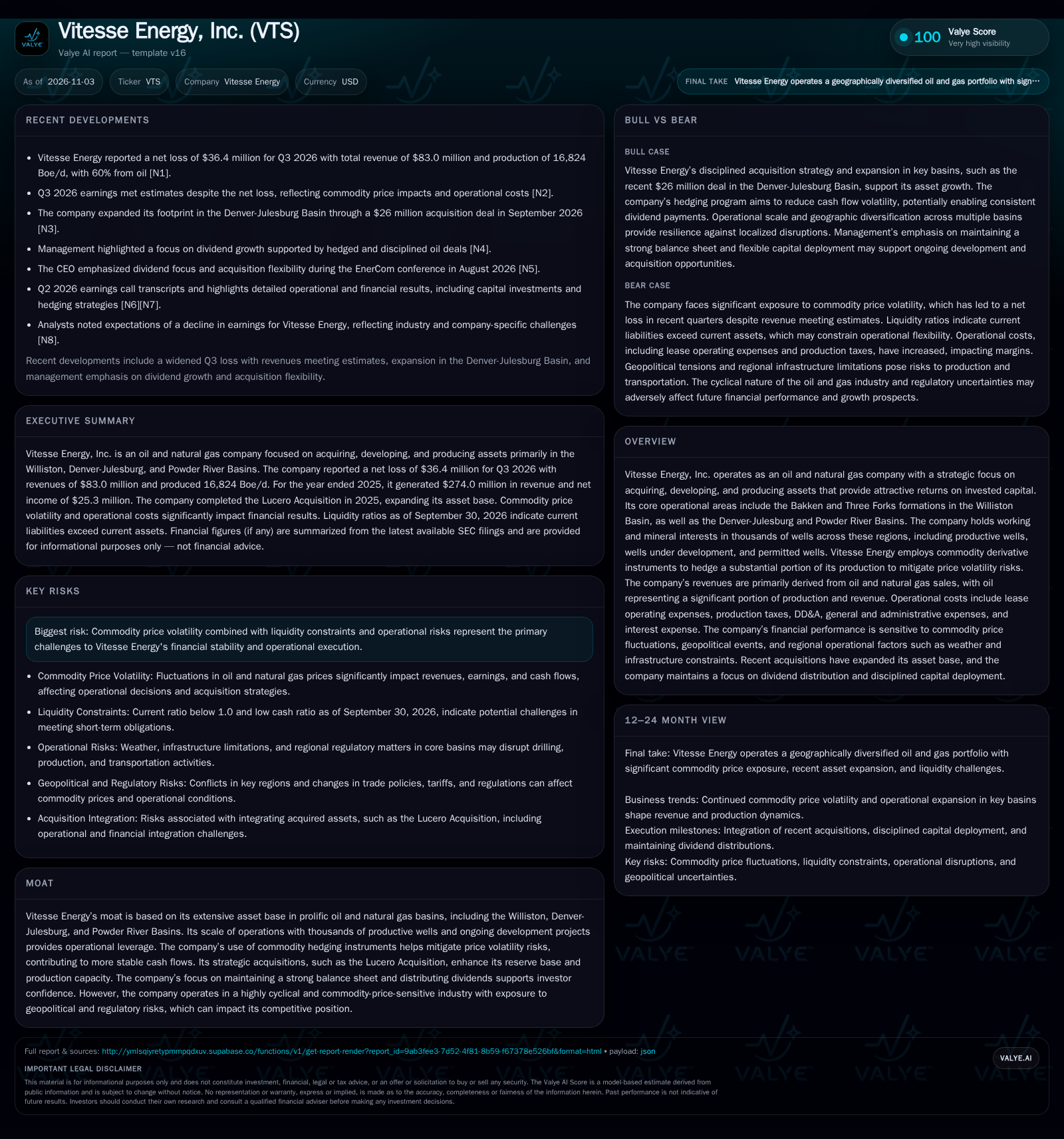
Vitesse Energy, Inc. has built a diversified oil and gas portfolio spanning the Bakken, Three Forks, Denver-Julesburg, and Powder River Basins, with a clear emphasis on acquisition-driven growth and consistent dividend distributions. The company’s recent asset expansions—most notably the Lucero Acquisition and a $26 million deal in the DJ Basin—have increased production capacity and operational leverage. Yet, these moves come amid persistent commodity price volatility and a balance sheet that shows current liabilities outstripping current assets, raising questions about the sustainability of its dividend-centric strategy. With a significant portion of production hedged to smooth cash flows, Vitesse’s future will hinge on its ability to integrate new assets, manage costs, and navigate the cyclical and capital-intensive realities of the upstream oil and gas sector. [S2] [N3] [N4]
Recent Acquisitions and Liquidity Position Redefine Vitesse's Risk-Reward Profile
As of September 30, 2026, Vitesse Energy reported a working interest in 272.6 net productive wells, 6.5 net wells being drilled or completed, and 13.0 net wells permitted for future development, reflecting a robust operational pipeline. The company’s asset base expanded materially with the Lucero Acquisition in March 2025 and a $26 million transaction in the Denver-Julesburg Basin in September 2026, both targeting oil-rich formations. These deals underpin a 16,824 Boe/d production rate and contributed to Q3 2026 revenues of $83.0 million. The company reported cash and liquidity metrics for the period; these figures do not by themselves establish operating runway, investment capacity, financial flexibility, or financing capacity. The cited source reports dividend-related activity; that disclosure alone does not establish dividend-policy continuity, management confidence, or a material constraint on capital flexibility. [S2] [N3] [N4]
How Vitesse Turns Asset Scale into Returns—And Where the Model Is Vulnerable
Vitesse Energy generates revenue primarily through the sale of oil and natural gas, with realized prices shaped by market benchmarks, hedging outcomes, and quality differentials. The company’s economics are heavily volume-driven, with cash flows highly sensitive to commodity price swings—a feature common in the sector, but especially acute here given the reported tilt toward oil production. Hedging a substantial portion of output reduces earnings volatility, but can cap upside in bullish markets. Cost structure includes significant fixed elements: lease operating expenses, production taxes, and DD&A, which scale with production but offer operating leverage as new wells come online or acquisitions are integrated.
Capital demands are significant. The company invested $127.7 million in capital and acquisitions over the past year, with $53.0 million in net capital investments after divestitures. Cash flows from operations reached $39.4 million, insufficient to fully cover capital needs, requiring funding from debt or asset sales. If commodity prices weaken or costs rise unexpectedly, the company’s ability to fund growth and distributions could be compromised. [S2]
The interplay between hedging strategies and capital allocation decisions is a critical factor shaping Vitesse's economic model. The cited source reports dividend-related activity; that disclosure alone does not establish dividend-policy continuity, management confidence, or a material constraint on capital flexibility. This trade-off influences management's ability to reinvest in high-return projects or pursue accretive acquisitions. Moreover, the fixed cost structure inherent in upstream operations means that any decline in production volumes or commodity prices disproportionately impacts profitability. Effective cost management and operational efficiency gains become essential to offset these vulnerabilities and sustain returns on invested capital.
Asset Depth, Basin Diversification, and the Realities of Oil Patch Competition
Vitesse Energy’s competitive strengths stem from its extensive portfolio of working and royalty interests across prolific basins—particularly the Bakken and Three Forks, but with meaningful exposure in the DJ and Powder River Basins. This geographic spread provides some insulation from localized disruptions (e.g., weather, infrastructure bottlenecks, or regulatory changes). Scale brings operational leverage and bargaining power with service providers, but Vitesse competes against both large independents and major oil companies with deeper pockets and more robust balance sheets.
The company’s focus on acquisitions and disciplined capital deployment is a differentiator in a fragmented market, but also exposes Vitesse to integration risks and the challenge of sustaining returns on incremental capital. Substitute risk from renewables and electrification remains a long-term headwind, but is unlikely to displace the competitive dynamics in Vitesse’s core basins in the near term.
Geographic diversification across multiple basins offers Vitesse a degree of risk mitigation against basin-specific operational disruptions; however, it also introduces complexity in managing disparate regulatory environments, infrastructure logistics, and workforce allocation. Each basin may have distinct cost structures, production profiles, and competitive dynamics, requiring tailored operational strategies. Furthermore, competition for acreage and capital in these prolific basins intensifies pressure on acquisition pricing and development returns. While scale provides negotiating leverage with service providers, sustaining competitive advantage demands continuous optimization of drilling and completion techniques, as well as proactive management of environmental and regulatory compliance costs.
If Integration Succeeds and Oil Prices Rebound, Dividend Model Could Flourish
The most favorable scenario for Vitesse hinges on successful integration of recent acquisitions, stable or rising oil prices, and disciplined execution on capital deployment.
Confirmation would come from consecutive quarters of increasing production, improving operating margins, and higher cash flow from operations relative to capital outlays. Evidence of successful integration would include lower per-unit operating costs in newly acquired assets and minimal disruption to base production. Falsification would be indicated by persistent cost overruns, integration delays, or missed production targets despite stable commodity prices.
Disciplined Growth but Ongoing Cash Constraints in a Volatile Oil Market
The most plausible trajectory is one in which Vitesse continues to grow production modestly through incremental development and selective acquisitions, but remains constrained by tight liquidity and sector volatility. Hedging provides some cash flow stability, but the company is forced to balance dividend payments, debt service, and reinvestment carefully. Production growth and cost control offset some commodity price pressures, but margins remain under pressure from rising operating costs and periodic price dips.
This scenario would be confirmed by steady, but not accelerating, production, relatively flat dividends, and continued reliance on external financing or asset sales to fund capital programs. Operating and financial results would show some progress on integration and cost discipline, but liquidity ratios would improve only marginally or remain subpar.
Liquidity Squeeze and Commodity Price Weakness Could Force Strategic Retreat
In a negative scenario, oil prices fall meaningfully or remain suppressed, while operating costs continue to rise and integration challenges emerge. If credit markets tighten or lenders become more risk averse, refinancing risk increases and the company may be compelled to reduce or suspend dividends, scale back development, or divest core assets.
Confirmation would be seen in declining production volumes, widening net losses, deteriorating liquidity ratios, and negative free cash flow. Management may signal a pivot away from acquisitions or announce dividend reductions. Falsification would be provided by stable or improving liquidity and debt metrics despite a challenging macro backdrop, or by evidence of cost reductions and operational efficiencies offsetting commodity price headwinds.
Milestones and Metrics That Will Clarify Vitesse’s Asset Integration and Dividend Sustainability
Quarterly production volumes by basin—particularly in newly acquired Bakken and DJ Basin assets—will reveal integration success and organic growth.
Operating cash flow versus capital expenditures: persistent shortfalls would signal unsustainable funding and raise liquidity risk.
Per-unit lease operating expenses and production taxes, if disclosed, to track cost discipline and margin evolution post-acquisition.
Liquidity ratios (current and cash ratios) and changes in total debt, to monitor the company’s ability to meet obligations and fund growth.
Realized oil and natural gas prices versus hedged benchmarks, to assess the effectiveness and opportunity cost of the hedging program.
Updates on asset sales, acquisitions, or refinancing activities, which could materially alter the company’s risk or capital structure.
Any management commentary or disclosures on integration milestones for the Lucero and DJ Basin deals, as these are immediate execution watchpoints.
Disclaimer: This is research-only, informational analysis and not investment advice. It may include AI-generated interpretation and general industry context. Always verify important details using primary sources.

Comments