
UMH Properties: Manufactured Housing Scale Meets Capital Complexity and Affordable Housing Demand
UMH Properties leverages a growing portfolio of manufactured home communities across twelve states, rising rental income, and a multi-pronged capital strategy to address the persistent U.S. affordable housing shortage. However, joint venture constraints, acquisition competition, and exposure to marketable securities present structural headwinds that could shape future performance.
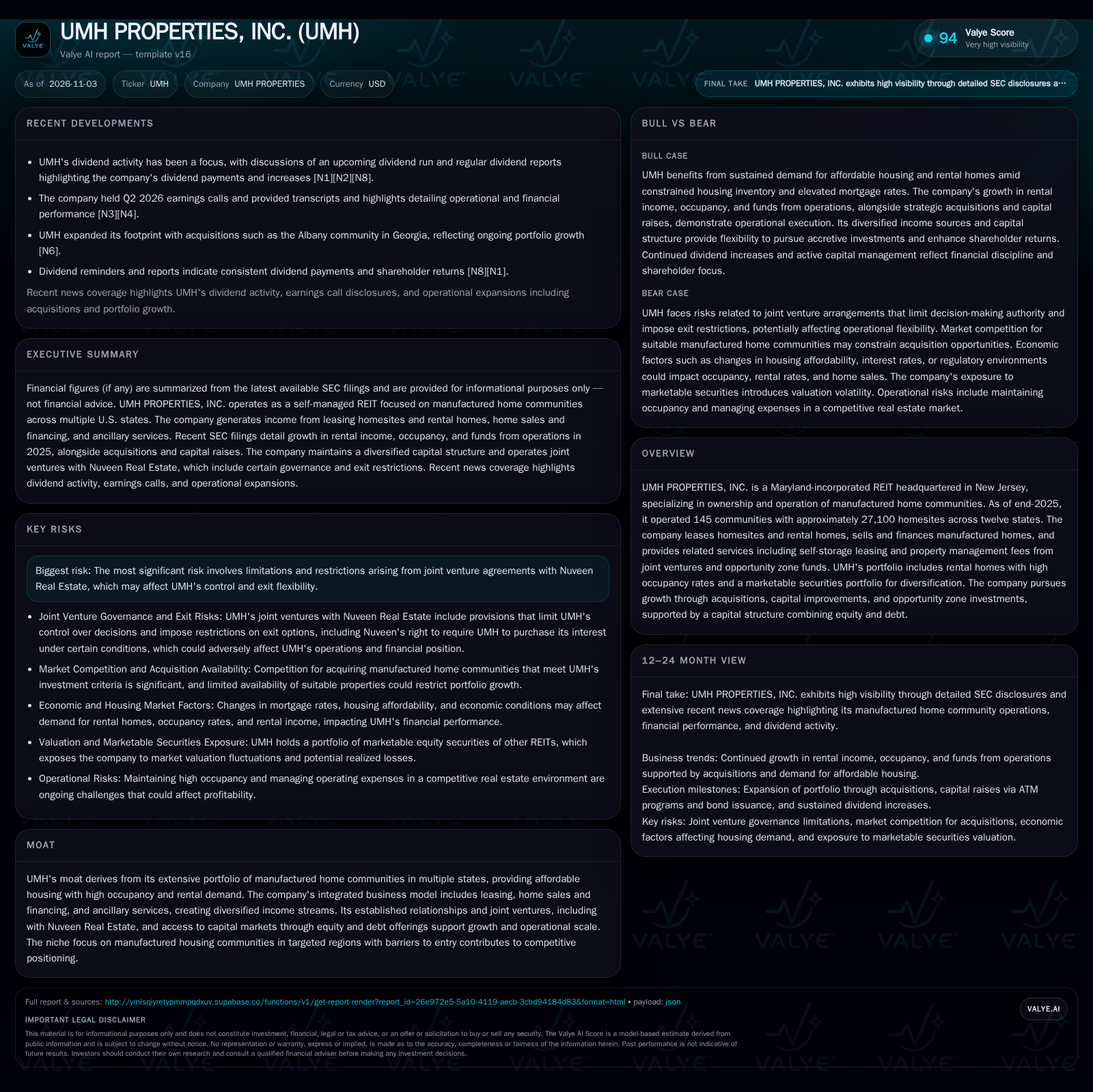
UMH Properties is expanding its manufactured home community footprint and rental income, benefiting from affordable housing demand and recent acquisitions. While financial performance shows momentum, joint venture governance limits, acquisition competition, and capital market volatility introduce risk. The cited source reports dividend-related activity; that disclosure alone does not establish dividend-policy continuity, management confidence, or a material constraint on capital flexibility. [S1] [S2]
UMH Properties, a major U.S. REIT focused on manufactured home communities, is navigating a complex landscape defined by surging demand for affordable housing, portfolio expansion, and layered capital strategies. Recent financials show continued growth in rental income, high occupancy, and opportunistic acquisitions, but also highlight the challenges of joint venture governance, competitive acquisition markets, and marketable securities exposure. The company’s ability to scale, maintain operational discipline, and manage risk will be decisive in unlocking long-term shareholder value.
Recent Performance: Growth, Expansion, and Financial Maneuvers
UMH Properties ended 2025 with 145 manufactured home communities encompassing approximately 27,100 homesites across twelve states. Rental home occupancy reached 93.8%, and same-property occupancy climbed to 88.3%. In 2025, rental and related income grew by 10%, community net operating income by 9%, and normalized funds from operations (FFO) by 15%, though normalized FFO per diluted share improved by only 2%. The company acquired five new communities totaling 587 homesites for $41.8 million and continued to diversify its capital stack with $45.1 million raised through common stock and $2.1 million via preferred stock ATM programs, plus an $80.2 million bond issuance in Israel. As of September 30, 2026, UMH reported $38.2 million in cash and $74.1 million in revenue for the first nine months of the year, with slightly negative EPS (-$0.02 per share). The company also maintained a five-year streak of dividend increases, raising the quarterly payout 4.7% to $0.225 per share in 2025. [S1] [S2] [N1] [N2] [N8]
How UMH Generates Returns: Leasing, Ancillaries, and Capital Allocation
UMH’s core revenue stream comes from leasing manufactured home spaces and rental homes, often on annual or month-to-month terms. The company also sells homes and provides financing through a taxable REIT subsidiary, adding a higher-yield but potentially more volatile income line. Ancillary services—including self-storage, third-party brokerage, and property management for joint ventures and opportunity zone funds—add incremental, often higher-margin revenue. This multi-pronged approach allows UMH to capture value across the manufactured housing value chain, smoothing income fluctuations and deepening tenant relationships.
The economics of manufactured housing communities are typically characterized by high operating leverage: fixed costs for land and infrastructure are spread across a large base of tenants, while incremental rental and service income flows through at high margins. UMH’s expansion strategy (acquiring new communities and infilling vacant sites) can drive both top-line growth and margin expansion, provided occupancy and rent collection remain robust. However, portfolio growth requires significant upfront capital—either via equity, preferred, or debt issuance—making capital allocation discipline and access to low-cost funding essential.
Recent capital raises and the $80.2 million Israeli bond issuance highlight management’s willingness to use multiple channels to fund acquisitions and improvements. However, the lag between capital deployment and income realization (especially when repositioning or infilling newly acquired sites) can temporarily compress per-share earnings and FFO, as seen in the relatively modest 2% per-share FFO growth in 2025 despite strong total FFO and NOI gains. [S1] [S2]
Defending Share in a Crowded Affordable Housing Market
UMH operates in a sector with high barriers to entry due to zoning restrictions, community opposition, and the scarcity of developable land for manufactured housing. Its scale—spanning 145 communities in twelve states—confers operational efficiencies and purchasing power, while geographic diversification mitigates localized economic or regulatory shocks. High occupancy rates (93.8% for rental homes) indicate strong demand and suggest some pricing power, especially as conventional single-family and apartment rents remain elevated.
However, the competitive landscape is tightening. Institutional capital has increasingly targeted manufactured home communities, attracted by resilient cash flows and demographic tailwinds. This has driven up acquisition multiples and made portfolio expansion more challenging and potentially less accretive. UMH’s niche focus on affordable and workforce housing is a relative advantage, as the U.S. continues to face a chronic shortage of lower-cost housing stock. Still, competition from both large REITs and private operators remains intense, and the company’s joint ventures—while expanding reach—come with governance and exit constraints that could limit strategic agility.
Substitutes for UMH’s offerings include traditional apartments, single-family rentals, and other forms of affordable or subsidized housing. The relative value proposition of manufactured homes is highest when mortgage rates are elevated and site-built housing is out of reach for many families—conditions that currently persist but could shift if interest rates fall or new inventory enters the market.
Unlocking Value Through Occupancy Gains and Accretive Acquisitions
A favorable scenario for UMH involves sustained demand for affordable housing, enabling the company to continue raising rents, infilling vacant sites, and maintaining high occupancy—especially among its 11,000 rental homes. If acquisition opportunities remain available at attractive cap rates, UMH could deploy its diversified capital base to expand the portfolio, driving both revenue and operating leverage. Further, successful integration of new communities and the ramp-up of ancillary services (such as self-storage and property management for third parties) would add incremental margin.
Shareholder returns could be amplified if normalized FFO per share accelerates, reflecting not just total growth but also capital efficiency and effective cost management. Dividend growth would likely continue, supporting total return. Upside confirmation would require evidence of faster-than-expected occupancy gains, rising rental rates outpacing expense growth, accretive acquisitions without excessive dilution, and further improvement in normalized FFO per share. If UMH can demonstrate higher same-property NOI growth and maintain its dividend growth streak, the thesis for compounding value through scale and operational leverage would be reinforced. [S1] [N1] [N2] [N8]
Sustaining Momentum Amid Acquisition Competition and Capital Constraints
The most plausible scenario is that UMH continues to grow rental income and funds from operations, but faces ongoing headwinds from competitive acquisition markets, the costs of capital, and the structural complexity of its joint ventures. Portfolio expansion is likely to persist, but at potentially compressed yields as acquisition multiples remain elevated. Occupancy rates may edge higher, but incremental gains will be harder won as the base grows and the market tightens.
Normalized FFO per share could track modestly above inflation, supported by disciplined capital deployment and steady rental growth, but diluted by ongoing equity and preferred issuances required to finance expansion. Dividend increases would likely continue at a measured pace, reflecting a balance between shareholder return and reinvestment needs. Confirmation of this scenario would come from continued NOI and FFO growth, stable or gradually rising occupancy, and prudent balance sheet management. Falsification would involve a material drop in occupancy, a slowdown in rental growth, or acquisition missteps leading to value destruction. [S1] [S2] [N3] [N4]
Governance Constraints and External Shocks Could Disrupt Growth
In a negative scenario, UMH’s growth could be hampered by joint venture governance limitations—particularly if Nuveen exercises its rights to force a buyout under unfavorable conditions, straining liquidity or leading to value-destructive exits. Intensifying competition could make acquisitions prohibitively expensive or limit available inventory, stalling portfolio growth and eroding scale advantages. A downturn in the broader economy, a sharp reversal in housing affordability, or a regulatory clampdown on manufactured housing could drive occupancy lower and compress rents.
Exposure to marketable equity securities of other REITs also introduces the risk of mark-to-market losses or impaired liquidity, particularly if real estate markets weaken. Operational missteps—such as failing to maintain high occupancy or control costs—would magnify the impact of external shocks. [S1]
Signals That Will Shape UMH’s Long-Term Value Proposition
Trends in same-property and rental home occupancy rates—faster gains could signal pricing power and robust demand; stagnation or declines would be an early warning of market saturation or competitive pressure. [S1]
Normalized FFO per share growth versus total FFO and NOI—divergence here would indicate dilution, inefficiency, or capital misallocation. [S1] [S2]
Pace and yield of new community acquisitions—details on purchase multiples, integration costs, and revenue ramp would help test accretive growth assumptions. If disclosed.
Terms and outcomes of joint venture arrangements, especially any exercise of Nuveen’s exit or buyout rights—material changes here could impact both liquidity and governance flexibility. [S1]
Exposure and performance of the portfolio of marketable REIT securities—material losses or forced liquidations could signal broader market or balance sheet stress. [S1]
Capital structure changes, including new equity, preferred, or debt issuances—the cost and dilution from these will affect long-term per-share economics. [S2]
Infilling of vacant sites and conversion of newly acquired communities to higher occupancy—progress here is a leading indicator of organic growth and operational execution. If disclosed.
Disclaimer: This is research-only, informational analysis and not investment advice. It may include AI-generated interpretation and general industry context. Always verify important details using primary sources.

Comments