
Vornado Realty Trust: Urban Redevelopment Ambitions Meet Earnings Volatility in a Shifting Office Landscape
Vornado Realty Trust is doubling down on high-profile urban redevelopment in Manhattan and select gateway cities, but persistent earnings volatility and execution risks on major projects highlight the stakes of its capital allocation strategy as the office sector adapts to evolving tenant preferences and macroeconomic headwinds.
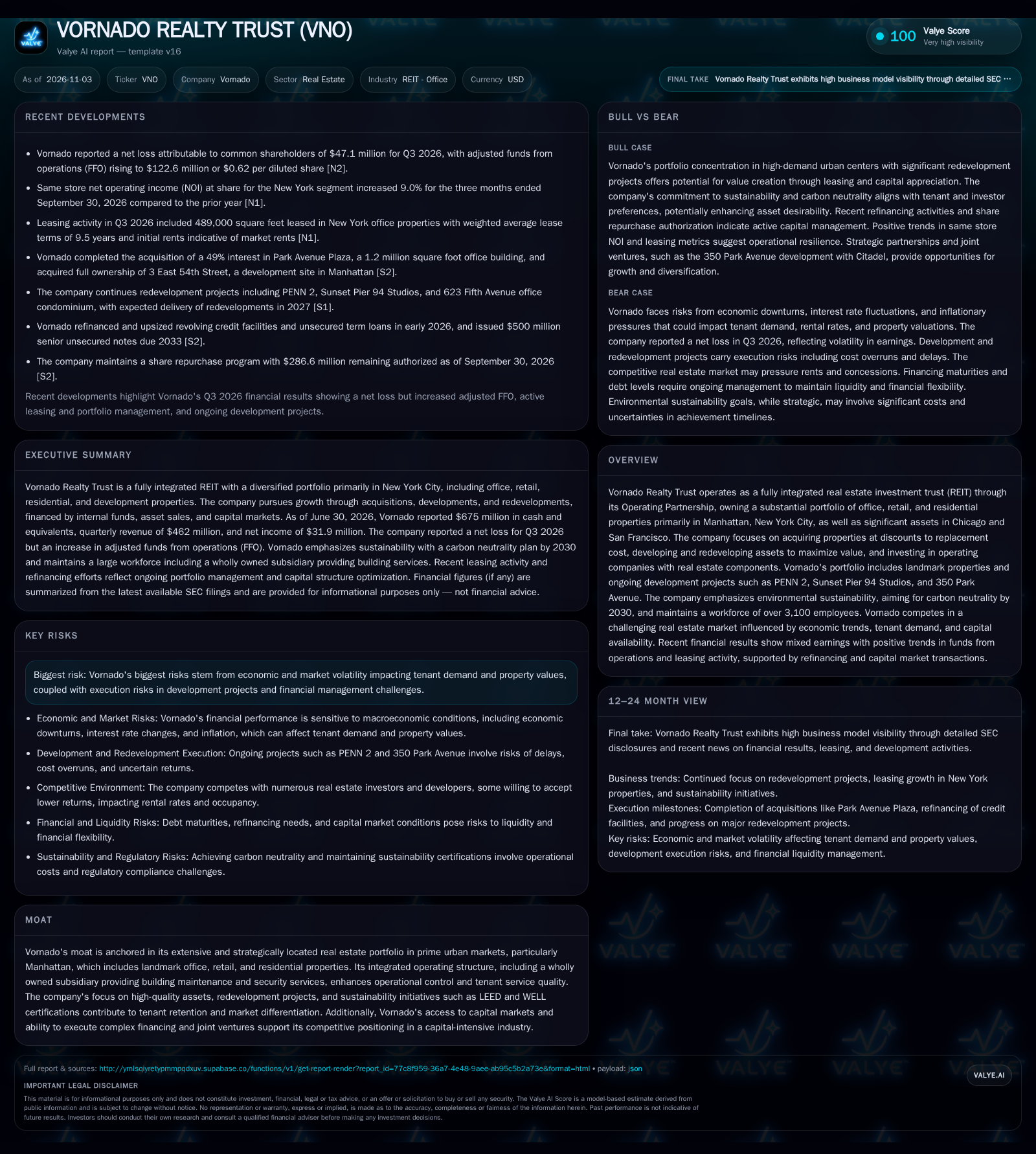
Vornado Realty Trust reported a net loss to common shareholders for Q3 2026 despite a notable rise in adjusted funds from operations (FFO), with New York same-store NOI up 9% year-over-year. Recent acquisitions and ongoing redevelopment projects, including PENN 2 and 350 Park Avenue, underscore an aggressive bet on urban office recovery, while refinancing actions and a sizable share repurchase authorization reflect ongoing capital structure management. The company’s exposure to market volatility, development execution, and tenant demand in urban cores remains the primary variable for forward returns. [S2] [N1] [N2]
Vornado Realty Trust’s latest quarter underscores the tension between its ambitious urban redevelopment strategy and the near-term financial volatility facing office REITs. Despite reporting a net loss to common shareholders for Q3 2026, Vornado continues to post solid operational results in its core New York portfolio, with same-store NOI rising and nearly half a million square feet leased at market rents. The company’s portfolio repositioning, marked by large-scale Manhattan projects and selective acquisitions, is backed by active refinancing and capital deployment. Yet, the durability of tenant demand, execution on major developments, and the evolving economics of urban office space remain central to the investment debate.
Recent Earnings, Leasing Momentum, and Capital Moves Define Vornado’s Present
Vornado Realty Trust reported a net loss attributable to common shareholders of $47.1 million for Q3 2026, even as adjusted funds from operations (FFO) climbed to $122.6 million ($0.62 per diluted share), highlighting ongoing earnings volatility amid mixed sector dynamics. [S2] [N2]
Operationally, the New York portfolio posted a 9.0% year-over-year increase in same-store net operating income (NOI) for the quarter ended September 30, 2026, signaling resilience in Vornado’s core market. [N1]
Leasing activity during the quarter included 489,000 square feet of New York office space leased with weighted average lease terms of 9.5 years, and initial rents described as indicative of current market levels. [N1]
The company’s capital structure saw continued activity: Vornado refinanced and upsized revolving credit facilities and unsecured term loans, issued $500 million in senior unsecured notes due 2033, and maintained an authorized $300 million share repurchase program with $286.6 million remaining as of September 30, 2026. [S2]
Urban Office Economics: Fixed Costs, Redevelopment Bets, and Funding Requirements
Vornado’s revenue streams are anchored in long-term leases for office, retail, and residential properties, with a pronounced concentration in Manhattan. Fixed costs are structurally high, given property taxes, operating expenses, and the capital intensity of urban assets. This creates significant operating leverage: marginal improvements in occupancy or rents can drive outsized changes in NOI, but declines in demand or rent rollovers may quickly erode profitability.
The company’s business model increasingly relies on value creation through major redevelopment projects (e.g., PENN 2, 350 Park Avenue, Sunset Pier 94 Studios), where upfront capital outlays are substantial and payback periods are extended. These projects can materially lift cash flow if delivered on time and leased at favorable terms, but cost overruns or leasing shortfalls would impair returns.
Vornado funds its activities through a combination of internally generated cash, asset sales, and capital market transactions—including recent refinancing and new note issuance. The company reported cash and liquidity metrics for the period; these figures do not by themselves establish operating runway, investment capacity, financial flexibility, or financing capacity. [S2]
The company’s FFO metric, a REIT standard for recurring earnings, is a key measure for dividend coverage and reinvestment capacity, but does not shield against asset value swings or cash needs for redevelopment.
Prime Urban Footprint and Integrated Operations: Strengths and Structural Challenges
Vornado’s competitive positioning is rooted in its control of landmark assets in Manhattan, Chicago, and San Francisco—urban markets that historically command premium rents and attract global capital. The company’s scale and focus in these gateway cities provide bargaining power with tenants, and its integrated operating model (including in-house maintenance and security via Building Maintenance Services LLC) enables tighter control of property quality and tenant experience. [S1]
However, the office sector’s post-pandemic reset has increased competition for tenants, with landlords offering more concessions and flexible lease structures. Vornado faces rivalry from both institutional REIT peers and private investors, some of whom may accept lower returns or have different risk tolerances.
The threat of substitution from remote work, hybrid models, and the growing appeal of newer, amenity-rich buildings (often with higher sustainability certifications) continues to pressure legacy assets. Vornado’s emphasis on redevelopment and environmental performance (targeting carbon neutrality by 2030 and portfolio-wide LEED/WELL certifications) is designed to counter these trends, but the pace of tenant demand recovery is not assured.
Retail and residential exposures in the portfolio provide some diversification, but Manhattan office remains the primary value driver—and the most exposed to secular and cyclical headwinds.
If Redevelopment Delivery and Urban Office Demand Rebound Align
A constructive scenario for Vornado sees its major redevelopment projects—PENN 2, 350 Park Avenue (anchored by Citadel), and others—delivered on schedule and leased at or above market rents, coinciding with a sustained recovery in urban office demand. Tenant flight to quality, ESG mandates, and the unique cachet of Manhattan trophy assets could drive above-average occupancy and rental growth, translating to outsized NOI and FFO expansion.
Evidence confirming this path would include: pre-leasing milestones for major projects at premium rates; sustained same-store NOI growth in New York; new anchor tenant commitments; and an upward revision to FFO guidance. Additionally, capital recycling—selling mature or non-core assets at attractive cap rates to fund new development—would further validate management’s capital allocation discipline.
Falsification would come from weak leasing velocity on delivered projects, persistent rent concessions, or evidence that new supply is not being absorbed by the market.
Navigating Mixed Office Fundamentals with Select Redevelopment Successes
The most plausible outlook is one of gradual stabilization: Vornado maintains moderate leasing momentum in its core New York portfolio, with occupancy and rents supported by its premium asset base, but not fully insulated from sector headwinds. Some redevelopment projects are completed and attract high-quality tenants, but others face longer lease-up periods or require greater concessions to close deals.
FFO remains positive and stable, supported by recurring income from existing properties and incremental contributions from new development, but net income continues to fluctuate due to non-cash charges, interest expense, and asset revaluations. Capital management—via refinancing, selective asset sales, and measured share repurchases—keeps liquidity adequate, but does not eliminate the need for disciplined cost control and project execution.
Evidence supporting this scenario would include continued positive same-store NOI growth, steady leasing metrics in New York, and progress updates on development timelines. Falsification would come from a sharp drop in occupancy, a material increase in unleased space post-delivery, or financial strain forcing asset sales at distressed prices.
Urban Office Weakness and Project Execution Misses Could Compound
The adverse scenario materializes if urban office demand remains structurally impaired—due to a persistent shift to remote/hybrid work, tenant downsizing, or macroeconomic contraction—leading to rising vacancies, compressed rents, and higher tenant incentives. If Vornado’s redevelopment projects are delayed or significantly over budget, with sluggish leasing on delivery, the capital invested would generate subpar returns and potentially strain liquidity.
Should refinancing conditions tighten or capital markets become less accessible, the company’s ability to fund ongoing projects and service debt could be challenged, forcing defensive asset sales or curtailment of redevelopment ambitions.
This scenario would be confirmed by negative same-store NOI trends, declining FFO, rising vacancy rates in Manhattan, project delays or cost overruns, and company disclosures about covenant pressures or distressed dispositions.
Milestones and Metrics That Will Clarify Vornado’s Urban Office Thesis
Pre-leasing rates and achieved rents for PENN 2, 350 Park Avenue, and other major redevelopment projects—if disclosed—will test the value creation thesis.
Same-store NOI growth or decline in the New York segment, as reported quarterly, will indicate the underlying health of Vornado’s core market.
Quarterly leasing volume, average lease term, and rent spreads (relative to expiring leases) in Manhattan office properties will reveal tenant demand trends.
Updates on redevelopment timelines, budget adherence, and delivery milestones for the company’s key projects would clarify execution risk.
Net debt to EBITDA or similar leverage metrics—if disclosed—will help assess balance sheet flexibility as development outlays continue.
Asset sales activity and pricing relative to book value or prevailing cap rates will indicate the liquidity of Vornado’s portfolio and management’s discipline in capital recycling.
Progress metrics on environmental sustainability goals (LEED/WELL certifications, energy intensity, carbon emissions) will matter for tenant/investor appeal and regulatory compliance.
Disclaimer: This is research-only, informational analysis and not investment advice. It may include AI-generated interpretation and general industry context. Always verify important details using primary sources.

Comments