
Herbalife’s Direct-Selling Engine Faces Transition Pressures and Margin Imperatives
Herbalife’s global nutrition business remains anchored by its vast Member network and product innovation, but recent underperformance, leadership transition, and competitive threats raise questions about the continued resilience of its direct-selling model.
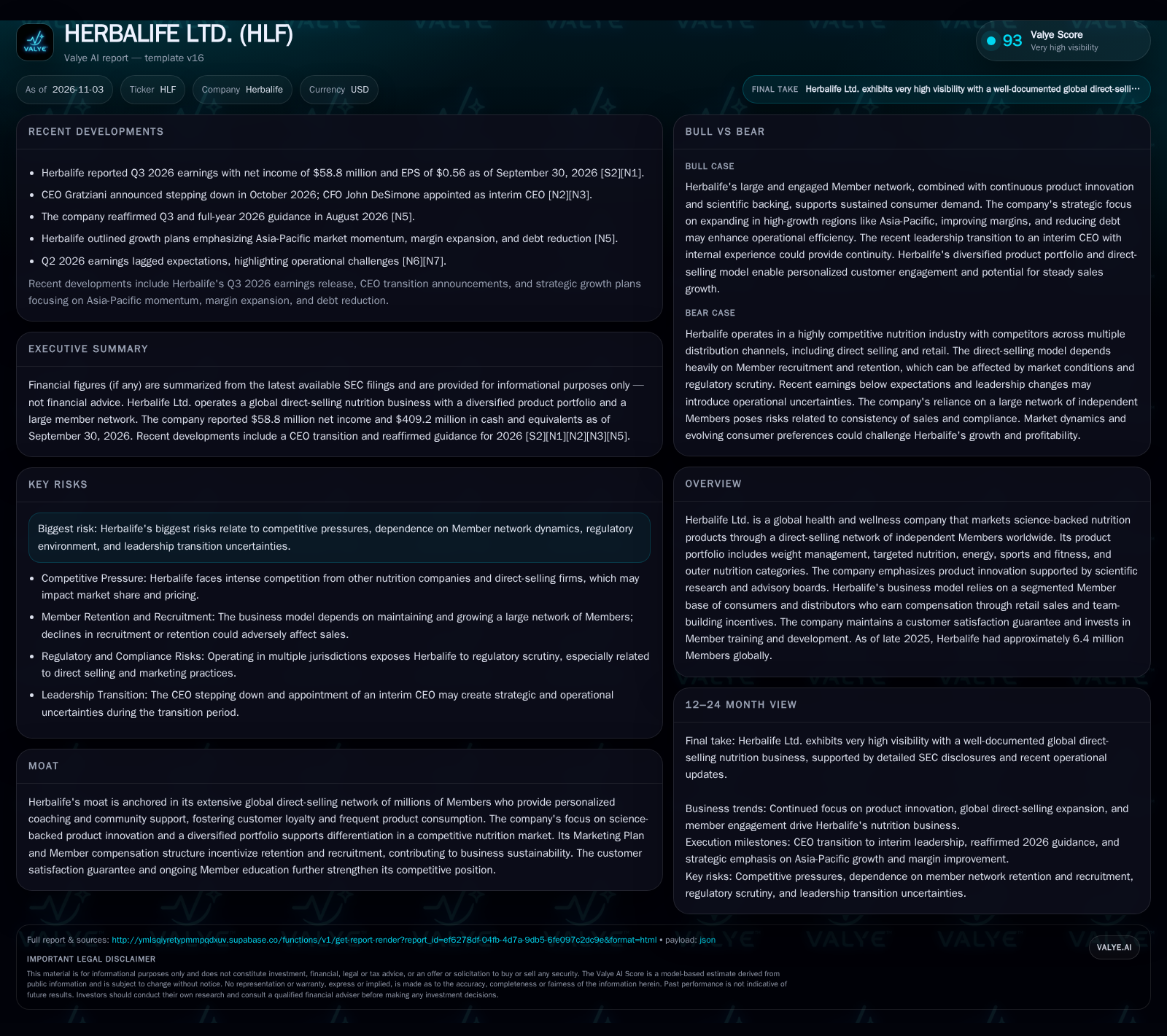
Herbalife reported Q3 2026 net income of $58.8 million, but earnings fell short of expectations as the company undergoes a CEO transition and navigates a challenging operating environment. The direct-selling model’s dependence on Member recruitment and retention remains both a strength and a vulnerability, especially as competitive intensity and regulatory scrutiny persist. Near-term prospects hinge on reinvigorating Asia-Pacific growth, expanding margins, and maintaining network engagement amid leadership uncertainty. [S2] [N1] [N2] [N5]
Herbalife Ltd. enters late 2026 at a strategic crossroads. While its global direct-selling model and science-backed nutrition portfolio have delivered scale—anchored by 6.4 million Members and a best-selling shake mix—recent quarters have seen earnings shortfalls and a CEO transition. With CFO John DeSimone stepping in as interim CEO and operational challenges persisting, the business faces renewed scrutiny over its ability to sustain Member engagement, expand margins, and defend its position in a fiercely competitive wellness market. The coming quarters will test whether Herbalife’s network-driven engine can adapt amid leadership change and shifting industry dynamics. [S2] [N1] [N2] [N5]
Earnings Miss, CEO Change, and the Stakes for Herbalife’s Network Model
Herbalife reported Q3 2026 net income of $58.8 million and basic EPS of $0.56, but these results fell short of consensus expectations, marking a second consecutive quarter of underperformance. [S2] [N1] This earnings miss comes as CEO Michael O. Johnson Gratziani steps down, with CFO John DeSimone assuming the interim CEO role as of October 2026. [N2] [N3] The leadership transition adds an additional layer of uncertainty atop operational challenges, particularly as Herbalife’s growth strategy increasingly emphasizes Asia-Pacific market momentum, margin expansion, and debt reduction. [N5] With a Member network of 6.4 million and a sales leader retention rate of approximately 70.3% for the latest annual period, the company’s ability to sustain engagement and performance through this transition is now under the microscope. [S1]
Direct-Selling Economics: Margin Leverage Versus Recruitment Dependence
Herbalife’s core economics are rooted in its direct-selling model, which leverages a segmented Member base (preferred consumers and distributors) to drive both product sales and network expansion. The business collects revenue primarily from the sale of nutrition products—weight management (54.5% of 2025 net sales), targeted nutrition (30%), and energy/sports/fitness (12.2%)—with the flagship Formula 1 shake mix alone contributing roughly a quarter of sales. [S1]
Gross margin is structurally supported by the absence of traditional retail markup and the use of volume-based compensation for Members. However, the model’s variable cost structure is directly linked to sales force incentives, meaning that as sales volumes fluctuate, so do commission and bonus outlays. Fixed costs (R&D, product innovation, regulatory compliance, Member training) are significant but scale with global reach. The model offers operating leverage if Member productivity and retention remain high, but is exposed to sharp volume declines if recruitment or engagement falters.
Capital needs are moderate, with working capital requirements tied to inventory and receivables rather than heavy fixed-asset investment. The company reported cash and liquidity metrics for the period; these figures do not by themselves establish operating runway, investment capacity, financial flexibility, or financing capacity. [S2] The company’s ability to expand margins now appears to rest on further optimizing compensation expenses, improving product mix, and driving growth in higher-margin geographies.
Network Depth and Brand Science: Herbalife’s Defenses and Vulnerabilities
Herbalife’s principal competitive asset is its vast global direct-selling network, which fosters personalized coaching, community support, and frequent product consumption. The company’s structured Marketing Plan, with volume-based incentives and annual re-qualification, is designed to reinforce engagement and retention among sales leaders. [S1]
Product differentiation is reinforced by an emphasis on science-backed formulations, internal R&D, and external scientific advisory boards. This supports brand credibility in a crowded nutrition market. However, the direct-selling model faces mounting counterforces: competition from both other network marketing firms and traditional/online retailers; rising regulatory scrutiny (especially around recruitment and income claims); and evolving consumer preferences toward digital and retail-first wellness platforms.
Switching costs for Members may be moderate—driven more by community and personal investment than contractual lock-in—suggesting that retention could weaken if alternative opportunities or superior brands emerge. The customer satisfaction guarantee helps mitigate churn but is not a structural moat. The question is whether Herbalife’s network, compensation structure, and product innovation can offset these external pressures and defend share in the long run.
Margin Expansion and Asia-Pacific Momentum Could Revitalize Growth
A favorable scenario for Herbalife would see its Asia-Pacific strategy deliver outsized growth, leveraging both demographic tailwinds and strong Member engagement in that region. If new product launches and science-backed marketing resonate, the company could increase wallet share among existing Members and attract new recruits, driving volume growth without a proportional increase in incentive payouts.
Margin expansion could materialize if the product mix shifts toward higher-value targeted nutrition and sports/energy categories, and if digital tools improve Member productivity. Operational discipline—particularly on compensation and working capital—would further support earnings leverage. Evidence of this scenario would include accelerating sales in Asia-Pacific, improving gross and operating margins, and a sustained or rising sales leader retention rate. Confirmation would also come from outperformance versus sector peers or successful rollout of new product lines.
Sustained Direct-Selling with Margin Pressure and Incremental Growth
The most plausible outcome is that Herbalife maintains a stable but not rapidly growing core business, with incremental gains in select geographies offset by ongoing pressure on margins and network productivity. Modest improvements in product innovation and Member training may help retain existing sales leaders and consumers, but competitive intensity and regulatory scrutiny likely cap upside.
Retention rates near the current 70% level would support revenue stability, while the leadership transition could result in only limited disruption if interim CEO DeSimone maintains continuity in strategy and Member engagement. Margins may be squeezed by higher incentive costs or promotional spending required to defend share, especially if consumer preferences shift or rival nutrition brands escalate digital and retail efforts. Confirmation of this scenario would be stable Member counts, flat to gradually rising earnings, and limited changes in regional sales mix.
Network Attrition, Regulatory Headwinds, and Strategic Drift
A negative scenario would see weakening Member recruitment and declining sales leader retention, potentially triggered by leadership uncertainty, increased regulatory intervention, or more aggressive competition from alternative wellness platforms. If Asia-Pacific momentum stalls or new product launches fail to gain traction, sales volumes could decline—amplifying the model’s exposure to fixed costs and reducing operating leverage.
Further, changes in compensation rules or heightened regulatory scrutiny (particularly in major markets) could disrupt the direct-selling engine, either by constraining Member incentives or by damaging brand reputation. Evidence confirming this scenario would include a drop in Member/leader retention rates, declining sales in key regions, margin contraction, or material increases in regulatory/legal costs.
Benchmarks for Testing Herbalife’s Direct-Selling Resilience in 2027
Sales leader retention rate: Any meaningful change from the current 70.3% level would signal shifts in Member engagement and network health. [S1]
Regional revenue mix: Acceleration or deceleration in Asia-Pacific sales growth will be pivotal for the company’s near-term strategy. [N5]
Gross margin trends: Improvement or erosion would reflect success or strain in product mix shift, cost control, and incentive management.
Member count trajectory: Sustained growth or attrition in the 6.4 million Member base would directly impact the sales engine. [S1]
Impact of CEO transition: If disclosed, leadership commentary or Member feedback regarding the interim CEO’s direction and continuity.
Regulatory developments: Any new investigations, fines, or rule changes in key markets would test the model’s adaptability.
Debt reduction progress: Updates on leverage and interest expense would clarify management’s ability to execute on stated financial priorities. [N5]
Disclaimer: This is research-only, informational analysis and not investment advice. It may include AI-generated interpretation and general industry context. Always verify important details using primary sources.

Comments