
W. R. Berkley: Specialty Insurance Expertise, Agile Decentralization, and the Importance of Underwriting Discipline
W. R. Berkley stands out among commercial insurers for its decentralized structure, niche market focus, and robust financial strength. As the company navigates underwriting cycles and global expansion, the core question is whether its specialized approach and capital discipline can sustain superior returns amid intensifying competition and evolving risk dynamics.
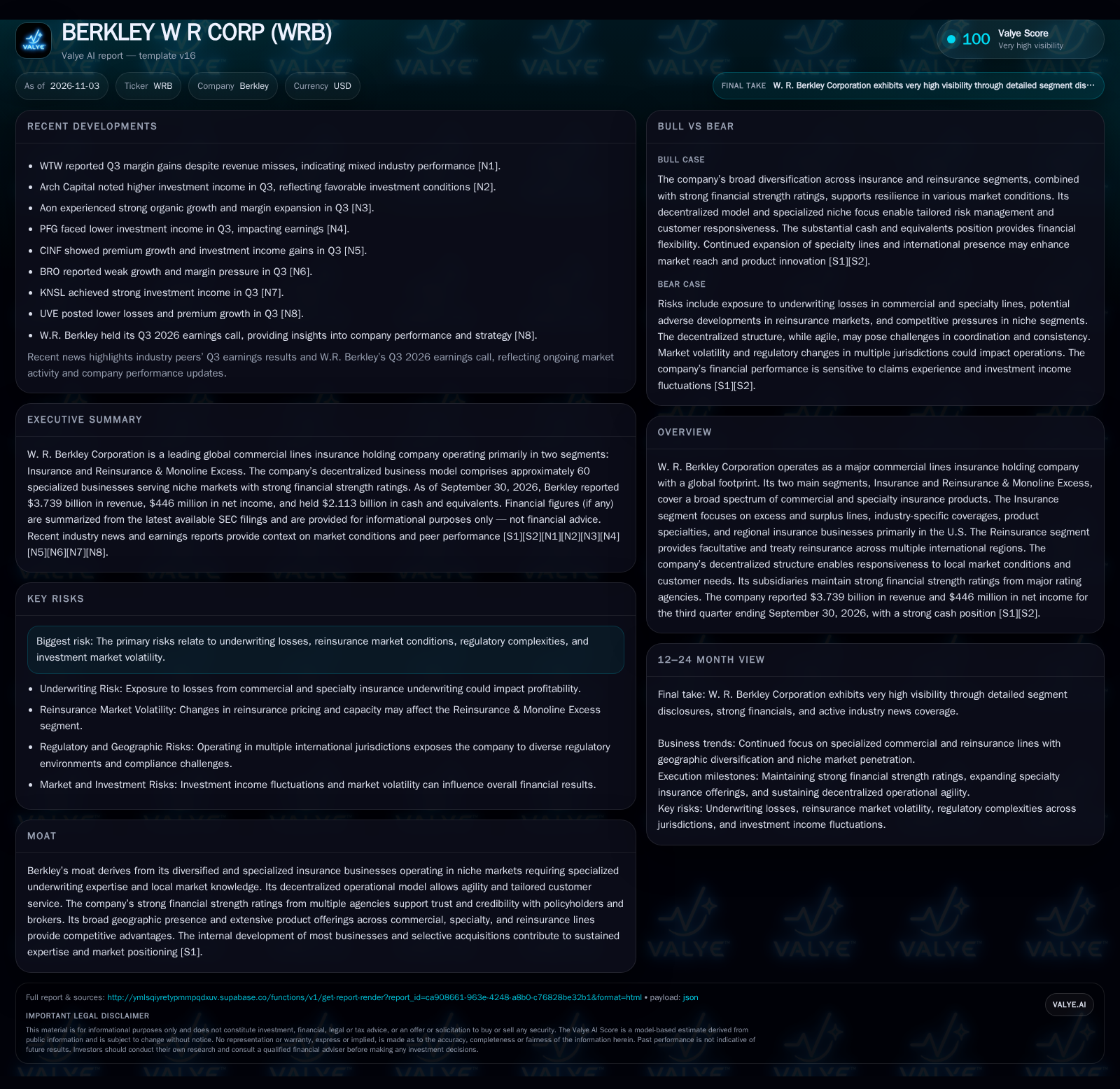
W. R. Berkley reported $3.739 billion in Q3 2026 revenue and $446 million in net income, underpinned by a broad portfolio of commercial and specialty insurance and reinsurance businesses. Its decentralized, niche-focused model and strong financial strength ratings provide both agility and credibility, but the company faces ongoing challenges from underwriting risk, global regulatory complexity, and reinsurance market volatility [S1] [S2].
W. R. Berkley Corporation occupies a distinctive position in the global commercial insurance landscape: its decentralized, niche-focused model combines specialized underwriting expertise with the scale of roughly 60 businesses spanning insurance and reinsurance. The company’s latest quarterly results highlight both financial strength and the complexity of managing risk across diverse markets. The central challenge—and opportunity—for Berkley lies in sustaining underwriting profitability and capital discipline as it expands specialty lines and international operations, all while navigating competitive pressures and evolving regulatory regimes.
Performance Trends and Strategic Positioning
As of Q3 2026, W. R. Berkley reported $3.739 billion in revenue and $446 million in net income, with basic EPS of $1.15 and diluted EPS of $1.14. Cash and cash equivalents stood at $2.113 billion [S2]. These results affirm Berkley’s continued scale and capacity to generate profits across its insurance and reinsurance platforms. The company’s portfolio comprises about 60 businesses, with a strong bias toward internally developed operations, each targeting niche or specialty markets [S1].
Berkley’s insurance subsidiaries maintain high financial strength ratings—A+ from A.M. Best, AA- from S&P, A1 from Moody’s, and AA- from Fitch—reinforcing its reputation for creditworthiness and reliability in fulfilling policyholder obligations [S1]. Its decentralized structure, spanning both U.S. and international markets, remains central to its strategy of local responsiveness and risk diversification.
Profitability and Risk Dynamics in Berkley’s Operating Model
Berkley’s business economics hinge on disciplined risk selection, pricing accuracy, and the ability to underwrite complex or non-standard risks that command higher premiums per unit of exposure. In the Insurance segment, underwriting profitability depends on tight control of loss ratios and expense management, while investment income from the float (premiums held before claims are paid) provides a secondary but sometimes volatile earnings lever.
The decentralized structure means each business unit operates with significant autonomy, tailoring products and pricing to local or sector-specific conditions. This can foster sharper underwriting and product innovation, but may also introduce coordination and oversight risks, particularly in volatile or emerging risk categories.
In reinsurance, Berkley accepts both facultative and treaty business, which exposes it to industry-wide loss events and cyclical pricing swings. The mix between insurance and reinsurance, as well as between admitted and excess/surplus lines, influences the company’s overall risk appetite and return profile.
Specialty Focus and Geographic Reach Amid Competitive Pressures
Berkley’s competitive advantage is rooted in its ability to serve fragmented, specialized markets where underwriting expertise and customer proximity matter more than brute scale. By operating through approximately 60 businesses, most built internally, Berkley is less exposed to commoditized pricing than broader multiline insurers [S1]. Its strong financial ratings underpin broker and policyholder trust, especially in high-severity or long-tail lines.
However, the specialty and excess & surplus (E&S) space is attracting new entrants—including insurtechs and global carriers seeking higher-margin business—raising the bar for innovation and service. In reinsurance, competition is global and cyclical, with alternative capital and new risk transfer mechanisms (such as insurance-linked securities) exerting structural pressure on pricing and returns. Larger multiline insurers and focused specialty peers may compete aggressively on both price and bespoke product design.
Switching costs in commercial insurance tend to be moderate: while specialized expertise and service can foster loyalty, brokers and buyers will move for price or coverage. Berkley’s decentralized model may help defend share in niches, but could also make it harder to achieve scale-driven cost advantages across the group.
Conditions for Berkley’s Decentralized Approach to Surpass Expectations
A favorable scenario would see Berkley’s niche focus and decentralized structure continuing to drive superior underwriting results, particularly as commercial insurance pricing remains firm and specialty exposures grow in complexity. The company could leverage its reported balance sheet position to selectively expand or acquire in higher-growth specialty areas, deepening expertise in cyber risk, healthcare, or environmental lines.
Upside would be confirmed by sustained improvement in combined ratios (reflecting underwriting profitability), market share gains in targeted niches, and stable or rising returns on equity even as new competitors enter the specialty space. Evidence of successful international expansion—such as profitable growth in regions outside the U.S. or effective use of Lloyd’s global licensing—would also support the thesis.
Additional confirmation would come from the ability to maintain or improve financial strength ratings and generate consistent investment income, despite market volatility. If Berkley can demonstrate lower-than-peer loss ratios or expense ratios in its core businesses, it would further validate the decentralized, expertise-driven approach.
Stable Returns Driven by Decentralized Operations Despite Market Fluctuations
The most plausible outcome is that Berkley continues to deliver solid, if cyclical, profitability by leveraging its specialty focus and decentralized decision-making. Premium growth is likely to track industry trends in commercial and specialty lines, with periodic upticks when market conditions tighten (e.g., after large loss events or during hard markets).
Combined ratios and investment income may fluctuate with claims experience and market cycles, but the company’s emphasis on underwriting discipline and capital strength should provide a buffer against severe downturns. Occasional missteps in new or emerging lines, or in international markets, are plausible but not thesis-breaking if offset by core business stability.
Confirmation would come from maintaining combined ratios close to or better than industry averages, stable financial strength ratings, and continued cash generation. Conversely, a persistent rise in loss ratios or material downgrades by rating agencies would challenge the base case.
Potential Impact of Underwriting Challenges and External Disruptions
The chief threat to Berkley’s model is a combination of adverse underwriting cycles, unexpected claims severity, and investment income shortfalls. A major catastrophe, liability trend shift, or systemic risk event could stress both the insurance and reinsurance books, particularly if loss reserves prove inadequate or pricing discipline erodes in a soft market.
The decentralized structure, while agile, could hinder rapid response to emerging risks or aggregate exposures, especially if local units underprice or misjudge risk in pursuit of growth. Regulatory or compliance failures in international operations present another downside vector, potentially leading to fines, reputational damage, or capital charges.
Confirmation of a downside scenario would include a sharp deterioration in combined ratios, significant reserve charges, or a downgrade of financial strength ratings.
Factors Influencing the Viability of Berkley’s Specialty Insurance Strategy
Combined ratio trends by segment, particularly in specialty lines and international operations, if disclosed, would help test underwriting discipline and risk selection.
Movement in financial strength ratings from major agencies (A.M. Best, S&P, Moody’s, Fitch) would reflect capital adequacy and market confidence.
Growth rates in premium volumes for new specialty products or international regions, if disclosed, would clarify the success of expansion efforts.
Loss reserve development—whether adverse or favorable—would signal the accuracy of pricing and claims estimation.
Expense ratio changes, especially if the decentralized model leads to inefficiencies or cost creep.
Market share shifts within targeted niche segments or E&S markets, if available, would test the durability of Berkley’s competitive position.
Material changes in investment income or asset allocation, particularly during periods of market volatility.
Incidents of regulatory or compliance challenges in overseas operations, if disclosed, would highlight the risks of global expansion.
Disclaimer: This is research-only, informational analysis and not investment advice. It may include AI-generated interpretation and general industry context. Always verify important details using primary sources.

Comments