
SITE Centers Corp.: Disposition Strategy, Asset Wind-Down, and the Stakes for Shareholder Value
SITE Centers Corp. is unwinding its retail REIT portfolio through property sales, with declining revenues and no consolidated debt. The company’s ability to liquidate assets efficiently, manage tenant and market risks, and preserve cash will determine outcomes for remaining shareholders as the wind-down progresses.
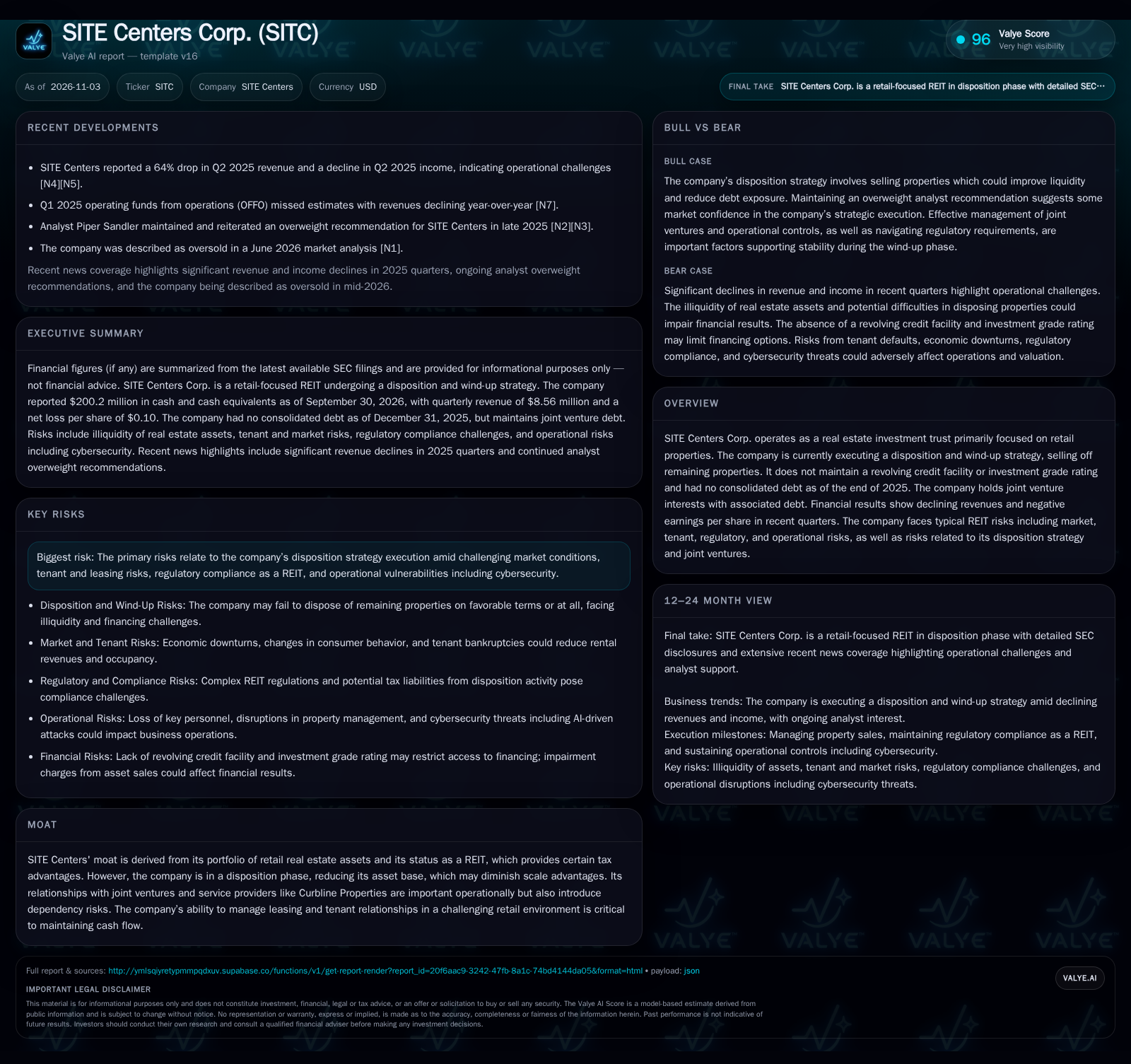
SITE Centers is in the midst of a wind-down strategy, selling off its retail real estate assets amid sharply declining revenues and negative earnings per share. With $200.2 million in cash and no consolidated debt, the company’s execution on property dispositions and risk management will shape its ultimate value realization for shareholders. Key risks include real estate illiquidity, potential impairment charges, and tenant or market disruptions. Analyst overweight ratings suggest some confidence in strategic execution, but the path remains highly execution-dependent. [S2] [N4] [N5]
SITE Centers Corp. is in the late stages of a deliberate wind-down, selling off its retail property portfolio and transitioning from an operating REIT to a liquidating entity. The ultimate outcome will hinge on management’s ability to execute timely, value-maximizing disposals and navigate the regulatory and tenant risks inherent in the process. Analyst overweight ratings hint at some optimism, but the thesis is highly contingent on execution and market absorption.
Wind-Down Progress: Cash, Debt, and Revenue Contraction Shape the Endgame
SITE Centers is executing a disposition and wind-up strategy, actively selling its remaining portfolio of retail properties. As of September 30, 2026, the company reported $200.2 million in cash and cash equivalents and had no outstanding consolidated debt as of December 31, 2025. This distinguishes SITE Centers from most REITs, which typically maintain leverage and recurring rental income streams. However, quarterly revenue has collapsed to $8.56 million and EPS turned negative (-$0.10) in the most recent quarter, reflecting the shrinking asset base and disposition focus. The company continues to face risks from illiquid real estate, potential impairment charges on asset sales, and tenant or market disruptions. [S2] [N4] [N5]
Disposition Economics: How Value Can Be Realized in an Asset Wind-Down
SITE Centers’ economics are no longer driven by traditional REIT rental spread or operational leverage, but by the pace and pricing of property disposals. Revenue is declining rapidly as assets are sold, and the company’s earnings now reflect a mix of residual rental income, gain or loss on sales, and any impairment charges. With no consolidated debt, the company avoids debt service drag but also loses the leverage that can amplify returns in a rising market. The core value-creation lever is maximizing proceeds from property sales net of transaction costs and tax leakage, while minimizing the time assets remain on the balance sheet (and thus exposed to market risk and carrying costs). The company reported cash and liquidity metrics for the period; these figures do not by themselves establish operating runway, investment capacity, financial flexibility, or financing capacity. The company’s joint ventures introduce additional complexity, as outcomes are partially dependent on partner decisions and JV-level debt terms. [S2]
In this context, value realization is highly sensitive to: (1) prevailing cap rates and buyer demand for retail real estate; (2) the company’s ability to avoid distressed or forced sales; and (3) effective management of the wind-down process to minimize operational overhead. If assets can be sold at or near carrying value, and overhead is quickly scaled down, the company could preserve more value for shareholders. However, slow-moving or impaired asset sales could erode NAV and shrink final distributions.
Competitive Dynamics: Asset Sales in a Crowded and Cautious Retail Real Estate Market
SITE Centers is not competing for new tenants or developments, but rather for buyers in the secondary property market. The retail real estate environment remains challenging, with shifting consumer patterns, tenant bankruptcies, and macroeconomic uncertainty all weighing on demand. The company’s competitive position is shaped by the quality and location of its remaining assets relative to other sellers, as well as its ability to attract institutional or private equity buyers seeking stabilized retail assets.
Other REITs or private owners also looking to divest properties may create a supply glut, pressuring valuations. SITE Centers’ relationships with joint venture partners and service providers (such as Curbline Properties) are material, as they affect both the pace and terms of asset sales. The absence of a strong recurring income stream or scale advantages reduces bargaining power. In this environment, the company’s ability to differentiate its properties (e.g., through tenant quality, location, or redevelopment potential) could influence disposition outcomes. Buyers may also demand discounts for uncertainty, further compressing proceeds.
Efficient Dispositions and Favorable Market Absorption Drive Above-Expectations Shareholder Returns
In the best-case scenario, SITE Centers successfully sells the remainder of its portfolio at or above book value, benefiting from resilient buyer demand for retail assets or specific property strengths (such as high-quality tenants or prime locations). Regulatory compliance as a REIT is maintained, avoiding tax leakage from asset sales.
Shareholder value is maximized if overhead is reduced in sync with asset dispositions, and if joint venture interests are unwound efficiently. Confirmation of this scenario would include property sale announcements at strong valuations, minimal impairment charges, and a shrinking but profitable expense base. Continued analyst overweight ratings and positive market commentary would further validate execution strength. [N2] [N3]
Orderly Liquidation with Ongoing Execution Hurdles and Value Erosion from Discounts
The most plausible outcome is a continued orderly wind-down, with properties sold over several quarters—some at or near book, others at discounts reflecting market caution or property-specific issues. Revenue and earnings remain negative but cash outflows are controlled. Some impairment charges occur as less attractive assets are sold below carrying value, and the company’s expense base is gradually reduced but remains a drag on final distributions.
Shareholders ultimately receive a distribution representing a moderate discount to current NAV, reflecting transaction costs, market headwinds, and the time-value of a protracted wind-down. Evidence supporting this scenario would include continued but slowing revenue declines, impairment charges disclosed in quarterly filings, and steady progress in asset sales. Analyst sentiment stays neutral to mildly positive, but with growing focus on execution risks and timeline uncertainty. [S2] [N4] [N5]
Asset Illiquidity, Forced Disposals, and Regulatory or Litigation Shocks Jeopardize Value Preservation
In the adverse case, weak buyer demand or deteriorating market conditions force SITE Centers to accept deep discounts or delay property sales, tying up capital and increasing carrying costs. Illiquid assets could remain unsold for extended periods, while joint venture complications or partner disputes further impede wind-down. Regulatory hurdles, tax complications, or litigation (for example, disputes over sales or legacy liabilities) could consume cash and erode final shareholder distributions.
Confirmation of this scenario would be seen in sharply increased impairment charges, prolonged negative earnings, a persistent cash burn without corresponding asset sales, and adverse updates on regulatory or legal fronts. Analyst downgrades or warnings about NAV erosion and wind-down delays would also support the downside thesis. [S2]
Milestones That Will Define SITE Centers’ Wind-Down Success or Failure
Progress and pricing of property dispositions—timing, sale proceeds relative to book value, and any disclosed discounts or premiums. [S2]
Magnitude and frequency of impairment charges linked to asset sales, which signal value erosion or market weakness if they accelerate. [S2]
Changes in cash and equivalents, especially net of wind-down costs, as a barometer of remaining value for shareholders. [S2]
Updates on joint venture asset sales, unwinding of JV structures, and any partner-related complications, if disclosed.
Regulatory/tax developments affecting REIT status or triggering tax leakage from asset sales.
Expense base and G&A trends—how quickly overhead is reduced as assets exit the portfolio, if disclosed.
Disclosures regarding litigation, legacy liabilities, or operational disruptions that could consume cash or delay distributions.
Analyst sentiment shifts, particularly if overweight recommendations are downgraded or warning language increases. [N2] [N3]
Disclaimer: This is research-only, informational analysis and not investment advice. It may include AI-generated interpretation and general industry context. Always verify important details using primary sources.

Comments