
Roku’s Platform Monetization and Strategic Implications of the Fox Merger
Roku’s robust Q3 2026 profit surge underscores the leverage of its advertising-driven platform, but the pending Fox merger introduces a new layer of strategic complexity. As the streaming ecosystem matures, Roku’s ability to deepen engagement, diversify revenue, and navigate regulatory and integration risks will define its next phase.
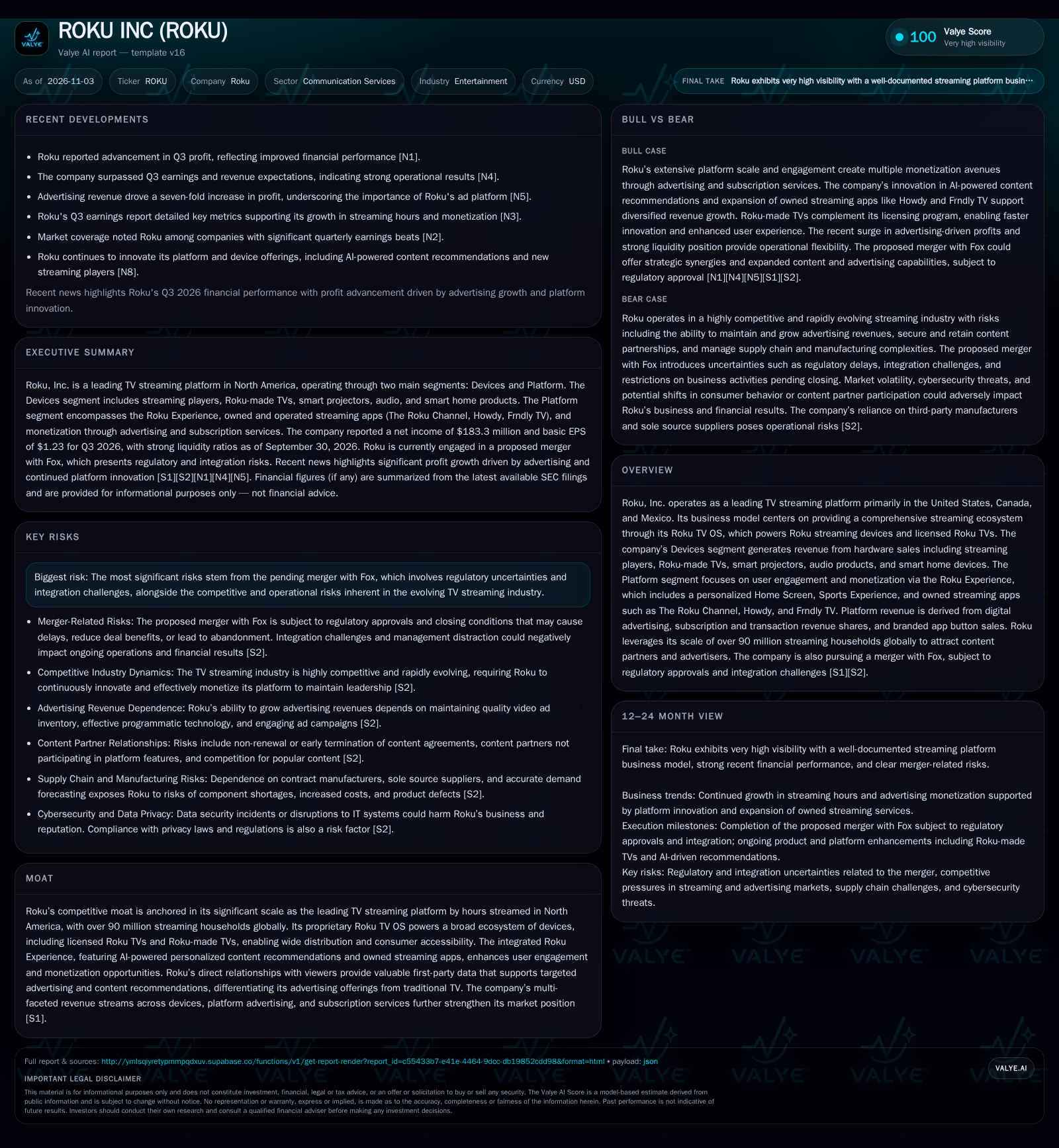
Roku reported a sharp increase in Q3 2026 profitability, primarily driven by advertising revenue growth, while maintaining a reported liquidity position. The company’s platform spans over 90 million streaming households, supporting both device and platform monetization. However, the proposed merger with Fox carries significant regulatory and operational uncertainties. Roku’s future trajectory depends on sustaining engagement, growing ad yields, and successfully integrating with Fox if the deal closes. [S1] [S2] [N5]
Roku’s third quarter of 2026 marks a pivotal moment for the company’s evolution from hardware-centric beginnings to a platform monetization powerhouse. A seven-fold jump in quarterly profit, fueled by advertising gains, demonstrates the operating leverage inherent in Roku’s scale. Yet, the looming Fox merger and intensifying industry competition raise the stakes for execution and strategic clarity. The next phase will test Roku’s ability to extract more value per user, manage integration risk, and defend its position as the connective tissue of North American streaming.
Profit Growth, Reported Liquidity Position, and the Fox Merger Define Roku’s Current Position
Roku delivered Q3 2026 net income of $183.3 million, with a diluted EPS of $1.20, reflecting a substantial increase in profitability versus prior periods—an outcome attributed to surging advertising revenue [S2] [N5]. This profit expansion signals that Roku’s platform monetization strategy, particularly in digital advertising, is gaining traction at scale.
The company’s cash and equivalents stood at $2.52 billion as of September 30, 2026, complemented by short-term investments of $201.8 million, yielding a current ratio of 2.7 and a cash ratio of 1.86 [S2]. While these balance sheet metrics describe available liquidity, they do not, by themselves, guarantee future investment or shock-absorption capacity.
Roku’s platform now reaches over 90 million streaming households globally, providing a foundation for both advertising and subscription revenue streams [S1].
A proposed merger with Fox, announced in June 2026, is subject to regulatory review and closing conditions. The deal structure includes a mix of Fox stock and cash, but also introduces potential for delays, integration risk, and changes in strategic direction for Roku [S2].
Roku’s Revenue Model: Platform, Devices, and Scale Effects
Roku’s business model relies on a dual-engine approach: device sales (including streaming players and Roku-made TVs) and a platform layer that captures value through advertising, subscription revenue shares, and branded integrations [S1]. The Devices segment is typically lower-margin and somewhat commoditized, with pricing pressure and hardware cycles influencing short-term results. In contrast, the Platform segment—now split into Advertising and Subscriptions for internal reporting—offers much higher gross margins and provides the fulcrum for Roku’s operating leverage.
Advertising is the primary monetization lever, encompassing in-stream video ads, display ads within the Roku Experience, and branded UI elements such as remote buttons. Roku’s direct relationship with users and proprietary data enable targeted ad delivery, which can command premium CPMs relative to linear TV, especially as advertisers migrate budgets to connected TV (CTV) platforms. Revenue from subscriptions and transactional shares (via The Roku Channel, Howdy, and Frndly TV) diversify the platform income, but advertising remains the dominant profit driver.
Roku’s cost structure is characterized by high fixed expenses in R&D and content acquisition, but variable costs scale more slowly than revenue as household engagement deepens. This dynamic underpins the sharp profit expansion observed in Q3 2026: incremental platform revenue, especially from advertising, falls disproportionately to the bottom line once core infrastructure is in place. However, the company’s ability to sustain this margin expansion depends on continued growth in streaming hours, ad yield, and content partner participation.
Maintaining Platform Strength: Adtech Innovation and Ecosystem Engagement
Roku’s competitive advantages stem from its scale (90 million+ households), proprietary TV OS, and integrated ecosystem of devices and services [S1]. This breadth allows Roku to serve as an aggregator for both viewers and content partners, with the ability to influence content discovery and advertising flows.
However, the competitive landscape is intense, with rival platforms such as Amazon Fire TV, Google TV, Samsung’s Tizen, and Apple TV offering strong alternatives. These competitors benefit from deep pockets, global reach, and, in some cases, vertically integrated hardware and content businesses. Roku’s open approach to content partnerships and neutrality among streaming services has historically been a differentiator, but could be threatened if major content owners pursue more closed ecosystems or exclusive distribution.
Technology substitution risk is present: smart TVs with embedded OS platforms may reduce the need for standalone streaming devices over time. Roku’s response—licensing its OS to TV OEMs and launching Roku-made TVs—aims to mitigate this, but margins and leverage in these arrangements may differ from the legacy player business.
On the adtech front, Roku’s first-party data and direct viewer relationships provide a partial moat, supporting targeted advertising and measurement. Nonetheless, the arms race in CTV ad technology, privacy regulation, and the entry of large digital advertising incumbents represent ongoing threats.
Potential Catalysts for Sustained Margin Growth on the Platform
A favorable trajectory for Roku would see continued growth in streaming hours per household, rising ad loads, and improving CPMs as more advertisers shift budgets from linear TV to CTV. Enhanced AI-powered recommendations could drive deeper engagement and more valuable ad inventory, while expanded owned-and-operated streaming apps (such as Howdy and Frndly TV) would increase Roku’s share of subscription and transactional economics.
If the Fox merger is approved and executed smoothly, Roku could benefit from access to additional premium content, cross-platform advertising sales, and broader reach. Strategic synergies might include joint audience targeting, integrated sports and news offerings, and more bargaining power with advertisers and content suppliers.
Confirmation of this scenario would include evidence of accelerating platform ARPU, further profit margin expansion, and rapid growth in advertising revenue outpacing device sales. Signs of successful Fox integration, such as new joint-content launches or cross-promotional campaigns, would further validate the upside case.
Base Outlook: Consistent Engagement and Gradual Monetization with Integration Risks
The most plausible path forward is one of continued, but moderating, engagement growth and gradual improvement in platform monetization. Roku’s scale advantage should allow it to maintain a leading position in North American streaming, but advertising growth rates may normalize as the CTV market matures and competition intensifies.
The Fox merger may proceed, but with potential for regulatory delays and post-closing integration challenges. In this scenario, Roku would need to balance near-term execution—sustaining user engagement, avoiding content partner churn, and managing device profitability—against the longer-term work of realizing merger synergies.
Evidence supporting this outcome would include stable or slowly rising streaming hours, consistent ARPU growth, and manageable operating expenses. Signs of merger progress, but not full completion, and the absence of major disruptions in content partnerships or device supply would further confirm the base case.
Risks of Margin Pressure and Strategic Setbacks for Roku
Adverse developments could include a slowdown or reversal in streaming hour growth, pricing pressure on advertising inventory, or a decline in ARPU due to increased competition for ad budgets or regulatory constraints on targeting and measurement. If major content partners reduce participation or demand higher revenue shares, Roku’s platform economics could weaken.
A failed or significantly delayed Fox merger would result in prolonged management distraction, uncertainty for employees and partners, and potential restrictions on new business initiatives during the regulatory review period. Integration missteps could lead to cultural clashes, loss of key personnel, or under-delivery of expected synergies.
Confirmation would come from flat or declining platform revenue, margin compression, negative trends in engagement metrics, or public disputes with content partners. Regulatory setbacks or abandonment of the Fox deal would also be strong signals of downside risk.
Key Developments Influencing Roku’s Platform Value and Merger Success
Trends in platform ARPU (average revenue per user) and ad yield, if disclosed, to track the effectiveness of monetization initiatives.
Growth rates in streaming hours per household, which would signal the depth of user engagement and platform relevance.
Updates on regulatory review and anticipated closing timeline for the Fox merger, including any required divestitures or concessions.
Integration milestones post-merger, such as the launch of joint content offerings or unified advertising products, should the deal close.
Retention and renewal rates for content partners and TV OEM licenses, which underpin platform breadth and device distribution.
Gross margin trends across the newly segmented Advertising, Subscriptions, and Devices businesses, to reveal operating leverage or compression.
Evidence of successful adoption and monetization of new AI-driven recommendation features and proprietary streaming apps.
Supply chain stability and manufacturing cost trends, particularly for Roku-made TVs and new device launches.
Disclaimer: This is research-only, informational analysis and not investment advice. It may include AI-generated interpretation and general industry context. Always verify important details using primary sources.

Comments