
Centerspace: Strategic Uncertainty and Operational Execution Under Merger Review
Centerspace’s focus on operational improvement and targeted metropolitan markets is tested by Q3 underperformance and merger-related distractions. The company’s ability to sustain tenant retention, optimize capital allocation, and navigate sectoral headwinds will define outcomes in the coming quarters.
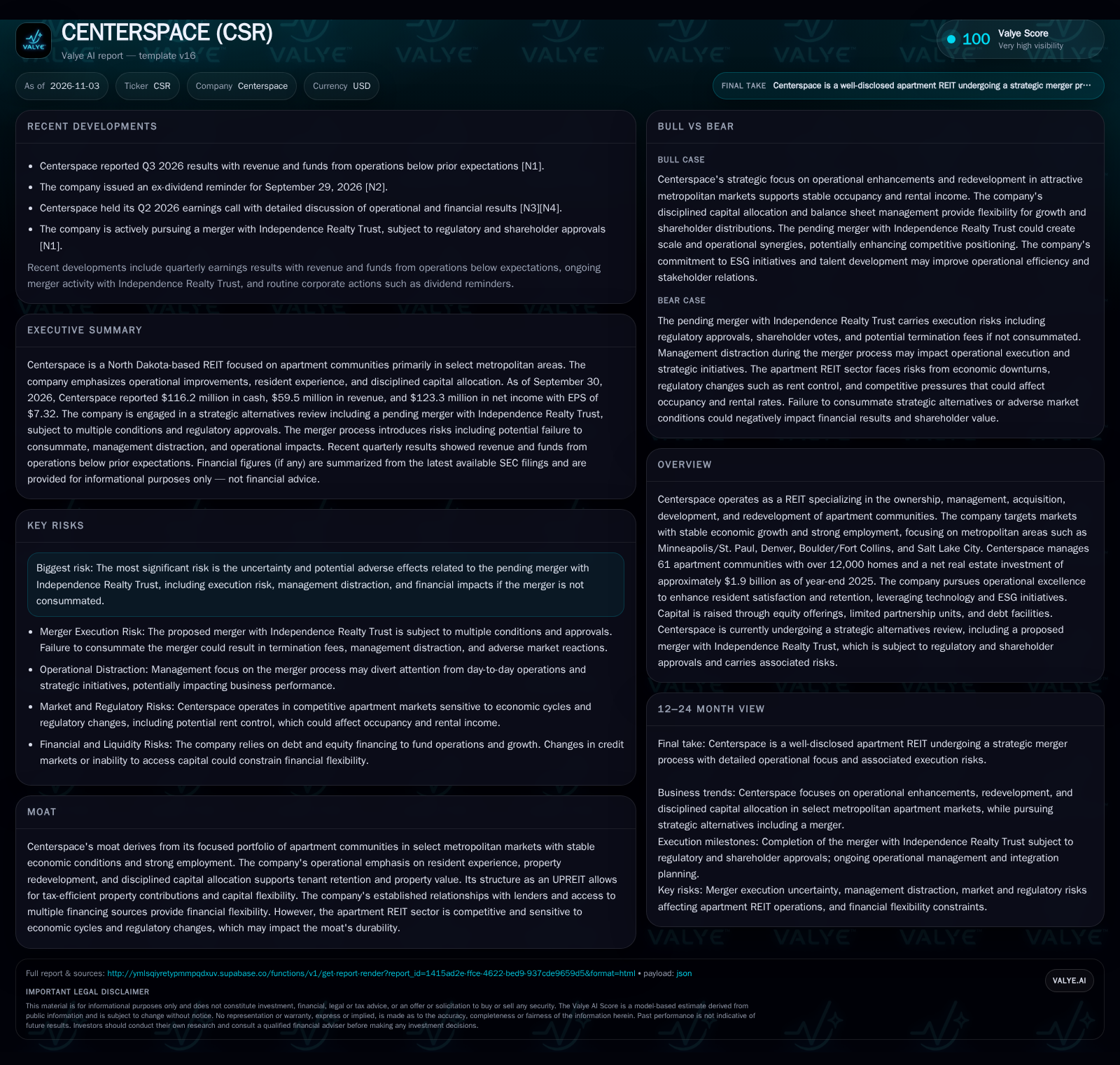
Centerspace, an apartment REIT with a $1.9B real estate portfolio, reported Q3 2026 revenue and FFO below expectations while undergoing a strategic alternatives review, including a potential merger. The company’s operational focus and capital allocation are challenged by management distraction and sector headwinds. The thesis turns on the interplay between execution, market conditions, and the outcome of the ongoing merger process. [S1] [S2] [N1]
Centerspace stands at a crossroads: while its $1.9 billion apartment portfolio in select stable metropolitan markets provides a foundation for recurring income, recent earnings shortfalls and a high-profile merger review inject significant uncertainty. Management’s operational focus and capital discipline are being tested by both sectoral headwinds and the distractions inherent in strategic deal processes. The company’s future will likely be shaped by its ability to maintain tenant retention, execute redevelopment, and respond to evolving market and regulatory dynamics—even as the prospect of a major transaction looms overhead.
Earnings Misses and Merger Review Shape Near-Term Outlook
Centerspace reported Q3 2026 revenue of $59.5 million, with both revenue and funds from operations (FFO) coming in below prior expectations—a signal that operational or market headwinds are impacting results [N1] [S2]. The company is also undergoing a strategic alternatives review, which could result in a sale, merger, or other business combination, introducing considerable uncertainty and the risk of management distraction [S1]. [S2] The company's 61-property portfolio, totaling 12,262 apartment homes, remains concentrated in large metropolitan areas such as Minneapolis/St. Paul, Denver, Boulder/Fort Collins, and Salt Lake City [S1].
How Apartment Portfolio Economics Influence Rent-Driven Cash Flow
Centerspace’s core business model is to generate rental income from its apartment communities, supplemented by ancillary fees and, potentially, gains on property redevelopment or disposition [S1]. Revenue is primarily a function of occupancy rates, average rent per unit, and the scale of the portfolio. In a typical apartment REIT structure, fixed costs (property taxes, maintenance, corporate overhead) are significant, while variable costs scale more slowly with incremental occupancy, enabling some operating leverage if rents and occupancy rise. The company’s ability to manage property-level expenses and maximize occupancy is central to FFO generation.
Capital intensity remains high, with ongoing investment in maintenance, redevelopment, and occasional acquisitions. Centerspace funds these needs through a mix of common and preferred equity, limited partnership units, and debt—including a revolving credit facility and unsecured senior notes [S1]. Rising interest rates or tightening credit markets could increase the cost of capital and compress spreads between rental yields and financing costs. The company’s stated focus on operational enhancements and ESG initiatives may support efficiency and resident retention, but the impact on margins is ultimately a function of market power and cost control.
Metropolitan Focus Reveals Strengths and Sector Challenges
Centerspace’s portfolio is concentrated in stable, economically vibrant metropolitan areas, which historically support higher occupancy and rent growth [S1]. This geographic focus can confer advantages—such as access to deeper tenant pools and potential for premium rents—but also exposes the company to intense competition from other institutional landlords, new apartment supply, and shifting tenant preferences. The apartment REIT space is characterized by relatively low product differentiation; switching costs for tenants are modest, and pricing power is often limited by local market conditions and regulatory constraints.
Centerspace’s operational emphasis on resident experience, property redevelopment, and talent development may help drive retention and efficiency, but these are incremental in a sector where scale, location, and capital discipline are primary drivers. The UPREIT structure offers tax efficiency and flexibility for property acquisitions, but this advantage is not unique to Centerspace. Regulatory risks—such as rent control measures—are a persistent threat, especially as affordability issues intensify in target markets. The durability of any competitive moat is thus closely tied to the company’s ability to select and manage properties that outperform peers on occupancy and rent growth despite sectoral headwinds.
Unlocking Value Through Operational Execution and Strategic Focus
A favorable outcome for Centerspace would see management maintaining focus on operational excellence despite the merger process, leading to improvements in occupancy, rent growth, and cost discipline. Successful redevelopment of existing properties could drive rent premiums and enhance portfolio value.
On the strategic front, a well-executed merger or sale—at a premium to net asset value—could crystallize value for shareholders and mitigate execution risk. Evidence confirming this scenario would include a return to revenue and FFO growth in subsequent quarters, improved occupancy and rental metrics (if disclosed), and a positive market reaction to any announced transaction terms. Conversely, operational setbacks or a failure to reach a strategic deal would falsify this upside path.
Steering Through Sector Headwinds and Execution Challenges
The most plausible scenario is that Centerspace continues to operate its portfolio with moderate success, but faces ongoing sectoral and internal challenges. Management distraction from the merger review may lead to delayed or less effective operational initiatives, resulting in occupancy or rent growth lagging regional benchmarks. At the same time, the company is likely to continue investing in redevelopment and ESG enhancements, supporting resident satisfaction but not materially altering competitive dynamics.
Financial performance may stabilize but remain below best-in-class peers, especially if macroeconomic pressures (e.g., elevated interest rates, labor costs, or sluggish job growth) persist in core markets. Confirmation of this scenario would come from flat or modestly improving revenue and FFO, stable but unexceptional occupancy rates, and a lack of transformative strategic outcomes in the near term. Falsification would require either a dramatic turnaround in operating metrics or a disruptive event such as a failed or value-destructive merger.
Value Erosion Linked to Merger Uncertainty and Market Volatility
In a negative scenario, the merger process fails to culminate in a transaction, leading to direct costs, management distraction, and reputational damage. Prolonged uncertainty could undermine employee morale, delay property-level improvements, and erode tenant satisfaction—potentially manifesting in higher turnover and lower occupancy. If macroeconomic conditions deteriorate (e.g., recession, job losses, or regulatory tightening in key markets), rental income could fall, exacerbating fixed-cost leverage and pressuring cash flow.
Compounding these risks, tighter credit markets or rising rates could increase debt service costs and restrict access to capital for redevelopment or acquisitions. Confirmation would come from further revenue and FFO shortfalls, rising vacancy rates, or a marked decline in dividend coverage (if disclosed). Falsification would require clear evidence of operational resilience and successful completion of a value-accretive transaction.
Factors That Will Influence Centerspace’s Future Path
Quarterly trends in occupancy rates and average rent per unit, if disclosed, will reveal whether operational execution is offsetting market and internal headwinds.
Updates on the strategic alternatives review process—including transaction terms, timing, and market reaction—will be critical in assessing deal-related value and risk.
Any disclosed changes in same-property net operating income (NOI) growth versus regional REIT peers would help clarify competitive positioning.
Details on redevelopment project returns, capital expenditures, or ESG-driven cost savings (if disclosed) will illuminate the effectiveness of operational initiatives.
Shifts in leverage ratios, debt maturity schedules, and access to credit facilities will indicate potential financial flexibility in a volatile capital markets environment.
Market-level indicators—such as employment rates, rental demand, and regulatory developments in core metropolitan areas—will influence both revenue potential and risk exposure.
Disclaimer: This is research-only, informational analysis and not investment advice. It may include AI-generated interpretation and general industry context. Always verify important details using primary sources.

Comments