
Black Rifle Coffee: Channel Shifts, Brand Depth, and the Stakes of Wholesale Expansion
BRC Inc. (Black Rifle Coffee) is navigating a deliberate pivot from direct-to-consumer subscriptions toward broader retail distribution and ready-to-drink innovation. Recent financial losses, a completed reverse stock split, and a resilient but slightly declining subscriber base sharpen questions about the long-term economics and defensibility of its omnichannel strategy.
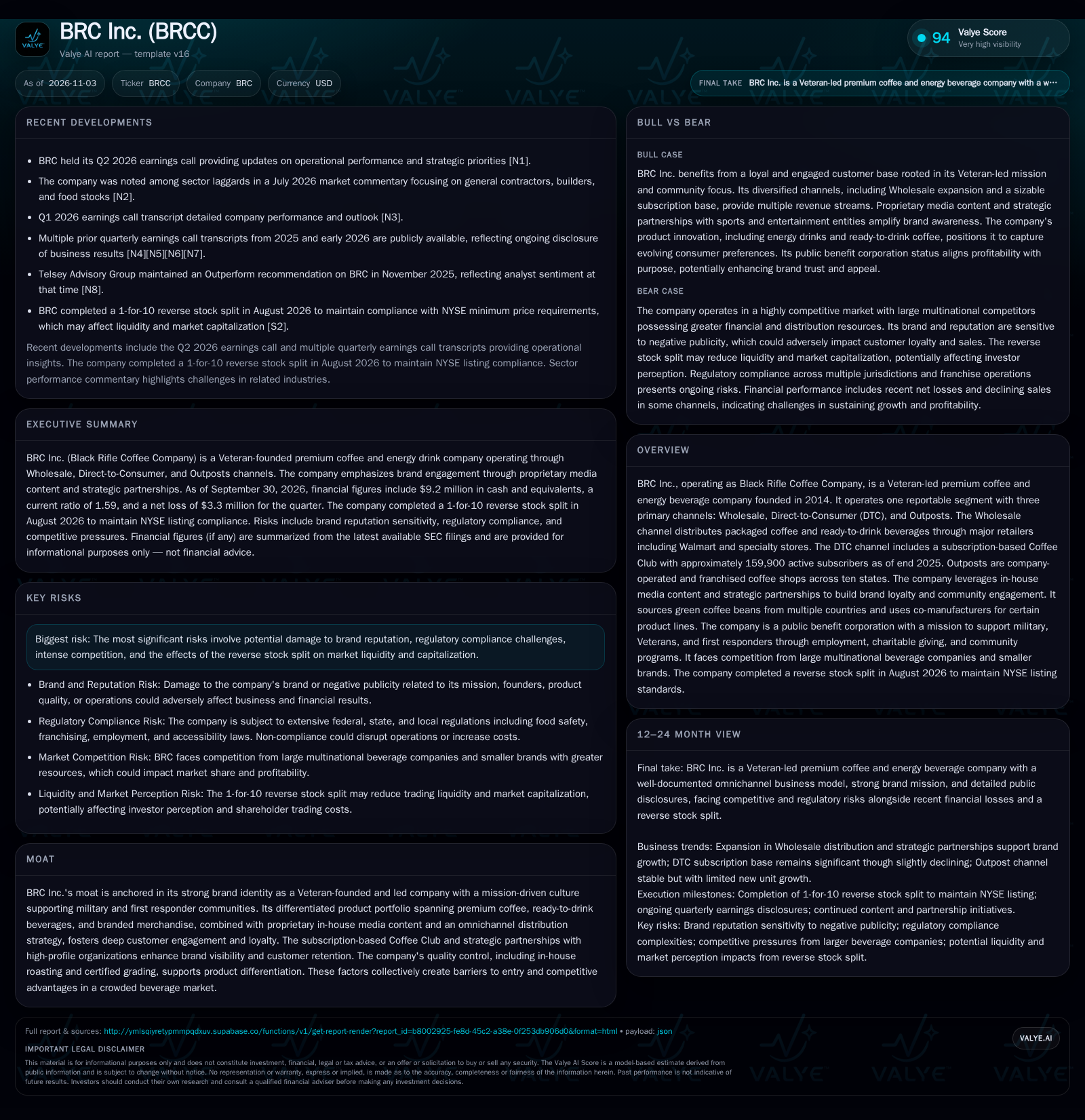
BRC Inc. is a mission-driven coffee and energy beverage company with a strong brand foundation and diversified distribution. Wholesale channel growth has outpaced direct-to-consumer sales, which are declining. Recent financial losses and a 1-for-10 reverse stock split highlight execution and perception risks. The company's ability to scale profitably while maintaining brand integrity and customer loyalty will determine whether it can outmaneuver much larger competitors in a crowded category. [S2]
Black Rifle Coffee’s journey from a small-batch roaster to a national omnichannel brand has hinged on a potent mix of mission, content, and community. Yet as the company’s financials reveal a pivot toward retail and ready-to-drink beverages—and away from its once-core direct-to-consumer subscriptions—the commercial logic and durability of its business model are under a new kind of scrutiny. Recent losses, a reverse stock split, and flatlining subscriber growth raise questions about how BRC can defend its niche and scale profitably in a beverage industry dominated by giants. The answer may lie in how effectively it can convert brand depth into sustainable economics across its chosen channels.
Recent Results Reveal Shifting Channel Dynamics and Financial Strain
BRC Inc. reported Wholesale channel sales of $258.0 million in 2025, a modest increase from $245.0 million in 2024, while Direct-to-Consumer (DTC) revenue declined 5% to $117.6 million over the same period. This pivot reflects both consumer migration toward brick-and-mortar retail and a strategic reallocation of resources away from DTC. The Coffee Club subscription base—once a growth driver—stood at 159,900 active members at the end of 2025, essentially flat and highlighting the challenge of expanding or even maintaining digital recurring revenue. Outpost sales (company-owned and franchised coffee shops) were stable at $22.6 million in 2025. As of September 30, 2026, the company held $9.2 million in cash and equivalents, with a current ratio of 1.59, but reported a quarterly net loss of $3.3 million, indicating unresolved profitability pressures. The August 2026 1-for-10 reverse stock split, executed to maintain NYSE listing requirements, introduces new questions about market trading liquidity and investor perception. [S2]
Omnichannel Model: Margin Trade-offs and the Cost of Growth
BRC’s business model relies on three channels—Wholesale, DTC, and Outposts—each with distinct margin structures and capital requirements. Wholesale provides scale and national reach but typically delivers lower per-unit margins due to retailer bargaining power and slotting fees. The DTC channel, anchored by the Coffee Club subscription, historically offered higher margins via direct relationships and lower distribution costs, but its recent contraction suggests that customer acquisition costs may have risen or that retention is under pressure. Outposts blend retail and experiential economics, with company-owned shops requiring significant upfront investment and operational oversight, while franchised units offer capital-light expansion but less control over brand experience and margins.
Product mix is evolving: ready-to-drink (RTD) coffee and new energy beverages potentially access larger, faster-growing beverage segments but may further compress margins due to co-manufacturing costs, promotional spending, and the need to compete for shelf space against established brands. Operating leverage in this context is double-edged; fixed costs from corporate infrastructure, content creation, and product development must be spread over a larger revenue base, but if growth stalls or channel mix shifts unfavorably, losses can deepen quickly. The company’s reported cash balance and recent losses signal a need for careful capital discipline as it seeks profitable scale.
Brand Mission and Media Muscle vs. Beverage Giants and Upstarts
BRC’s competitive identity is rooted in its veteran-led, mission-driven ethos and reinforced by proprietary media and digital content that foster community engagement. This differentiates the brand from mainstream competitors, potentially creating emotional switching costs and deeper loyalty among its core demographic. However, in the broader beverage landscape, BRC faces formidable competition from multinational incumbents (Starbucks, Nestlé, Monster, Pepsi) with vastly superior distribution, marketing budgets, and economies of scale. At the same time, nimble specialty brands and private-label offerings can undercut on price or target emerging niches.
The company’s omnichannel reach and in-house content creation are assets, but their defensibility depends on continued cultural relevance and the ability to translate brand affinity into high-frequency purchase behavior. Strategic partnerships (e.g., UFC, Dallas Cowboys) amplify visibility but may not deliver lasting competitive insulation unless they drive sustained customer acquisition or retention. Product breadth—across coffee, RTD, energy drinks, and merchandise—offers diversification, but also exposes BRC to more direct competition with CPG heavyweights in each vertical.
If Wholesale Expansion Drives Profitable Scale Without Eroding Brand Loyalty
The most favorable outcome for BRC would see its Wholesale channel continue to grow, leveraging national retail distribution to reach new customer segments while maintaining enough brand authenticity to avoid dilution. If RTD and energy beverages gain traction—supported by effective in-store marketing and continued viral content—BRC could achieve higher volumes that offset lower unit margins, unlocking operating leverage and a path back to profitability.
Confirmation would come from accelerating Wholesale revenue growth, stabilization or renewed growth in the Coffee Club subscriber base (suggesting that retail exposure also boosts DTC engagement), and a visible improvement in gross and operating margins. Reduced quarterly losses or a return to profitability—without a corresponding spike in marketing or promotional spend—would further validate the thesis. Evidence that the brand’s mission-driven positioning continues to resonate, as measured by engagement metrics or positive earned media, would bolster confidence in long-term differentiation.
Wholesale Growth Partially Offsets DTC Weakness, but Margin Pressure Persists
The most plausible trajectory is that BRC continues to expand in Wholesale, helping to mitigate the ongoing decline or stagnation in DTC sales and flat Outpost performance. In this scenario, the company grows revenue but struggles to improve profitability due to the inherently lower margins of scaled retail distribution, competitive pricing pressure, and higher promotional costs. The Coffee Club subscription base remains sizable but does not return to robust growth, limiting the contribution of high-margin recurring revenue.
Operating losses persist or narrow only modestly, as fixed costs are gradually absorbed by a larger revenue base. The company maintains brand integrity among its core audience but finds it increasingly difficult to break out of its niche or defend against copycat brands. Confirmation would come from continued reports of Wholesale gains paired with stagnant or modestly declining DTC/Outpost revenue, and quarterly losses that improve only incrementally. A lack of material improvement in gross margin or cash flow would further support this middle path.
Brand Dilution, Margin Compression, and Liquidity Stress Undermine the Platform
The bear case sees BRC’s push into mass retail and RTD beverages resulting in brand dilution—eroding its differentiation and weakening loyalty among its core veteran and first responder audience. If larger competitors outspend BRC in marketing and promotions, the company could be forced into a price war or heavy discounting, further compressing margins. Meanwhile, DTC and Outpost channels stagnate or decline, and the subscription base erodes as customers defect to other brands or lose interest.
Signs of this scenario would include accelerating declines in DTC/Outpost sales, shrinking Coffee Club membership, deteriorating gross margins, and widening net losses. If negative publicity or a misstep damages the brand’s reputation, the company’s core community advantage could unravel quickly, amplifying downside risk.
Metrics That Will Determine Whether Brand and Channel Strategy Can Deliver Profitable Growth
Quarterly trends in Wholesale revenue growth versus DTC and Outpost sales—continued divergence would clarify whether channel shift is sustainable or cannibalizing.
Gross margin progression, especially as product mix shifts toward RTD and energy beverages—improvement would suggest successful scale or pricing power.
Active Coffee Club subscriber count and churn rate (if disclosed)—a stabilizing or growing base would signal enduring brand loyalty.
Operating cash flow and quarterly net income—evidence of narrowing losses or sustained profitability would support a bullish thesis.
Market share gains or losses in key retail partners and beverage subcategories—a useful metric would be shelf space or velocity data, if disclosed.
Customer acquisition cost and lifetime value (if disclosed)—rising CAC or falling LTV would signal weakening DTC economics.
Impact of strategic partnerships on brand engagement and new customer growth—measured by digital engagement, earned media, or traffic spikes following major partnership activations.
Liquidity and capital discipline—watch for any new debt issuances, equity raises, or changes in working capital that could signal funding pressure.
Disclaimer: This is research-only, informational analysis and not investment advice. It may include AI-generated interpretation and general industry context. Always verify important details using primary sources.

Comments