
IAC Inc.: Capital Strength Meets Strategic Uncertainty in Digital Media’s Shifting Landscape
IAC Inc. boasts reported liquidity position and a seasoned board but faces significant operational losses and limited revenue transparency, raising questions about the durability of its diversified internet and media strategy.
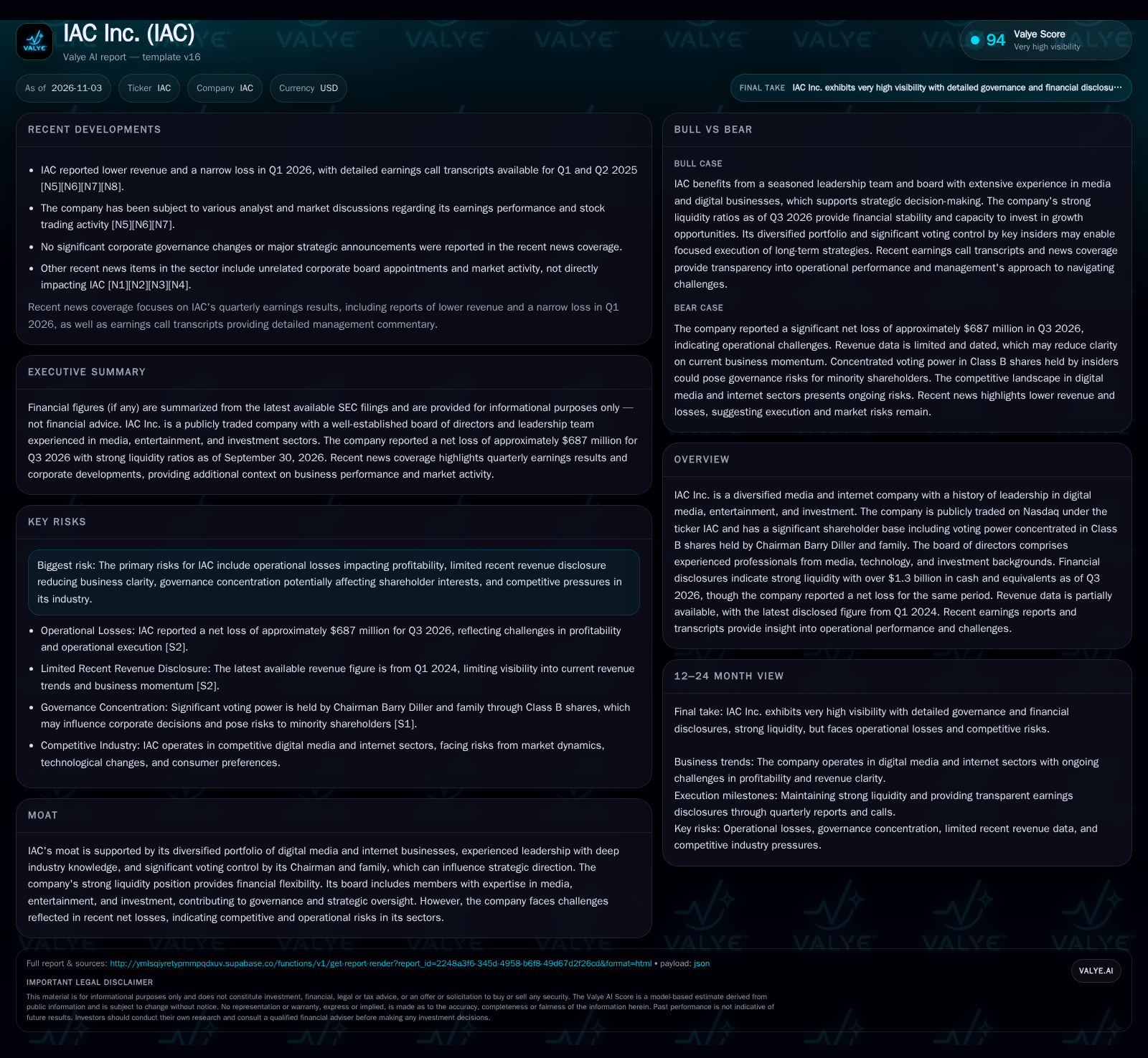
IAC Inc. reported a steep net loss of $687 million in Q3 2026 despite a reported cash position exceeding $1.3 billion. Voting power remains concentrated with Chairman Barry Diller, and the most recent revenue disclosure is from Q1 2024, constraining visibility into current business momentum. [S1] [S2]
IAC Inc. stands at a crossroads: armed with over $1.3 billion in cash and a board stacked with media and technology veterans, it faces the formidable challenge of reversing deep operational losses and restoring revenue momentum in an intensely competitive digital landscape. With voting power firmly held by Chairman Barry Diller and family, governance direction is clear, but the company’s future hinges on whether its financial resources and management expertise can unlock value in a market where legacy digital models face mounting pressure. The coming quarters will test whether IAC’s liquidity and experience can translate into strategic renewal—or whether persistent losses signal deeper structural headwinds.
Liquidity and Losses Define IAC’s Immediate Position
As of September 30, 2026, IAC reported $1.32 billion in cash and equivalents, with current assets totaling $1.76 billion against current liabilities of $438 million—yielding a current ratio of 4.01 and a cash ratio of 3.01 [S2]. The company reported cash and liquidity metrics for the period; these figures do not by themselves establish operating runway, investment capacity, financial flexibility, or financing capacity. However, this financial strength is offset by a net loss of $687 million for Q3 2026, with EPS at -$9.15 [S2]. The most recent revenue figure dates back to Q1 2024 ($930 million), leaving a near two-year gap in disclosed top-line performance [S2]. Voting control remains concentrated in Chairman Barry Diller and family via Class B shares, cementing insider influence over strategic decisions [S1].
How IAC’s Economic Model Faces Structural Headwinds
Historically, IAC’s business model has centered on incubating and scaling digital media and internet businesses, often spinning off mature assets to unlock value. Revenue generation typically blends advertising, subscription, and transaction-based streams across a portfolio of consumer-facing brands. However, absent recent revenue disclosures, it is unclear whether IAC’s portfolio is delivering meaningful growth or margin expansion. The reported Q3 2026 net loss suggests that fixed costs and overhead may be outpacing any operating leverage from digital scale, or that portfolio assets are underperforming in competitive, low-margin segments.
The company’s capital allocation choices—whether for organic investment, acquisitions, or returns to shareholders—will be critical, especially in the absence of clear revenue or cash flow momentum.
Variable costs in digital media, such as content acquisition and customer acquisition, can spike rapidly in response to market competition, while fixed platform and personnel expenses create operating leverage risk if revenue stalls. Without more recent revenue or segment disclosures, it is difficult to assess which business lines are driving losses or whether IAC’s traditional portfolio approach retains its historical economic appeal.
A critical aspect of IAC's economic model is its reliance on the scalability of digital platforms to achieve operating leverage. However, scalability is often contingent on network effects and user engagement metrics, which can be volatile in consumer-facing internet businesses. If these platforms fail to sustain or grow their active user bases, the fixed costs associated with technology infrastructure and content creation may become disproportionately burdensome. Moreover, the mix of revenue streams—advertising, subscription, and transaction—each carries unique margin profiles and sensitivity to macroeconomic fluctuations. For instance, advertising revenues are typically more cyclical and susceptible to shifts in digital ad spend, while subscription models may offer steadier income but require significant upfront investment in content or service quality to reduce churn. Understanding how IAC balances these revenue components would help evaluate the resilience of its economic model under varying market conditions.
Competitive Dynamics and Governance Shape Strategic Options
IAC operates in digital media and internet sectors characterized by rapid innovation, shifting consumer preferences, and intense competition from both entrenched platforms and nimble upstarts. The company’s historical advantage—combining capital with operating expertise to identify, grow, and eventually spin off high-potential digital assets—faces new challenges as digital advertising becomes more concentrated and consumer-facing internet businesses confront rising acquisition costs and shifting privacy standards.
IAC’s board, populated by veterans from media, entertainment, and investment, provides strategic depth, but the concentration of voting power in Barry Diller and family could limit minority shareholder influence or agility in responding to disruptive threats [S1]. In the current environment, scale, network effects, and proprietary data are more critical than ever; unless IAC’s portfolio companies can deliver unique value or defensible market positions, they risk margin compression or irrelevance.
Peer groups include diversified digital holding companies, pure-play internet platforms, and media conglomerates. While IAC’s structure offers flexibility, it may also dilute focus and create a conglomerate discount if market participants view its assets as subscale or strategically disconnected.
The competitive landscape in which IAC operates is marked by increasing consolidation among digital platforms, which intensifies barriers to entry and raises the stakes for scale-dependent advantages. Proprietary data assets and sophisticated user targeting capabilities have become critical differentiators, enabling larger incumbents to command premium advertising rates and customer loyalty. For IAC, maintaining relevance may require not only innovation in product offerings but also strategic partnerships or technology investments to enhance data analytics and personalization. Furthermore, evolving regulatory frameworks around data privacy and content moderation introduce additional complexity, as compliance costs and operational constraints can disproportionately impact mid-sized players lacking the resources of dominant platforms. These external factors underscore the importance of governance agility and strategic foresight in navigating competitive threats and capitalizing on emerging opportunities.
Unlocking Value Through Portfolio Realignment or Strategic Spin-Offs
A favorable outcome would see IAC leveraging its reported liquidity position and board expertise to restructure underperforming assets, redeploy capital into growth verticals, or execute value-creating spin-offs. If management can identify portfolio companies with scalable economics and competitive moats—such as platforms with high retention, network effects, or differentiated content—these could drive a return to profitability and attract investor re-rating.
Signs that would confirm this scenario include new segment disclosures showing accelerating revenue or margin improvement in key businesses, announcements of strategic divestitures or spin-offs unlocking hidden value, and evidence of successful capital deployment into high-growth digital sectors. Falsification would come from continued portfolio underperformance, absent new investments, or asset impairments without clear strategic rationale.
Portfolio Triage and Defensive Posture Amidst Industry Flux
The most plausible near-term trajectory is one of cautious portfolio management: IAC maintains high liquidity, selectively invests in core businesses, and seeks incremental operating improvements while minimizing risk. Losses may persist, but are partially offset by cost controls and limited new investment pending clearer signals of sector recovery or new growth vectors.
This scenario would be reinforced by continued high cash balances, restrained M&A activity, and management commentary focusing on operational discipline rather than aggressive expansion. Conversely, evidence of accelerating losses, shrinking cash reserves, or governance disputes would undermine the plausibility of a stable, defensive approach.
Structural Portfolio Weakness Triggers Asset Sales or Restructuring
The adverse scenario envisions that IAC’s digital properties are fundamentally subscale or structurally disadvantaged—unable to compete effectively against dominant platforms or adapt to changing monetization models. Persistent operating losses erode cash reserves, forcing management to pursue asset sales or strategic retrenchment at unfavorable terms.
Confirmation would come from further large quarterly losses, asset write-downs, negative cash flow trends, or disclosures of strategic reviews and asset divestitures. If the board’s governance concentration limits flexibility or minority shareholder dissent rises, the risk of value-destructive decisions may increase.
Milestones That Will Reveal Whether IAC’s Strategy Can Restore Value
Disclosure of up-to-date consolidated and segment-level revenue and margin performance would help clarify whether any portfolio assets are returning to growth or profitability, or if losses remain broad-based.
Announcements of asset sales, spin-offs, or meaningful acquisitions would signal strategic realignment and test whether management can unlock value from the existing portfolio.
Commentary or disclosures regarding changes to governance structure or voting rights would help gauge whether minority shareholder interests are being addressed or diluted.
Earnings call guidance or management commentary on market trends, cost controls, or capital allocation priorities would provide insight into the company’s operational discipline and strategic intent.
Reports of new partnerships, platform launches, or customer wins in portfolio companies (if disclosed) would be a tangible sign of competitive progress.
Any regulatory or legal developments affecting digital media and internet businesses, such as changes in privacy law or advertising practices, could materially impact IAC’s operating environment.
Disclaimer: This is research-only, informational analysis and not investment advice. It may include AI-generated interpretation and general industry context. Always verify important details using primary sources.

Comments