
First Hawaiian, Inc.: Regional Banking Strength, Expansion Ambitions, and the Stakes of Concentration Risk
With a reported balance sheet position and deep roots in Hawaii, First Hawaiian, Inc. faces a pivotal period as it contends with intensifying fintech competition, regulatory and environmental risks, and a major acquisition designed to expand its Pacific banking footprint.
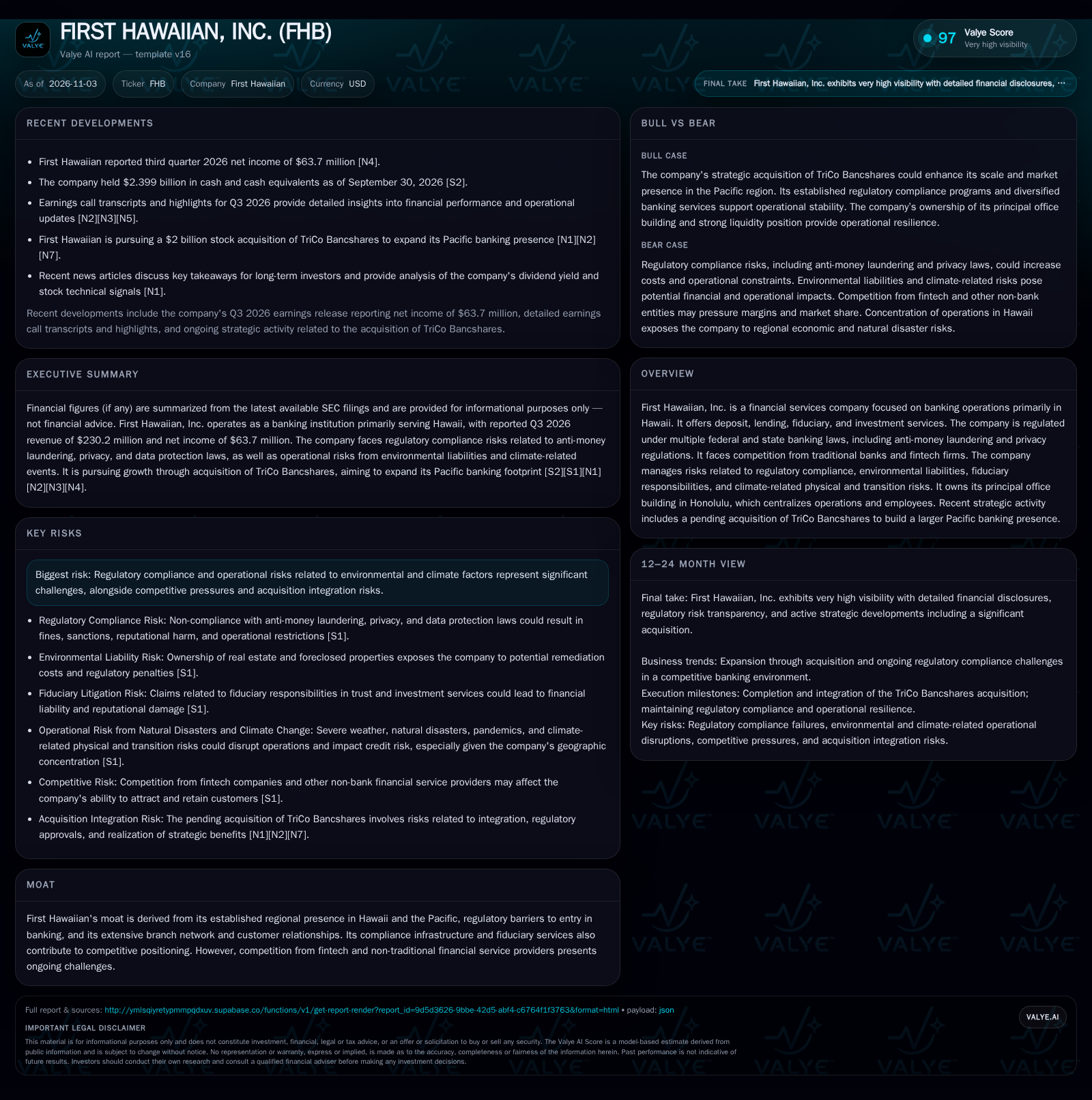
First Hawaiian, Inc. reported Q3 2026 revenue of $230.2 million and net income of $63.7 million, supported by $2.399 billion in cash and cash equivalents. The company is pursuing the acquisition of TriCo Bancshares to broaden its Pacific presence, but remains exposed to regional concentration, regulatory burdens, and evolving competition from fintech and non-bank entities. The next phase will test its ability to leverage its balance sheet and compliance infrastructure to sustain earnings and defend market share in a changing landscape. [S2] [N4] [N1]
First Hawaiian, Inc. stands at an inflection point defined by its robust regional presence, reported liquidity position, and an ambition to extend its reach through acquisition. While the bank’s Q3 2026 earnings and balance sheet underscore operational resilience, management’s bid to acquire TriCo Bancshares signals a strategic response to the limits—and risks—of geographic concentration in Hawaii. The company faces rising compliance costs, environmental liabilities, and mounting competition from both traditional and digital banking entrants. The question is whether First Hawaiian can successfully navigate this complex landscape, leveraging its capital and compliance strengths to secure durable growth.
Earnings Strength, Acquisition Ambitions, and Regional Exposure Define the Moment
First Hawaiian, Inc. reported third quarter 2026 revenue of $230.2 million and net income of $63.7 million, translating to basic and diluted EPS of $0.52. The company’s cash and cash equivalents stood at $2.399 billion as of September 30, 2026, representing a reported liquidity position for a regional bank of its scale. In parallel, First Hawaiian is pursuing the acquisition of TriCo Bancshares, a move that would expand its footprint within the Pacific region and reduce its single-market concentration risk. However, the company’s operations and workforce remain heavily centralized in its Honolulu headquarters, exposing it to operational disruption from natural disasters or other catastrophic events. These factors collectively frame the near-term strategic and risk landscape for First Hawaiian. [S2] [N4] [N1]
How First Hawaiian’s Banking Model Generates Value—and Where the Pressure Points Lie
First Hawaiian’s core business model relies on the traditional spread between interest earned on loans and securities versus interest paid on deposits—the classic net interest margin (NIM) engine of commercial banking. Fee-based income from fiduciary, investment, and trust services supplements the core, but likely remains a minority of overall revenues absent explicit disclosure. Operating leverage is typical of regional banks: high fixed costs (branches, compliance, technology) mean incremental revenue growth can drive outsized profit gains if credit quality remains stable.
The company reported cash and liquidity metrics for the period; these figures do not by themselves establish operating runway, investment capacity, financial flexibility, or financing capacity. However, persistent competition for deposits—especially from digital-first banks and fintechs—can compress NIMs and erode profitability if funding costs rise faster than loan yields. Capital requirements and regulatory compliance costs, already significant, may increase further as the bank grows or faces new rules, adding to fixed operating expenses. Environmental and climate-linked liabilities also introduce potential for unexpected remediation or legal costs, especially given the bank’s real estate holdings.
Can Regional Roots and Compliance Infrastructure Withstand Fintech Disruption?
First Hawaiian’s competitive position is anchored by its established brand, deep customer relationships, and regulatory barriers to entry in the Hawaiian market. The company’s extensive branch and service network provides sticky local deposit franchises and a platform for cross-selling banking and fiduciary products. Regulatory compliance infrastructure, necessary for anti-money laundering and privacy laws, creates a hurdle for digital-only entrants.
However, the landscape is shifting. Fintechs and non-bank financial services firms are increasingly targeting segments of the banking value chain—payments, lending, small business services—with digital offerings that may appeal to younger or underbanked populations. Larger national and regional banks, able to amortize technology and regulatory costs over broader footprints, also threaten to outcompete on digital convenience and pricing. The planned acquisition of TriCo Bancshares could help diversify both market and product exposure, but successful integration and retention of acquired customers will be critical.
Expanding Beyond Hawaii: How Scale and Diversification Could Drive Durable Growth
If First Hawaiian successfully completes the TriCo Bancshares acquisition, integrates operations, and leverages scale to enhance product breadth and digital capabilities, it could materially reduce its geographic concentration risk and unlock new revenue streams across the Pacific region. Greater scale may allow the bank to better absorb regulatory and compliance costs, negotiate more favorable vendor terms, and invest in technology platforms that improve customer experience and operational efficiency.
Confirmation of this scenario would be visible in sustained loan and deposit growth outside Hawaii, margin stabilization or expansion, and improved operating efficiency ratios. Evidence of cross-selling success in new markets, positive customer retention metrics post-acquisition, and stable or improving credit quality across a broader geographic base would further validate the upside case.
Incremental Improvements within a Challenging, Regulated Market
The most plausible outcome is that First Hawaiian continues to operate as a stable, moderately growing regional bank, with core earnings driven by loan growth, prudent risk management, and careful cost control. The acquisition of TriCo, if completed, may provide some diversification benefit, but integration challenges, regulatory scrutiny, and competitive pressures from fintechs and larger banks are likely to constrain outsized gains.
In this scenario, net interest margins could remain under pressure from deposit competition and rising funding costs, offset by continued fee income from trust and investment services. Regulatory and compliance costs are likely to remain elevated, and environmental or litigation risks could periodically impact reported results. Evidence supporting this scenario would include steady but unspectacular revenue and net income growth, stable asset quality, and manageable expense trends.
What Happens If Concentration and Emerging Risks Overwhelm the Model?
A negative outcome could emerge if First Hawaiian faces a confluence of adverse events: a major natural disaster or climate-driven event disrupts operations in Honolulu, new regulatory mandates sharply increase compliance costs, and fintech competitors accelerate deposit outflows or compress lending margins. The company’s environmental exposures—particularly related to real estate and foreclosed properties—could trigger significant remediation or legal expenses under new or existing regulations.
If the TriCo acquisition falters or fails to deliver expected synergies, integration costs and cultural mismatches could further strain financial results. Confirmation of this scenario would be visible through declining loan/deposit market share in core geographies, significant credit losses, sharp increases in non-interest expense, or regulatory enforcement actions related to compliance or environmental issues.
Milestones That Will Shape First Hawaiian’s Expansion and Resilience Thesis
Progress and terms of the TriCo Bancshares acquisition, including regulatory approvals, integration planning, and post-deal financial reporting.
Loan and deposit growth rates both in Hawaii and in any new markets post-acquisition; a useful metric would be geographic mix and growth trends if disclosed.
Net interest margin (NIM) trends, especially in the context of rising competition for deposits from fintechs and digital banks.
Expense ratios and any reported increases in regulatory, compliance, or environmental remediation costs.
Asset quality metrics such as nonperforming loan ratios, charge-offs, and reserve coverage.
Customer retention and cross-sell rates for newly acquired or existing customers, if disclosed.
Incidence or cost of environmental or fiduciary litigation, and any related regulatory enforcement actions.
Business continuity and operational risk disclosures related to the Honolulu headquarters and disaster preparedness.
Disclaimer: This is research-only, informational analysis and not investment advice. It may include AI-generated interpretation and general industry context. Always verify important details using primary sources.

Comments