
Tactile Systems Technology: Profitability Amid Cost Pressures and the Stakes for Durable Growth in Medtech
Tactile Systems Technology posts positive net income and maintains reported liquidity position, but operational spending growth outstrips sales, highlighting an inflection point for its business model. The company’s ability to translate financial stability into margin expansion hinges on controlling costs and defending its niche in lymphedema and airway clearance solutions.
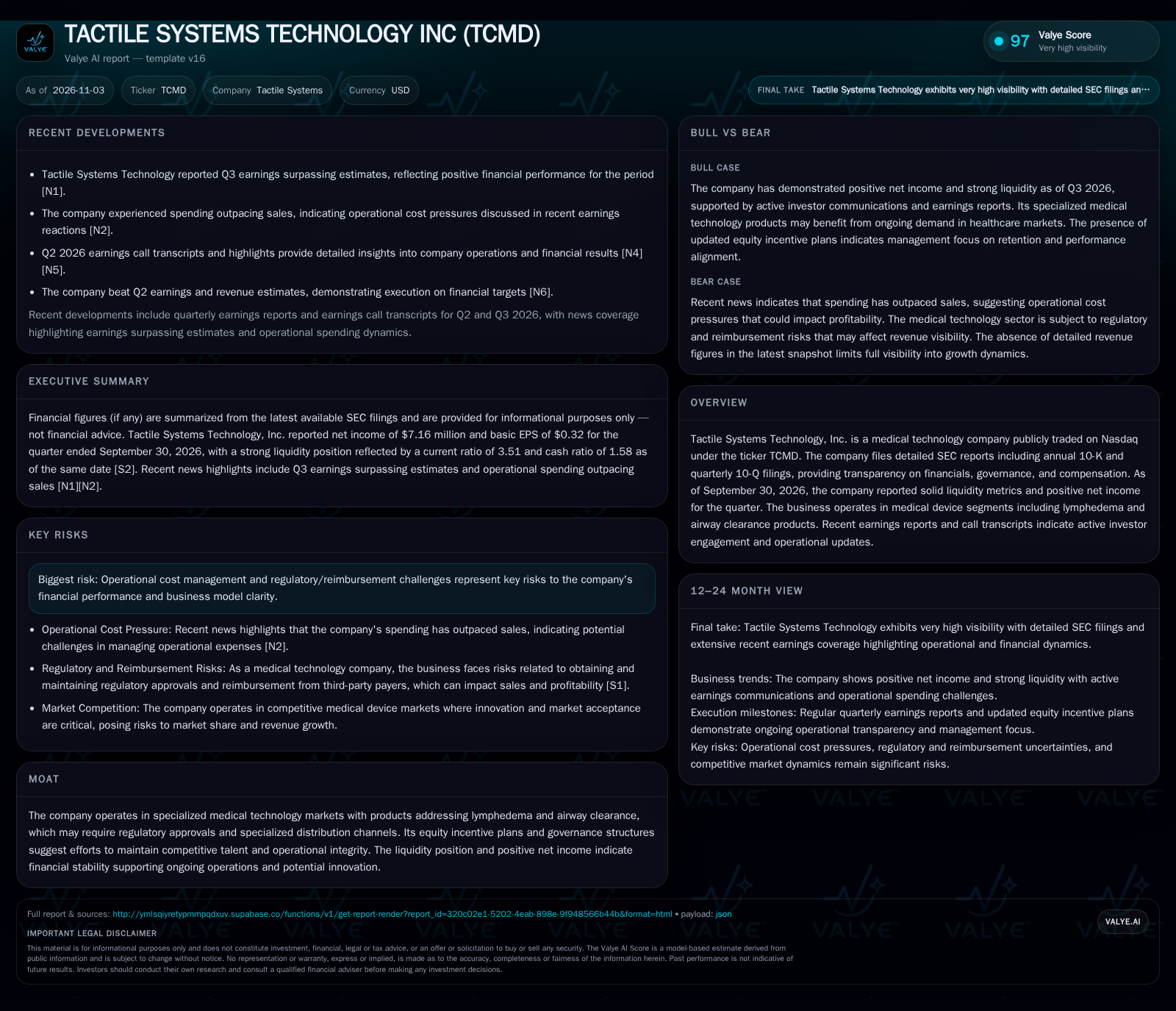
Tactile Systems Technology reported Q3 2026 net income and reported liquidity position, but recent news reveals operational spending rising faster than sales. The company’s medical device focus offers potential for resilient demand, but faces cost management and regulatory risks. Margin trends and the ability to sustain profitable growth are central to the forward thesis. [S2] [N1] [N2]
Tactile Systems Technology stands at a critical juncture: while recent results show the company achieving positive net income and maintaining a reported liquidity position buffer, a pattern of operational spending outpacing sales is raising new questions about business model scalability. As a provider of medical devices for lymphedema and airway clearance, Tactile Systems occupies a specialized segment with inherent barriers but also faces regulatory and cost-management headwinds. The next phase for the company will depend on its ability to balance financial discipline with growth, defend its niche against competitive encroachment, and adapt to shifting healthcare economics.
Profitability Surges, but Cost Growth Signals a New Challenge
Tactile Systems Technology reported a net income of $7.16 million for Q3 2026, with basic earnings per share of $0.32 and diluted EPS of $0.31, marking a period of profitable operations [S2]. The company’s liquidity is reflected by $75.11 million in cash and cash equivalents, a current ratio of 3.51, and a cash ratio of 1.58 as of September 30, 2026 [S2]. However, recent news highlights that operational spending is now outpacing sales, pointing to intensifying cost pressures that could affect future margin trends [N2]. The company’s ongoing focus areas—lymphedema and airway clearance devices—remain foundational, but the evolving cost structure is now a central variable in its outlook.
How Product Mix and Cost Dynamics Shape Financial Outcomes
Tactile Systems’ core revenue streams derive from medical devices targeting chronic conditions—primarily lymphedema and airway clearance. In this sector, revenue is typically driven by a combination of device sales, disposable consumables, and potentially recurring service or support contracts, though the precise mix is not disclosed. Pricing power often hinges on clinical efficacy, reimbursement rates, and the ability to differentiate versus commodity alternatives. If the company’s products are covered by insurance and command premium reimbursement, this can support higher average selling prices and margin stability.
However, the medical device business is capital intensive, with substantial fixed costs in R&D, regulatory compliance, and field sales infrastructure. Operating leverage can be significant: as sales rise, fixed costs may be absorbed over a larger base, expanding margins. Conversely, if spending on sales, marketing, or development rises faster than top-line growth—as recent news suggests—profitability can erode quickly. The company reported cash and liquidity metrics for the period; these figures do not by themselves establish operating runway, investment capacity, financial flexibility, or financing capacity.
Beyond the interplay of fixed and variable costs, the cost structure’s sensitivity to external factors such as supply chain disruptions and raw material price volatility can materially influence financial outcomes. For a company like Tactile Systems, which relies on specialized components and manufacturing processes, even modest increases in input costs or delays can exacerbate margin pressures. This dynamic underscores the importance of operational agility and supplier diversification as mechanisms to mitigate cost inflation risks. Furthermore, the company’s ability to leverage economies of scale hinges not only on volume growth but also on optimizing production efficiency and reducing waste, which can provide incremental margin benefits independent of revenue expansion.
Defensible Niche or Exposed to Substitution? Competitive Realities in Medtech
Tactile Systems operates in a specialized segment of the medical device market, addressing chronic conditions with significant patient impact. This focus can create natural barriers: regulatory approval requirements, clinical validation, and channel relationships with healthcare providers and payers. However, the sector is fiercely competitive. Large diversified medtech firms, as well as emerging device manufacturers, routinely invest in updated technologies and may seek to capture share in niche categories if growth is attractive.
Switching frictions in medical devices can be moderate: once a device is prescribed and covered, patients and clinicians may resist change unless a clear clinical or economic benefit is demonstrated. However, reimbursement changes, new evidence, or aggressive competitor pricing could erode these advantages. Tactile Systems’ ability to update its portfolio, secure continued reimbursement, and deliver measurable patient outcomes will be critical to sustaining its current position.
The competitive landscape in medtech also reflects evolving technological paradigms, including the integration of digital health and remote monitoring capabilities. If Tactile Systems can incorporate such innovations into its product portfolio, it may enhance patient engagement and adherence, thereby strengthening clinical outcomes and payer value propositions. Conversely, failure to keep pace with digital transformation could render its offerings less attractive compared to competitors who provide comprehensive, data-driven solutions. Additionally, partnerships or collaborations with healthcare providers and payers can serve as strategic levers to fortify market position by embedding devices into broader care pathways, increasing switching costs and patient dependency on the company’s ecosystem.
Margin Expansion if Sales Growth Reaccelerates and Cost Control Holds
A favorable outcome would see Tactile Systems leveraging its reported liquidity and recent profitability to accelerate revenue growth while stabilizing or reducing operating expense growth. This could be achieved through successful product launches, expansion into adjacent indications, or deeper penetration of existing healthcare provider networks. If insurance coverage and reimbursement remain stable or improve, and if the company can demonstrate superior clinical outcomes, pricing power may increase, supporting both volume and margin.
Evidence confirming this scenario would include disclosure of accelerating revenue growth that outpaces expense increases, stable or rising gross and operating margins, and continued positive net income across multiple quarters. Announcements of successful reimbursement renewals, new clinical data supporting product efficacy, or expanded distribution agreements would further validate a bullish outlook.
Sustained margin expansion would also depend on the company’s success in managing the product lifecycle effectively. This includes timely introduction of next-generation devices that address unmet clinical needs or improve ease of use, which can justify premium pricing and reduce competitive substitution risk. If Tactile Systems can demonstrate robust real-world evidence supporting superior outcomes, it may unlock additional reimbursement tiers or gain preferential formulary placement. Moreover, operational improvements such as automation in manufacturing or streamlined sales processes could reduce overhead and variable costs, amplifying the margin impact of revenue growth. Strategic investments in these areas, if executed with discipline, would be critical enablers of durable profitability gains.
Sustained Profitability with Ongoing Cost Vigilance
The most plausible trajectory is that Tactile Systems maintains profitability but faces periodic margin pressure as it balances investment in growth with the need to control operating expenses. Revenue may grow at a moderate pace, supported by ongoing demand for existing products, but without clear acceleration unless new products or markets are unlocked.
In this scenario, cost containment becomes a central management focus. The company may moderate R&D or SG&A growth to align with revenue trends, preserving positive net income but limiting upside. Confirmation would come from sequential quarters of modest but stable profits, relatively flat operating margins, and management commentary emphasizing expense discipline and targeted investment.
Profit Erosion if Cost Pressures Persist and Reimbursement Weakens
A negative outcome would occur if operational costs continue to rise faster than revenue, eroding margins and potentially returning the company to net losses. This risk is heightened if the company faces reimbursement cuts, increased price competition, or slower-than-expected adoption of new products. Medtech companies can also face regulatory delays or setbacks that disrupt sales momentum.
This scenario would be confirmed by declining gross or operating margins, negative net income, or warnings about reimbursement headwinds in earnings calls.
Signals to Clarify the Scalability and Defensibility of Tactile Systems’ Business Model
Trends in quarterly revenue growth versus operating expense growth: a useful metric would be the ratio of sales growth to expense growth to test the sustainability of profitability.
Gross and operating margin progression, especially if disclosed by segment or product line, to gauge the impact of cost pressures and pricing dynamics.
Updates on reimbursement coverage and pricing for key products, as changes here could materially shift revenue predictability and margin structure.
Disclosure of new product launches, pipeline advancements, or regulatory approvals that could open new markets or refresh the growth engine.
Evidence of customer retention or recurring revenue, such as renewal rates or proportion of sales from established customers, if disclosed.
Cash burn trends and capital allocation priorities, particularly if operating losses emerge or if investments outpace near-term revenue gains.
Management commentary or strategic actions aimed at cost containment, restructuring, or margin improvement initiatives.
Disclaimer: This is research-only, informational analysis and not investment advice. It may include AI-generated interpretation and general industry context. Always verify important details using primary sources.

Comments