
Acadia Realty Trust: Retail Real Estate in High-Barrier Markets Confronts Margin Pressures and Strategic Crossroads
Recent losses and a reduced FY26 outlook spotlight the tension between Acadia Realty’s high-barrier retail property strategy and the operational, financial, and tenant risks that define the sector’s current environment. The company’s capital flexibility, development activities, and joint ventures offer upside, but execution and external market forces remain critical swing factors.
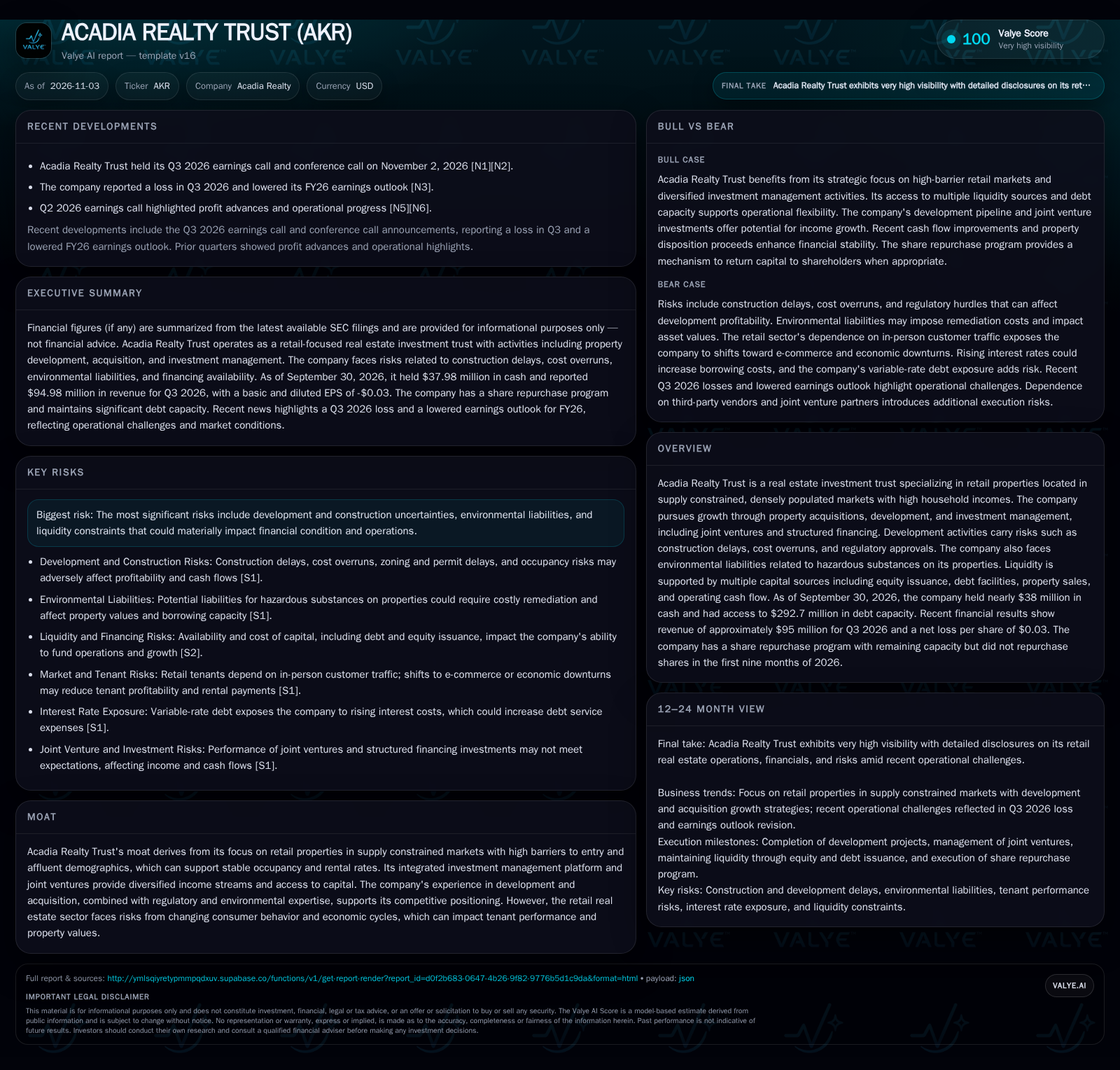
Acadia Realty Trust’s Q3 2026 loss and lower full-year outlook highlight the challenges of executing a retail-focused real estate strategy in supply-constrained, affluent markets. The next phase will test Acadia’s ability to translate property dispositions and joint ventures into sustainable income and value creation. [S2] [N3]
Acadia Realty Trust sits at a pivotal juncture as its strategy of owning and developing retail properties in high-barrier, affluent markets faces new pressures. Q3 2026 results revealed a shift to losses and a downward revision of full-year guidance, underscoring how even well-located retail real estate is not immune to rising costs, tenant volatility, and external headwinds. The company’s ability to navigate development and market risks, while capitalizing on selective growth and capital return opportunities, will shape its trajectory in a sector where both resilience and adaptability are now essential. [S2] [N3]
Recent Losses and Guidance Cut Define the Near-Term Landscape
Acadia Realty Trust reported Q3 2026 revenue of $94.98 million but swung to a net loss per share of -$0.03, marking a reversal from prior period profitability. Management also lowered its FY26 earnings outlook, signaling operational and market headwinds that are affecting near-term performance. The company’s net cash from operating activities grew to $132.5 million year-to-date, while investing cash flow was buoyed by real estate sales and lower acquisition outlays. These developments put a spotlight on the dual challenge of maintaining income stability amid sector volatility and deploying capital effectively to offset cyclical and structural risks. [S2] [N3]
How Acadia’s Retail Portfolio Generates—and Risks—Income
Acadia Realty Trust’s core economics are built on owning, developing, and managing retail properties in supply-constrained, high-income markets. Rental income from these properties is the primary revenue driver, typically governed by multi-year leases that can provide a degree of predictability, though exposure to tenant health and retail trends remains persistent. Development and acquisition activities, including joint ventures and structured financing, are intended to diversify income streams and enhance returns through both rental growth and capital appreciation.
The company’s economics are influenced by the mix of stabilized properties versus assets under development, with the latter carrying greater risk of cost overruns, construction delays, and uncertain lease-up outcomes. Fixed costs—interest, property taxes, and G&A—are significant, so occupancy rates and rent levels are critical levers for operating leverage. Capital needs are ongoing, given the requirements for property repositioning, tenant improvements, and opportunistic acquisitions. Acadia’s ability to recycle capital through dispositions and redeploy into higher-yielding assets or share repurchases (though no buybacks occurred in the first nine months of 2026) can affect both earnings growth and capital efficiency. [S1] [S2]
Interest rate exposure, especially on variable-rate debt, adds another layer of earnings volatility and can compress margins if rates rise faster than rental income can be repriced. Environmental liabilities and regulatory compliance costs can also create unplanned capital requirements, potentially reducing net returns.
Barriers to Entry, Location, and the Shifting Retail Tenant Landscape
Acadia’s competitive strategy is anchored in targeting retail assets in densely populated, affluent, supply-constrained markets—locations where permitting and new development are difficult, supporting higher baseline rents and occupancy. This focus can provide some insulation from oversupply and enable the company to attract higher-credit tenants, but it does not eliminate exposure to the broader structural shifts in retail, such as e-commerce substitution, changes in consumer behavior, and the financial health of brick-and-mortar retailers.
Competitors include both public and private REITs, real estate private equity funds, and local developers, all vying for scarce prime assets. Larger national REITs may benefit from scale, lower borrowing costs, and tenant relationships, while local players may offer agility and market-specific expertise. Acadia’s integrated investment management approach and use of joint ventures potentially expand its capital base and deal flow but also increase complexity and execution risk.
Switching costs for tenants are generally low in the retail property sector, especially in environments where alternative locations exist, though prime locations with high traffic and affluent demographics can partially mitigate this. Ultimately, the company’s ability to maintain or grow rents and retain high-quality tenants will depend on both property-level execution and macro-level retail trends.
Value Creation If Dispositions, Developments, and Tenant Resilience Intersect
A favorable outcome for Acadia would see recent property dispositions recycled into higher-yielding assets, successful lease-up of development projects, and robust tenant performance even amid sector headwinds. If the company can leverage its balance sheet flexibility to opportunistically acquire distressed or undervalued assets in preferred markets, and development execution outpaces cost inflation and regulatory delays, income growth could resume. The joint venture strategy could deliver incremental returns if partners bring capital or expertise that enhances asset value and operating performance.
Confirmation of this scenario would come from sequential improvement in occupancy and same-property net operating income (NOI), stabilization of development projects at or above pro forma rents, and evidence of successfully redeploying disposition proceeds into accretive investments. Sustained or growing operating cash flow, announced lease signings with high-credit tenants, and an upward revision of earnings guidance would further validate the upside case. [S2]
Falsification would be signaled by continued losses, a lack of progress on development lease-up, or evidence that disposition proceeds are not being reinvested in a manner that supports future earnings growth.
Managing Through Cyclical Headwinds with Defensive Capital Deployment
The most plausible trajectory is one where Acadia maintains stable core occupancy and rental rates in its key markets, but faces ongoing margin pressure from development risk, tenant churn, and interest rate volatility. Property dispositions and joint venture income help offset some operational challenges, but new acquisitions and developments are selectively pursued, with capital discipline prioritized over aggressive expansion.
Cash flow from operating activities remains positive, but growth is modest and tied to the pace of successful project completions and tenant performance.
Evidence supporting this scenario would include flat or slightly positive same-property NOI trends, stable or moderately declining occupancy, and continued access to credit and liquidity. A further downward revision of guidance, persistent losses, or a spike in tenant defaults would challenge the base case. [S2] [N3]
If Development, Tenant, and Capital Markets Risks Compound
The adverse scenario materializes if multiple risk factors coincide: major development projects suffer delays or cost overruns, tenant performance deteriorates due to economic downturns or accelerated e-commerce displacement, and capital market conditions tighten, increasing debt costs or limiting refinancing options. Environmental liabilities or regulatory hurdles could trigger unexpected remediation costs or impede asset sales.
In this scenario, same-property NOI declines materially, occupancy rates drop, and the company is forced to sell assets at unfavorable prices to meet obligations or deleverage. Joint venture and structured finance investments underperform, further eroding income and balance sheet strength. Dividend coverage becomes stressed, and management is unable to execute on planned capital return or growth initiatives.
Confirmation would come from a string of quarterly losses, reductions in the dividend, rising leverage, and negative trends in both occupancy and tenant health metrics. Deteriorating capital access or covenant breaches would further signal the downside case. [S2] [N3]
Signals That Will Shape Acadia Realty Trust’s Risk-Reward Profile
Quarterly same-property net operating income (NOI) trends, especially in core high-barrier markets, will help test whether rental growth or margin compression is prevailing.
Occupancy rates and lease renewal spreads, particularly for anchor tenants and high-credit retailers, will illuminate tenant demand resilience.
Progress and cost performance on active development and redevelopment projects, including any disclosed construction delays or overruns, are critical execution metrics.
Pace, pricing, and reinvestment of property dispositions—does capital recycling translate into higher-yielding or more strategic assets?
Debt maturity schedule, interest rate exposure (fixed vs. variable), and refinancing activity—especially as rates remain volatile.
Trends in joint venture and structured finance income, and any impairments or integration challenges reported.
Any material environmental or regulatory events affecting property values, development timelines, or liquidity.
Disclaimer: This is research-only, informational analysis and not investment advice. It may include AI-generated interpretation and general industry context. Always verify important details using primary sources.

Comments