
Odyssey Marine Exploration: Early-Stage Bets, Indirect Stakes, and the Realities of Offshore Mineral Prospecting
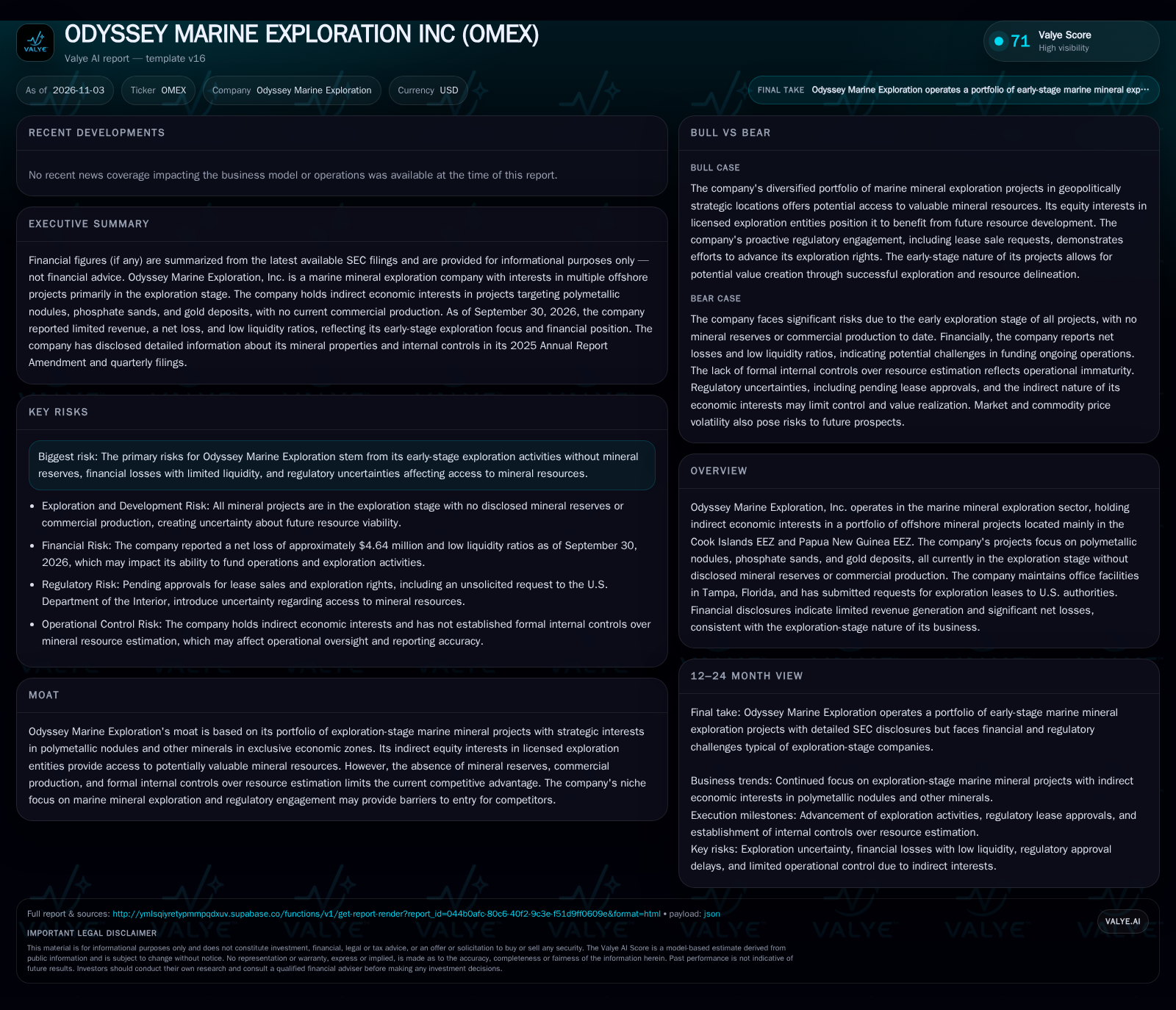
Odyssey Marine Exploration holds minority economic interests in several offshore mineral projects focused on polymetallic nodules, phosphate sands, and gold—none of which have reached the resource or production stage.
Odyssey Marine Exploration holds minority economic interests in several offshore mineral projects focused on polymetallic nodules, phosphate sands, and gold—none of which have reached the resource or production stage. Its business model is highly leveraged to exploration success, partner performance, and the ability to convert exploration rights into producing assets in a complex regulatory environment. [S2]
Odyssey Marine Exploration sits at the speculative end of the marine minerals spectrum: a company with indirect, minority economic interests in a handful of early-stage offshore projects targeting polymetallic nodules, phosphate sands, and gold. There are no proven reserves, no commercial production, and no direct operating control—just the hope that exploration-stage bets transform into future resource rights. For investors and observers, the central question is whether any of these early-stage options can move meaningfully closer to realization before capital constraints force a change in strategy or structure.
Exploration-Stage Stakes and a Tightening Financial Runway
As of September 30, 2026, Odyssey Marine Exploration holds a portfolio of indirect economic interests across several offshore mineral projects, none of which have advanced beyond the exploration stage or disclosed mineral reserves. Its most significant interests include approximately 15.7% in CIC Limited (the CIC Project, Cook Islands EEZ) and 7.0% in Ocean Minerals, LLC (OML Project, Cook Islands EEZ), as well as a majority interest in Bismarck Mining Corporation (Lihir Gold Project, Papua New Guinea EEZ). The company reported $109,000 in revenue for Q3 2026, a net loss of $4.64 million, and cash and equivalents of just $1.14 million against $27.88 million in current liabilities—a current ratio of 0.05. There is no commercial production, and all projects remain in early exploration, with no established mineral reserves or internal controls for resource estimation. Odyssey’s request for a U.S. offshore mineral lease remains pending, underscoring both the regulatory and capital intensity of the marine minerals sector. [S1] [S2]
How Value Could Be Created—and Diluted—in Marine Mineral Exploration
Odyssey’s business economics are fundamentally those of an exploration-stage mineral company with minority, indirect interests. The pathway to value creation relies on identifying, delineating, and eventually developing offshore mineral resources—such as polymetallic nodules or phosphate sands—that could one day command a premium in global commodity markets. However, the company’s lack of direct operating control and its small equity stakes mean future economic upside will be highly diluted unless it can negotiate favorable terms at the development stage.
Revenue at this stage is negligible, with only $109,000 recognized in Q3 2026. Fixed costs—primarily G&A and exploration-related expenses—drive recurring net losses. The lack of commercial production means no operating leverage is currently realized; costs are unlikely to scale materially until and unless a project advances to development. The capital requirements to bring an offshore project from exploration through permitting, feasibility, and into production are immense, often measured in hundreds of millions to billions of dollars. The company reported cash and liquidity metrics for the period; these figures do not by themselves establish operating runway, investment capacity, financial flexibility, or financing capacity.
If a project reaches the reserve and permitting stage, Odyssey’s minority interests could entitle it to a share of future revenues or royalties. However, the timing, magnitude, and certainty of such cash flows remain highly speculative, dependent on successful resource delineation, regulatory approval, and the ability of operating partners to finance and develop the asset. Until then, the business model is structurally cash-consuming with limited near-term visibility.
Niche Positioning in a Crowded, High-Barrier Sector
Odyssey occupies a niche within the broader extractive industries, focusing exclusively on marine mineral exploration in geopolitically sensitive EEZs. Its competitive advantage, if any, rests on early-mover access to promising offshore mineral tracts and the regulatory groundwork laid through lease applications and partner relationships. However, operationally, Odyssey is disadvantaged by its minority, indirect stakes and the absence of control over project progress, technical standards, or capital allocation.
The marine minerals industry is characterized by high entry barriers—namely, the need for specialized technology, substantial capital, and complex regulatory approvals. Larger, better-capitalized mining companies, sovereign-backed ventures, and state-sponsored entities also target offshore resources and could outcompete smaller players once a project demonstrates commercial viability. Substitution risk exists as well: land-based mineral projects, recycling technologies, or shifts in commodity demand (e.g., for battery metals) could undermine the economics of deep-sea mining.
Odyssey’s position as a portfolio holder rather than a direct operator may offer some diversification but also limits its ability to capture outsized returns if a project succeeds. Its moat, such as it is, is largely a function of early access and regulatory engagement, not technical or operational superiority.
Regulatory Wins and Exploration Breakthroughs Could Transform Option Value
The most favorable scenario for Odyssey would involve several reinforcing developments: the granting of a key offshore mineral lease (such as the pending U.S. request), successful delineation of commercial-scale resources by partner operators, and a surge in demand or pricing for targeted minerals. Such outcomes would sharply increase the option value of Odyssey’s minority stakes, potentially enabling the company to monetize its positions through asset sales, farm-outs, or royalty deals.
Falsification would come from continued regulatory inertia, disappointing exploration results, or an inability to secure new funding—each of which would erode the value of Odyssey’s options and likely force asset sales or restructuring.
Continued Cash Burn While Awaiting Regulatory and Partner Progress
The most plausible near-term trajectory is that Odyssey continues to incur net losses and burns cash while its project partners undertake further exploration, subject to regulatory timelines and capital constraints. The company’s role remains largely passive, dependent on external developments for any value inflection. Incremental milestones—such as lease approvals, resource delineation, or preliminary economic studies—may generate periodic bursts of speculative interest but are unlikely to deliver sustained cash flows absent a major breakthrough.
This scenario would be confirmed by ongoing financial disclosures showing persistent net losses, minimal revenue, and recurring fundraising activity (e.g., dilutive equity issuances or convertible securities). Evidence that would challenge this baseline would include the announcement of a major lease approval, a new strategic funding partner, or a shift to majority operating control in a key project.
Liquidity Crunch and Forced Asset Sales If Funding Remains Out of Reach
In this scenario, the company may be forced to sell down its project interests at distressed valuations, accept highly dilutive financing terms, or enter restructuring to address creditor claims.
Confirmation would come from the disclosure of going-concern warnings, asset impairments, or emergency financings at punitive terms. Additional evidence would include the loss of key project rights due to inability to meet funding or work commitments, or the exit of core partners. A mitigating development would be a successful non-dilutive capital raise or a strategic transaction that preserves upside while addressing near-term liquidity needs.
Tracking the Tipping Points for Odyssey’s Marine Mineral Ambitions
The outcome of Odyssey’s pending U.S. Bureau of Ocean Energy Management lease request—any approval, denial, or material update would significantly alter the company’s option value.
Disclosure by project partners of maiden resource estimates or preliminary economic assessments, which would provide the first hard evidence of commercial potential.
Changes in Odyssey’s liquidity position, including new capital raises, strategic investments, or amendments to debt agreements—especially if such transactions are non-dilutive or involve credible industry partners.
Any indications that the company is implementing formal internal controls over mineral resource estimation, signaling operational maturation.
Evidence of project advancement milestones: lease approvals, environmental permits, or the initiation of feasibility studies by operating partners.
Shifts in the regulatory or geopolitical climate affecting access to EEZ mineral rights, particularly in the Cook Islands and Papua New Guinea.
If disclosed, the terms and structure of any future joint ventures, farm-outs, or asset sales—especially as they relate to Odyssey’s economic interests and governance rights.
Sustained ability to meet current liabilities without resorting to asset fire sales or highly dilutive financings—a test of resilience through the next capital cycle.
Disclaimer: This is research-only, informational analysis and not investment advice. It may include AI-generated interpretation and general industry context. Always verify important details using primary sources.

Comments