
IDEXX Laboratories: Recurring Revenue, Platform Expansion, and the Stakes of Diagnostic Innovation
IDEXX Laboratories’ 2025 results highlight robust growth in its core veterinary diagnostics business, with recurring revenues and new instrument placements fueling a 10.4% top-line increase. As margin expansion faces renewed inflationary and competitive pressures, the company’s ability to deepen its installed base, innovate, and defend pricing will shape the next phase of value creation.
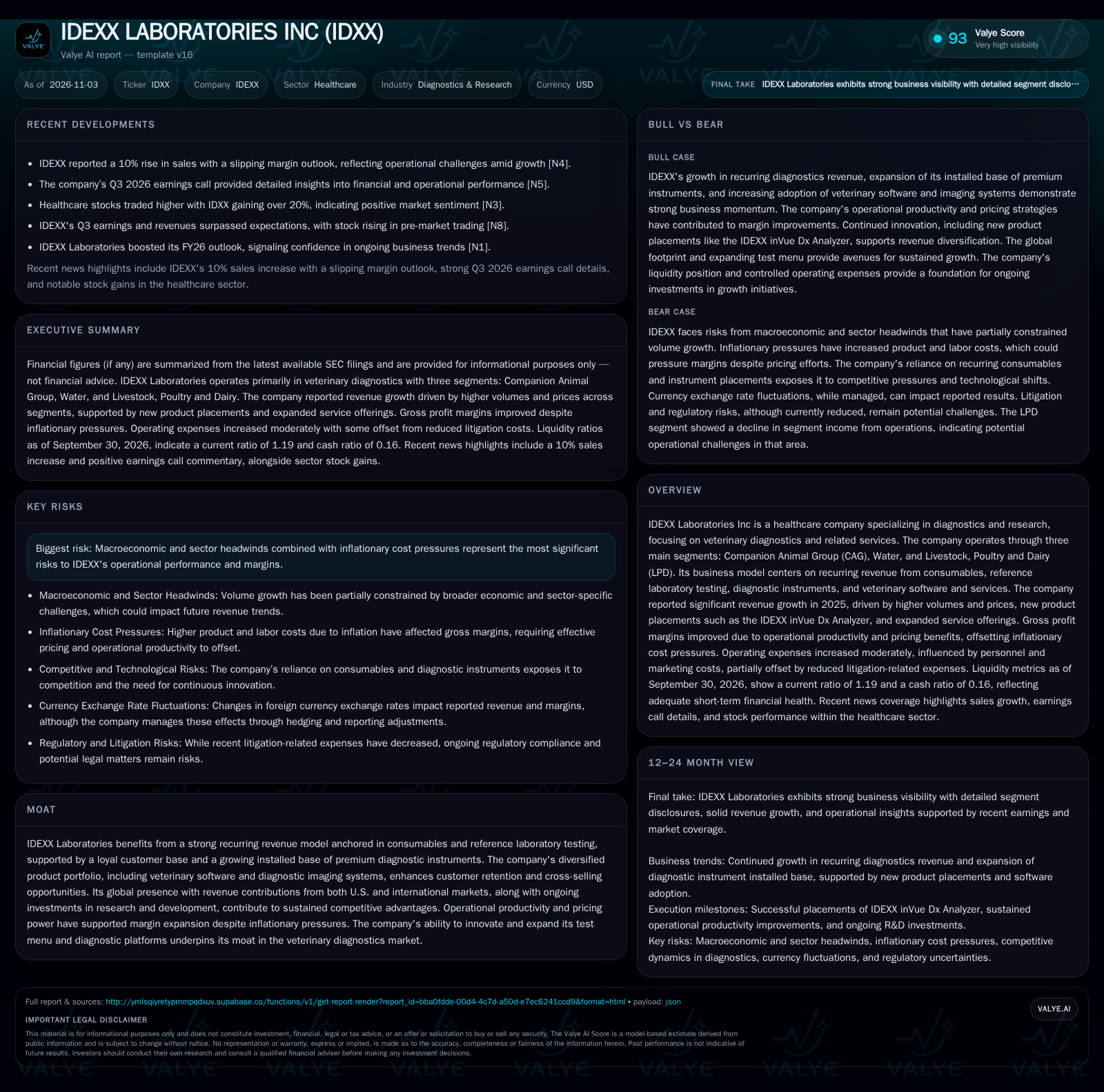
IDEXX Laboratories delivered 10.4% revenue growth in 2025, led by recurring diagnostics, new instrument placements, and higher prices. Gross margin improved to 61.8%, but margin outlook has become more cautious amid rising costs. The company’s business model relies on expanding its premium instrument base and recurring consumables, but faces ongoing inflation, competitive, and macroeconomic headwinds. Execution on new product launches and operational productivity will determine whether IDEXX can sustain its leadership in veterinary diagnostics.
IDEXX Laboratories sits at the intersection of diagnostics, recurring revenue, and veterinary market expansion. Its 2025 performance underscores the strength of its installed base and recurring consumables model, with double-digit revenue growth in core segments and a notable leap in premium instrument placements. Yet, even as gross margins edged higher, the company now contends with renewed cost pressures and a more cautious margin outlook. The central question: can IDEXX continue to leverage innovation and operational scale to defend its moat as competition and inflation intensify?
Recent Growth, Product Placements, and Margin Pressures: What’s Changed for IDEXX?
IDEXX Laboratories reported $4.3 billion in revenue for 2025, representing a 10.4% year-over-year increase and 9.6% organic growth. The Companion Animal Group (CAG) segment, which accounts for the vast majority of revenue, grew 10.6% to $3.95 billion, propelled by recurring diagnostics and a 14.8% jump in VetLab consumables sales. Instrument revenue within CAG soared 51.8%, driven by strong placements of the new inVue Dx Analyzer. Gross margin improved to 61.8%, up 80 basis points, reflecting productivity and pricing gains. However, recent commentary and news coverage have highlighted a slipping margin outlook, as inflationary cost pressures and increased sales and marketing spend begin to offset earlier efficiency gains [S2] [N4].
Liquidity as of September 30, 2026, was marked by $197.5 million in cash and equivalents, a current ratio of 1.19, and a cash ratio of 0.16. The company reported cash and liquidity metrics for the period; these figures do not by themselves establish operating runway, investment capacity, financial flexibility, or financing capacity. [S2]
IDEXX’s stock has responded positively to recent performance, gaining over 20% in sector-wide healthcare trading, but this momentum coincides with a more cautious management tone on margin sustainability [N3] [N4].
How IDEXX Makes Money: Recurring Revenue, Installed Base Leverage, and Margin Dynamics
IDEXX’s core business economics are built around a high-visibility, recurring revenue model. The company sells diagnostic instruments (notably the VetLab suite and the new inVue Dx Analyzer) to veterinary practices, which then generate ongoing demand for proprietary consumables and reference laboratory testing. This creates a razor/razor-blade dynamic: instrument placements expand the captive installed base, which in turn drives steady, high-margin consumables and service revenue.
Software, service, and diagnostic imaging subscriptions further deepen IDEXX’s customer relationships, providing cross-sell and retention opportunities. The company’s pricing power historically stems from a combination of proprietary test menus, integration with practice management software, and the high switching costs associated with diagnostic platforms.
On the cost side, IDEXX benefits from scale in manufacturing and reference lab operations, supporting high gross margins (61.8% in 2025). Operating leverage is achieved as incremental revenue from consumables and services generally outpaces associated variable costs. However, inflation in labor, logistics, and input costs is beginning to erode some of these gains, and recent increases in sales and marketing expenses signal continued investment in growth rather than pure margin expansion [S2] [N4]. IDEXX’s capital needs are moderate, focused on R&D and instrument innovation rather than heavy fixed-asset outlays.
Defending the Moat: Competitive Forces and the Threat of Platform Disruption
IDEXX’s competitive position is anchored by its broad installed base, proprietary test portfolio, and deep integration with veterinary practice workflows. The veterinary diagnostics market has high barriers to entry due to regulatory requirements, customer trust, and the complexity of developing reliable analyzers and assays. However, the market is not immune to disruption. Competitors—ranging from diversified diagnostics conglomerates to nimble, specialized startups—are targeting both hardware and software layers, potentially eroding IDEXX’s pricing power and customer lock-in over time.
The company’s moat is reinforced by switching frictions: once a practice invests in IDEXX’s instruments and integrates its workflow, changing platforms involves retraining staff, managing downtime, and risking diagnostic inconsistency. That said, rapid advances in cloud-based diagnostics, AI-assisted imaging, and telehealth could lower these frictions, especially if new entrants offer open platforms or superior economics.
IDEXX’s global reach and diversified product mix provide some insulation from regional shocks and single-product risks, but the company must continually invest in R&D and customer support to defend its leadership position. Any signs of accelerating customer churn, pricing concessions, or competitive wins in core segments would test the durability of IDEXX’s moat.
Leveraging Installed Base Expansion and Diagnostic Innovation for Sustained Outperformance
The favorable scenario for IDEXX hinges on the company’s ability to grow its installed base of premium analyzers, drive higher utilization of consumables and services, and successfully launch new, differentiated diagnostic platforms. If the inVue Dx Analyzer and future instrument launches maintain strong adoption, IDEXX can further entrench its recurring revenue streams and expand wallet share with existing customers.
Operationally, sustained gains in productivity and effective pricing strategies could offset inflationary pressures, enabling further gross margin expansion. The company’s software and imaging ecosystem, if it delivers tangible workflow and clinical benefits, could raise switching costs and open new subscription revenue streams.
Confirmation of this scenario would come from continued double-digit organic revenue growth, stable or rising gross margins despite cost inflation, further acceleration in instrument placements, and no evidence of meaningful customer churn or pricing concessions. Upside would be further supported by successful international expansion, the addition of higher-value test menus, and evidence that IDEXX’s R&D pipeline is delivering commercially relevant innovation [S2] [N5].
Recurring Revenue Growth Continues, But Margin Gains Moderate Amid Cost Pressures
The most plausible trajectory for IDEXX is continued healthy, if modestly decelerating, revenue growth driven by recurring consumables, reference lab testing, and incremental instrument placements. The installed base expands, but at a slower pace as market penetration rises and competitive intensity increases. Pricing actions partially offset inflation, but gross margin improvement slows or stalls as labor and input costs remain elevated.
Operating expenses continue to rise, reflecting ongoing investment in sales, marketing, and R&D needed to defend market share and support new product launches. While IDEXX maintains its leadership in veterinary diagnostics, the business becomes more sensitive to macroeconomic cycles, competitive encroachment, and regulatory changes.
Evidence for this scenario would include organic revenue growth in the high single digits, stable or slightly compressed gross margins, and a steady cadence of product launches without step-change innovation. Margin commentary from management would remain cautious, with a focus on operational discipline and selective investment in growth initiatives [S2] [N4] [N5].
Margin Compression and Slowing Recurring Growth: When the Model Is Tested
The adverse case materializes if IDEXX faces a combination of sustained inflation, increased competitive pricing pressure, and slower-than-expected instrument placements. Should veterinary practice budgets tighten or alternative diagnostic platforms gain traction, recurring consumable and service revenue could decelerate. In this scenario, IDEXX may be forced to offer discounts or enhanced service terms, directly impacting gross margin and profitability.
Worse, if operational productivity gains stall or input costs accelerate faster than price increases, margin compression could become acute. Regulatory or reimbursement changes, particularly in international markets, could further disrupt growth. Evidence of rising customer churn, stagnant or declining instrument placements, and a marked increase in price-sensitive competition would confirm this scenario.
Such a downside would likely be accompanied by downward earnings revisions, cautious management guidance, and increased scrutiny of IDEXX’s ability to sustain its innovation and service differentiation.
What Will Determine IDEXX’s Next Phase of Value Creation?
Instrument placement growth rate—especially for the inVue Dx Analyzer and next-generation platforms—if disclosed, would reveal the strength of IDEXX’s installed base expansion.
Recurring consumables and reference lab revenue growth, particularly same-practice growth rates, would help test the resilience of the core recurring model.
Gross margin trajectory: sustained expansion, stabilization, or compression will indicate IDEXX’s ability to offset inflation and defend pricing.
Evidence of customer churn or retention rates—if disclosed—would illuminate competitive threats and switching frictions.
Pricing realization metrics: the extent to which IDEXX can pass through cost increases without sacrificing volume or customer loyalty.
Operating expense growth relative to revenue: rising sales, marketing, and R&D spend could signal either healthy investment or margin pressure.
New product launch cadence and early adoption rates would demonstrate R&D productivity and the ability to defend or expand the moat.
International revenue contribution and segment performance, especially in Water and LPD, would indicate the breadth and vulnerability of IDEXX’s growth drivers.
Disclaimer: This is research-only, informational analysis and not investment advice. It may include AI-generated interpretation and general industry context. Always verify important details using primary sources.

Comments