
Unitil’s Regulated Utility Model: Decoupling, Seasonality, and the Stakes of Capital Discipline
Unitil operates as a regulated utility distributing electricity and natural gas to over 215,000 customers in New England, with revenue decoupling in key markets reducing exposure to sales volume swings.
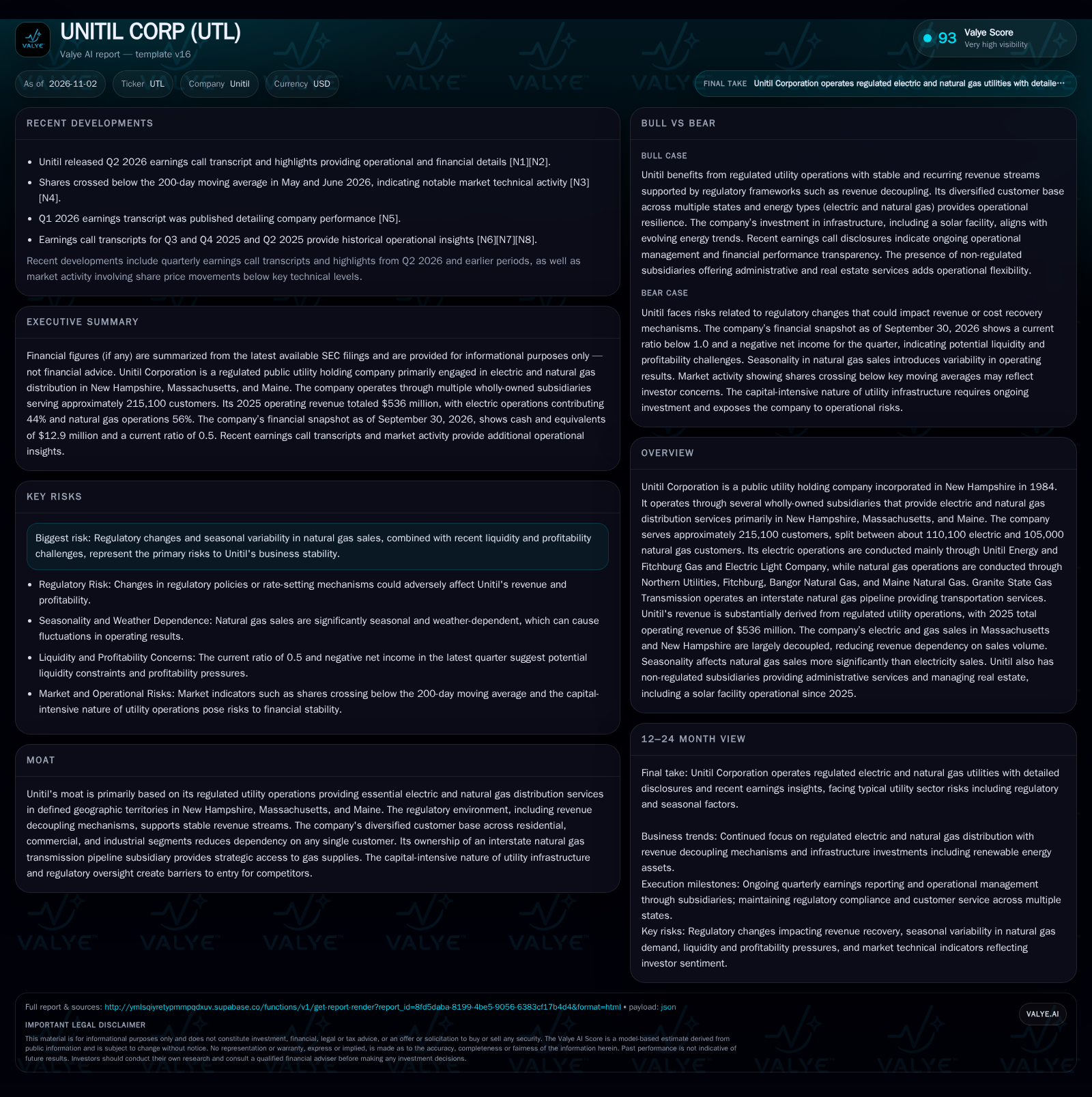
Unitil operates as a regulated utility distributing electricity and natural gas to over 215,000 customers in New England, with revenue decoupling in key markets reducing exposure to sales volume swings. The company’s business model relies on regulatory frameworks, capital-intensive infrastructure, and gradual adaptation to renewable trends. The outlook hinges on regulatory outcomes, cost recovery, and the ability to manage capital and seasonal demand cycles effectively. [S1] [S2]
Unitil Corporation exemplifies the strengths and strains of a small-cap regulated utility in New England. Its core business—electricity and natural gas distribution—benefits from stable, regulated revenue and decoupling mechanisms that buffer the impact of weather and demand swings. Yet the company’s latest financials show a squeeze: negative net income in the third quarter of 2026 and a current ratio well below 1.0. This juxtaposition highlights the delicate balance between capital-intensive operations, regulatory support, and the need for disciplined cost management. As Unitil invests in infrastructure and renewables, its success will depend on navigating regulatory reviews, managing seasonality, and securing cost recovery in an evolving energy landscape.
Recent Financial Results Spotlight Liquidity and Profitability Pressures
As of September 30, 2026, Unitil reported cash and equivalents of $12.9 million, current assets of $198.8 million, and current liabilities of $394.7 million, resulting in a current ratio of 0.5 and a cash ratio of 0.03. Net income for the quarter was negative $1.5 million, with basic and diluted EPS of -$0.08. These figures signal short-term liquidity constraints and raise concerns about operational profitability. While the company’s 2025 revenue base of $536 million underscores the stability provided by regulated utility operations, the current financial snapshot suggests that Unitil’s ability to absorb shocks, fund ongoing capital needs, and maintain potential financial flexibility is under pressure. The company’s shares crossing below the 200-day moving average in mid-2026 further reflect market nervousness around these financial dynamics. [S1] [S2] [N3] [N4]
Regulated Revenues, Decoupling, and the Economics of Capital-Intensive Distribution
Unitil’s business model is anchored in the regulated local distribution of electricity and natural gas, with 2025 operating revenue split 44% electric ($236.4 million) and 56% gas ($299.6 million). Gross margins are structurally higher in gas operations ($142.3 million GAAP, $199.1 million adjusted) than electric, reflecting regulatory mechanisms and the capital intensity of pipeline and distribution assets. The company’s revenue in Massachusetts and New Hampshire is largely decoupled from sales volume, meaning that distribution revenue is set by regulators to recover costs and a fair return, regardless of short-term demand swings. This reduces sensitivity to weather and economic cycles, but also means upside is capped unless allowed returns or rate base investments increase. Seasonality, especially in gas, drives earnings volatility, with colder quarters yielding higher revenue and profit contribution.
The capital-intensive nature of utility infrastructure is evident in Unitil’s net utility plant investment of $1.8 billion at year-end 2025. This creates high fixed costs and requires ongoing regulatory approval for cost recovery and return on capital. Non-regulated subsidiaries, including administrative services and a solar facility, provide marginal diversification but do not materially alter the fixed/variable cost mix. Funding needs are persistent, and operating leverage is limited by regulatory rate-setting, making disciplined capital allocation and cost control pivotal for sustainable returns.
Regulatory Barriers, Geographic Focus, and the Limits of Differentiation
Unitil operates in a sector where competition is largely constrained by regulatory allocations of service territory. The company’s primary moat is its monopoly over electric and natural gas distribution within its assigned regions in New Hampshire, Massachusetts, and Maine. Regulatory frameworks, including revenue decoupling and cost-of-service ratemaking, provide stability but also limit pricing power and innovation. The customer base is diversified across residential, commercial, and industrial segments, reducing concentration risk.
Threats to Unitil’s position are more likely to come from regulatory shifts (such as changes to allowed returns or decoupling mechanisms), new energy policies, or long-term technological substitution toward distributed generation and electrification that could erode natural gas demand. The capital intensity and complexity of utility infrastructure remain a high barrier to entry for would-be competitors, but also constrain the pace at which Unitil can adapt its portfolio to new energy trends.
If Regulatory Stability Persists and Rate Base Grows, Margin Expansion Is Possible
A favorable scenario for Unitil rests on continued regulatory stability, allowing the company to expand its rate base through ongoing infrastructure investments (including renewables and grid modernization) and to consistently recover costs plus a fair return. If decoupling mechanisms remain robust and regulators support timely rate case outcomes, Unitil could see gradual margin expansion—particularly if it manages to control operating costs and leverages efficiency gains from new technology or administrative scale.
Evidence of this scenario would include positive rate case outcomes, stable or improving allowed returns on equity, and rising adjusted gross margins. Sustained investment in renewables or grid upgrades, with associated cost recovery, would further confirm the thesis. Falsification would come from adverse regulatory rulings, delayed cost recovery, or political pressure to limit rate increases, any of which would compress margins and reduce returns.
Stable Operations with Earnings Volatility from Seasonality and Cost Recovery Timing
The most plausible outlook sees Unitil maintaining its core regulated utility operations with moderate rate base growth and recurring earnings, punctuated by seasonal swings in natural gas demand and periodic earnings volatility tied to the timing of rate case outcomes and infrastructure investments. Decoupling mechanisms continue to provide revenue stability in electric and gas distribution, but overall profitability remains sensitive to cost inflation, regulatory lag, and the capital costs of ongoing infrastructure needs.
This scenario would be confirmed by a pattern of stable revenues, periodic but not persistent negative quarters (reflecting seasonality), and regulatory filings showing a constructive relationship with state commissions. It would be challenged by evidence of accelerating cost pressures, persistent negative net income, or a deterioration in regulatory support for full cost recovery.
Adverse Regulatory or Market Shifts Could Expose Liquidity and Earnings Risk
Confirmation of this scenario would include sustained negative earnings, deterioration in credit metrics (if disclosed), regulatory filings indicating contested or adverse rate cases, or forced asset sales and capital expenditure reductions. Evidence to the contrary would be a quick return to profitability and stable cash metrics despite external shocks.
Upcoming Evidence That Could Shift the Unitil Thesis
The outcome and timing of major rate cases in Unitil’s key jurisdictions—clear regulatory approvals for cost recovery and allowed returns would support the bull case; adverse or delayed outcomes would challenge it.
Quarterly trends in adjusted gross margin (electric and gas), if disclosed, to assess the underlying profitability of core operations net of pass-through costs.
Net utility plant growth, reflecting ongoing infrastructure investments and the company’s ability to expand its rate base.
Earnings seasonality: quarterly net income trends, especially in shoulder periods, to test whether losses are transient or structural.
Updates on the solar facility and other renewable investments, including regulatory treatment and cost recovery status.
Any announced changes to state regulatory frameworks affecting decoupling, cost-of-service ratemaking, or allowed returns.
Customer growth or attrition in electric and gas segments, if disclosed, as a leading indicator for long-term demand and rate base health.
Disclaimer: This is research-only, informational analysis and not investment advice. It may include AI-generated interpretation and general industry context. Always verify important details using primary sources.

Comments