
Safeguard Acquisition Corp.: The Economics, Trade-offs, and Execution Stakes of a SPAC’s Pre-Combination Phase
Safeguard Acquisition Corp. has completed its IPO and is now in the critical phase of evaluating targets, with a capital structure shaped by founder incentives, warrant complexity, and the ticking clock of the SPAC model. The next steps will test whether its structure and sponsor alignment can deliver value or expose shareholders to dilution and execution risk.
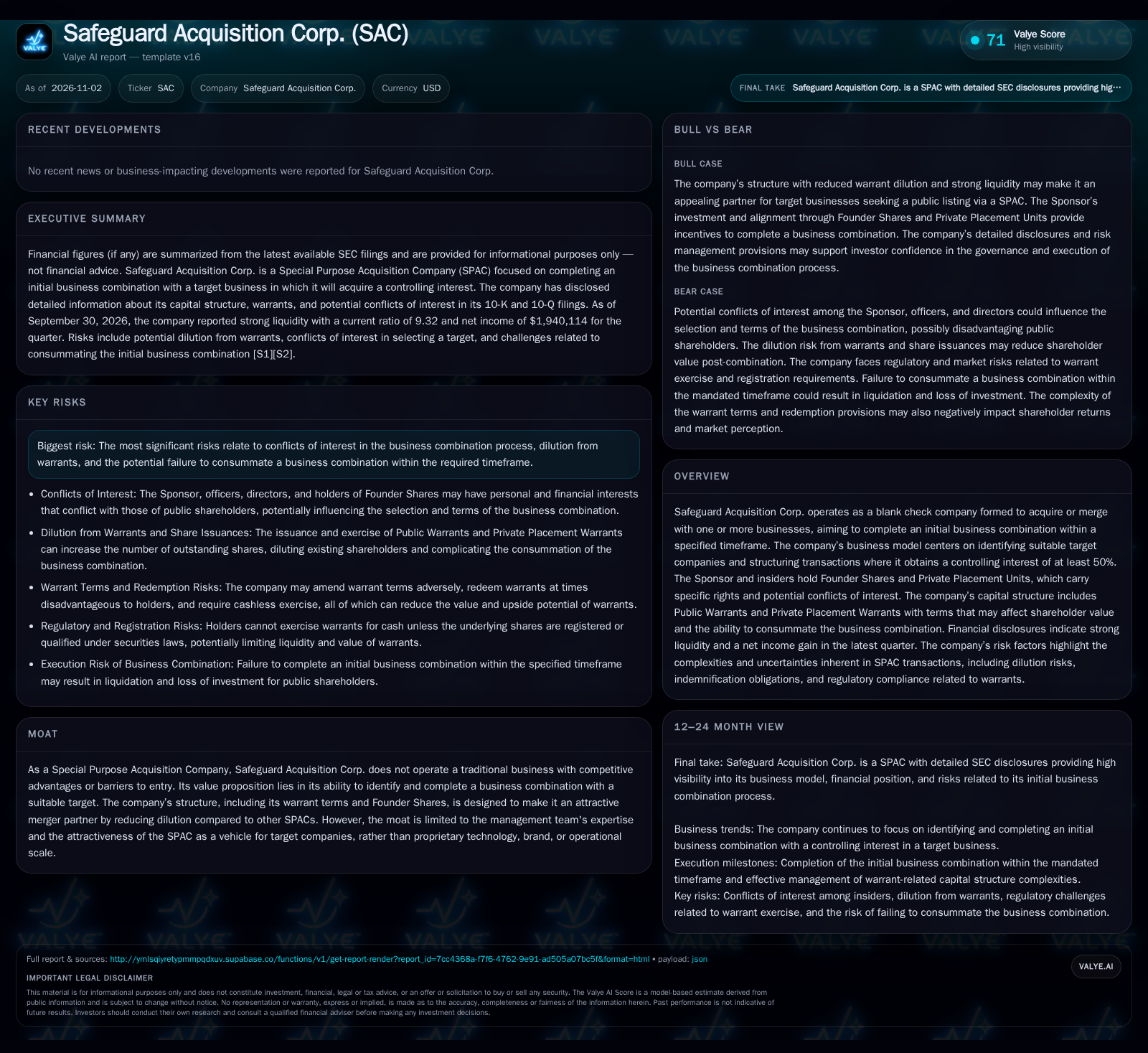
Safeguard Acquisition Corp. is a newly listed SPAC with over $230 million raised and strong current liquidity, but it faces the typical SPAC trade-offs: sponsor incentives, warrant-induced dilution, and a limited timeframe to complete a business combination. The outcome will depend on the quality of the target, deal terms, and management’s ability to balance shareholder interests against structural risks and regulatory hurdles. [S2]
Safeguard Acquisition Corp. (SAC) is a blank-check company now in the most consequential phase of its lifecycle: the hunt for a merger partner. With $230 million raised in its December 2025 IPO and a current ratio north of 9 as of September 2026, SAC is well capitalized for dealmaking. However, the clock is ticking—SPACs have a fixed window to consummate a business combination or face liquidation. The outcome for public shareholders will hinge not just on the quality of the eventual target, but also on how SAC’s sponsor, warrant structure, and regulatory navigation shape the economics and governance of the merger. [S2]
What SAC’s Capital Structure and Timeline Reveal About Its Strategic Position
Safeguard Acquisition Corp. completed its IPO on December 5, 2025, raising $230 million to pursue a merger or acquisition, and as of September 30, 2026, reports current assets of $1,032,321 against current liabilities of $110,801—a current ratio of 9.32. The company’s net income of $1.94 million for the recent quarter is derived entirely from interest on trust account investments, not from operations. No business combination target has been selected or announced, and all substantive activity remains focused on evaluating potential deals. The capital structure includes founder shares issued at a deep discount, private placement units, and both public and private warrants, each with terms that could affect shareholder value and deal execution. These facts set the stage for SAC’s next phase: either securing a compelling target under favorable terms or facing the risks of dilution, deal failure, or liquidation if the clock runs out. [S2]
How the SPAC Model Shapes Incentives, Dilution, and Economic Outcomes
Safeguard Acquisition Corp. does not generate operating revenue prior to a merger; its current earnings are from interest on trust account funds, which are restricted and cannot be used for ongoing operations. The central economic mechanism is the pursuit of a business combination that creates value for public shareholders—primarily through the potential appreciation of the combined entity’s shares post-merger.
The economics are shaped by several levers: sponsor and founder share incentives, which can lead to significant dilution for public shareholders if the combination is not accretive; warrant structures that, if exercised, can further increase share count and dilute equity; and the sunk costs of SPAC operations (legal, audit, due diligence) that are borne regardless of deal outcome. Fixed costs are relatively low until a deal is pursued, after which due diligence and transactional expenses can spike. The capital raised is largely sequestered in the trust until a deal closes or the SPAC is liquidated, limiting operating flexibility but preserving principal for redemption.
Operating leverage is minimal in the pre-merger phase, but post-merger, the economics swing to those of the acquired business. The structure incentivizes the sponsor to complete a deal—any deal—within the allotted timeframe, which can create misalignment with public shareholders if the sponsor’s economics are driven by founder shares and warrants rather than long-term value creation.
SPAC Market Dynamics: Competing for Targets and Navigating Regulatory Complexity
Safeguard Acquisition Corp. competes in a crowded SPAC market where sponsor reputation, deal structure, and alignment with targets are key differentiators. Unlike traditional operating companies, SPACs do not compete on product or service, but rather on their attractiveness as a public listing vehicle for private companies. SAC’s value proposition is shaped by its warrant terms, founder share structure, and the perceived ability of its sponsor team to source and execute a high-quality deal.
Counterforces include the glut of SPAC capital chasing a finite pool of attractive targets, rising regulatory scrutiny of SPAC transactions (especially around disclosures and conflicts of interest), and target companies’ alternative options—such as direct listings, traditional IPOs, or strategic sales. The complexity of SAC’s warrant and redemption provisions may deter some targets or complicate shareholder approval. Peer SPACs with less dilutive structures or more prominent sponsor teams may have a competitive edge in securing premium targets.
Sponsor-Target Alignment Drives a High-Quality, Accretive Business Combination
The most favorable scenario is one in which SAC leverages its capital, sponsor network, and relatively transparent structure to secure a high-growth, well-governed private company eager to access public markets. If the sponsor’s incentives are aligned with public shareholders—minimizing dilution and structuring warrants to reduce overhang—the resulting merger could drive significant share appreciation and attract long-term investors.
Evidence that would confirm this scenario includes the announcement of a target with robust financials, a credible growth plan, and limited need for additional equity capital post-merger; clear, investor-friendly deal terms with manageable dilution; and positive market reception to the business combination proposal. A low redemption rate by public shareholders at the time of the vote would also signal confidence in the deal.
Deal-Making Under Pressure: Typical Dilution, Mixed Shareholder Reception, and Regulatory Friction
The most likely outcome is that SAC identifies a viable but not marquee target, structures a deal with the standard suite of founder shares and warrants, and faces the typical SPAC trade-offs: moderate-to-high shareholder redemptions, some dilution, and a period of post-merger volatility as the market digests the combined entity’s prospects. Regulatory compliance around warrant registration and shareholder approval adds friction and could delay closing.
Confirmation of this scenario would look like a deal announcement with a mid-market private company, a proxy statement disclosing moderate dilution from warrant exercise and founder shares, and a redemption rate in line with recent SPAC transactions. If the stock trades near or slightly below the $10 trust value post-merger, it would suggest the market views the deal as fair but not transformational.
Clock Runs Out or Poorly Structured Deal Triggers Liquidation or Value Destruction
The adverse scenario is that SAC fails to secure an acceptable target within the mandated timeframe, leading to liquidation and the return of trust proceeds to shareholders—minus expenses. Alternatively, a deal is rushed near the deadline, with excessive dilution from founder shares and warrants, or the target’s fundamentals disappoint, resulting in sharp post-merger share price decline and high redemptions.
Signs of this scenario would include repeated deadline extensions, a last-minute or speculative target announcement, shareholder resistance to the deal structure, and a high percentage of redemptions. If the warrant terms are amended adversely or regulatory issues delay or block the transaction, the risk of liquidation or long-term value impairment rises.
Milestones That Will Determine Whether SAC Creates or Erodes Shareholder Value
Announcement of a definitive business combination agreement, including target identity, sector, and financial metrics.
Disclosure of the pro forma capital structure post-merger, especially the projected dilution from founder shares and warrant exercise (if disclosed).
Redemption rates by public shareholders at the time of the merger vote, as a proxy for deal quality and investor confidence.
SEC effectiveness of the registration statement for shares underlying warrants—a required step for cash exercise and full value realization.
Any amendments to warrant terms, especially related to exercise price, redemption triggers, or cashless exercise provisions.
Sponsor or insider participation in PIPE (private investment in public equity) financing, if any, as a potential signal of alignment.
Regulatory or shareholder challenges to the proposed deal structure, which could delay or jeopardize consummation.
Disclaimer: This is research-only, informational analysis and not investment advice. It may include AI-generated interpretation and general industry context. Always verify important details using primary sources.

Comments