
Boston Scientific: Innovation Depth, Operational Shocks, and the Stakes of Restoring Momentum
Boston Scientific’s broad-based product pipeline and global reach underpin its multi-segment growth ambitions, but the 2026 cybersecurity incident and manufacturing concentration have exposed material operational vulnerabilities. The company’s ability to translate restructuring, R&D investment, and post-incident stabilization into sustained growth will define its next phase.
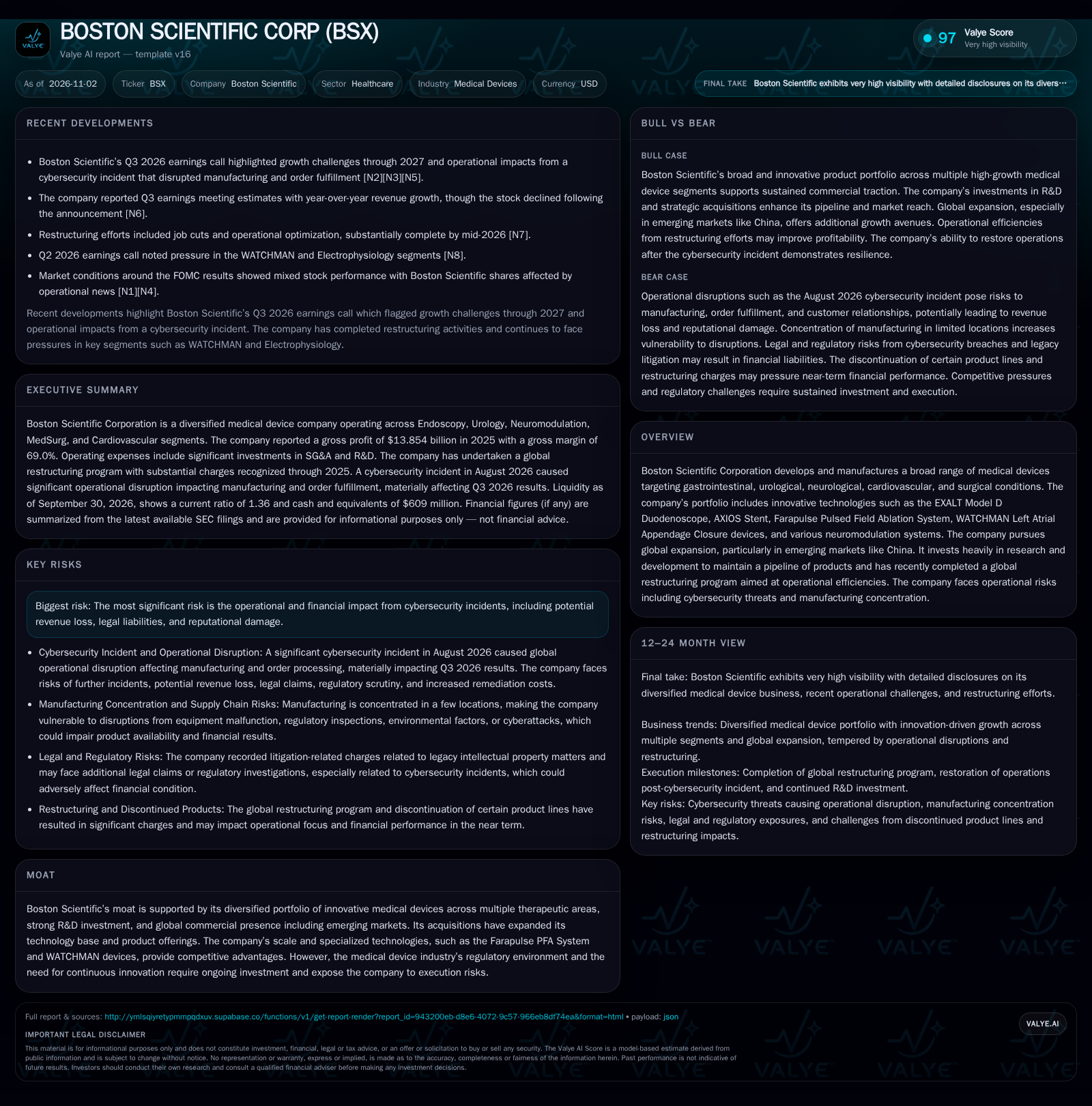
Boston Scientific’s diversified medical device portfolio supports its long-term growth strategy, but the August 2026 cybersecurity breach caused significant operational disruption and highlighted the risks of concentrated manufacturing. While restructuring is largely complete, ongoing pressure in key segments and the need for robust cybersecurity and operational redundancy will be critical to regaining momentum and defending market share. [S2] [N2] [N3] [N5] [N8]
Boston Scientific stands at a strategic crossroads: its reputation for innovation and a diversified product portfolio has enabled multi-segment growth, but the August 2026 cybersecurity incident delivered a stark reminder of execution and resiliency risks. As the company emerges from a global restructuring and works to stabilize operations, the interplay of operational discipline, R&D productivity, and market responsiveness—particularly in pressured cardiovascular franchises—will determine whether it can sustain leadership or cede ground to nimble competitors. With manufacturing still concentrated and cybersecurity risk now front and center, the next 12-24 months will test both the depth and agility of Boston Scientific’s business model.
Cyberattack Fallout and Operational Recovery: Where Boston Scientific Stands Now
Boston Scientific’s August 2026 cybersecurity incident triggered global disruption across manufacturing, order processing, and shipments, leading to a material negative impact on Q3 results and raising the specter of revenue loss, market share erosion, and regulatory scrutiny. Operations have since been restored, but the company cautions that residual risks remain, especially as some processes are still handled manually post-incident. Manufacturing remains concentrated in a handful of locations, heightening exposure to both IT and physical disruptions. Concurrently, a global restructuring program—substantially complete by end of 2025—has resulted in significant job cuts and operational changes, with $668 million in restructuring charges recorded in 2025. The company’s liquidity as of September 2026 included $609 million in cash and a current ratio of 1.36, but the true test will be whether stable operations and cash flows can be sustained post-crisis. [S2] [N2] [N3] [N5] [N7]
The Economics of Scale, Innovation, and Margin Tension in Medical Devices
Boston Scientific’s gross margin of 69.0% in 2025 reflects the company’s ability to commercialize high-value, specialized devices across endoscopy, urology, neuromodulation, and cardiovascular segments. This margin profile is typical for leading medical device franchises, where R&D-driven differentiation could support premium pricing, especially for novel therapies like the Farapulse Pulsed Field Ablation System or WATCHMAN devices. However, the model is capital intensive: in 2025, SG&A consumed 34.3% of net sales and R&D 10.2%, underscoring the ongoing need for investment in sales infrastructure, regulatory approvals, and innovation cycles. Fixed costs are significant, but operating leverage can be realized if top-line growth resumes and manufacturing utilization normalizes post-incident. Restructuring is intended to reset the cost base, but near-term benefits may be offset by the costs of remediating cyber vulnerabilities and potential legal liabilities. [S1] [S2]
Defending Share in a Crowded, Regulated, and Rapidly Evolving Device Landscape
Boston Scientific’s core advantage lies in its broad and innovative product portfolio, spanning multiple high-value therapeutic areas. This breadth enables cross-selling and reduces reliance on any single device or indication. The company’s scale, global reach—especially in emerging markets like China—and deep R&D pipeline are structural strengths. Yet, competition is intense: large diversified device peers, focused cardiovascular and neuromodulation specialists, and new entrants with disruptive technologies all vie for share in each segment. Regulatory hurdles and hospital procurement dynamics create moderate switching frictions, but price-based competition and clinical outcome data remain decisive. Segment-specific risks are rising: the WATCHMAN and Electrophysiology portfolios have come under pressure, both from alternative device platforms and evolving procedural standards. The cybersecurity incident exposes a further vulnerability, as customers and regulators may scrutinize operational reliability and data integrity more closely, potentially impacting preference and contract renewals. Acquisition-driven expansion has bolstered Boston Scientific’s portfolio but also increases integration and execution risk in a sector where clinical validation and reimbursement can lag innovation.
If Resilience and Innovation Reassert Leadership: What a Stronger Boston Scientific Could Look Like
A bullish outcome would see Boston Scientific leveraging its completed restructuring and restored operations to drive renewed commercial momentum. If the company can demonstrate robust cybersecurity controls and recover customer trust, it could defend and expand share in core segments—especially if new product launches in endoscopy, urology, or neuromodulation gain rapid clinical adoption. Sustained R&D productivity, combined with successful integration of recent acquisitions (such as Axonics), may yield pipeline wins that offset pressure in mature cardiovascular franchises. Margin expansion could follow from improved manufacturing efficiency, higher utilization rates, and a mix shift toward next-generation, higher-margin devices. The key confirming evidence would be a return to pre-incident revenue growth rates, stabilization or improvement in WATCHMAN and Electrophysiology sales, and a reduction in extraordinary costs related to cybersecurity and restructuring. Early signs could include positive hospital purchasing trends and new regulatory approvals. Conversely, continued customer losses or product launch delays would falsify this scenario.
Normalization with Persistent Frictions: Navigating a Post-Incident Recovery
The most plausible trajectory is that Boston Scientific stabilizes operations over the next 12-24 months, but growth remains muted as the company absorbs lingering effects of the cybersecurity breach and restructuring. Manufacturing and supply chain normalization may take several quarters, with some operational inefficiencies persisting due to interim manual processes. Core segments likely see mixed performance: innovation and emerging market sales provide some offset to ongoing pressure in WATCHMAN and Electrophysiology. Operating margins are constrained by higher cybersecurity costs, compliance investments, and selective R&D reprioritization. Confirmation would come from sequential improvement in operational metrics, limited customer attrition, and controlled expense growth. If the company faces additional regulatory actions, large legal settlements, or repeated operational disruptions, the base scenario risks morphing into a more negative outcome.
When Operational Vulnerabilities Compound: How Boston Scientific Could Lose Ground
The bear case unfolds if Boston Scientific faces additional operational shocks—whether from further cyberattacks, regulatory findings, or supply chain disruptions—before restored trust and efficiency can take hold. Prolonged manual remediation could lead to lost sales, customer defections, and reputational damage, especially as hospital systems and group purchasing organizations place greater weight on reliability and data security. If pressure in key cardiovascular franchises accelerates and new product launches fail to compensate, revenue growth could stall or reverse. Rising litigation and compliance costs, coupled with reported cash balance, might force the company to curtail R&D or delay strategic investments, weakening its competitive position. Confirmation would include a material decline in segment sales, further margin compression, increased legal or regulatory expenses, and negative working capital trends. A visible loss of market share in flagship device categories or persistent operational bottlenecks would further validate the downside.
Thesis-Defining Developments to Track for Boston Scientific
Quarterly revenue and margin trends in the WATCHMAN and Electrophysiology segments, as these are under the most competitive and pricing pressure. [N8]
Evidence of customer retention or defection post-cybersecurity incident—hospital system renewals, contract wins/losses, or new purchasing decisions would help test the resilience of Boston Scientific’s commercial relationships.
Update frequency and substance of cybersecurity disclosures: new incidents, remediation progress, external audits, or regulatory findings would be critical signals.
Manufacturing uptime and supply chain normalization metrics, if disclosed—especially the transition from manual to automated processes post-incident.
R&D pipeline milestones: regulatory approvals, major clinical trial readouts, or successful launches in high-margin categories would confirm innovation-driven growth.
Cash flow from operations and working capital trends, as these are more indicative of underlying business health than static cash ratios.
Any further restructuring, facility consolidation, or asset divestitures—these could signal either renewed efficiency or ongoing operational stress.
Emerging market sales growth, particularly in China, as a test of the company’s global expansion thesis.
Disclaimer: This is research-only, informational analysis and not investment advice. It may include AI-generated interpretation and general industry context. Always verify important details using primary sources.

Comments