
TETRA Technologies: Specialty Fluids Growth, Low-Carbon Bets, and the Execution Stakes of the Arkansas Bromine Project
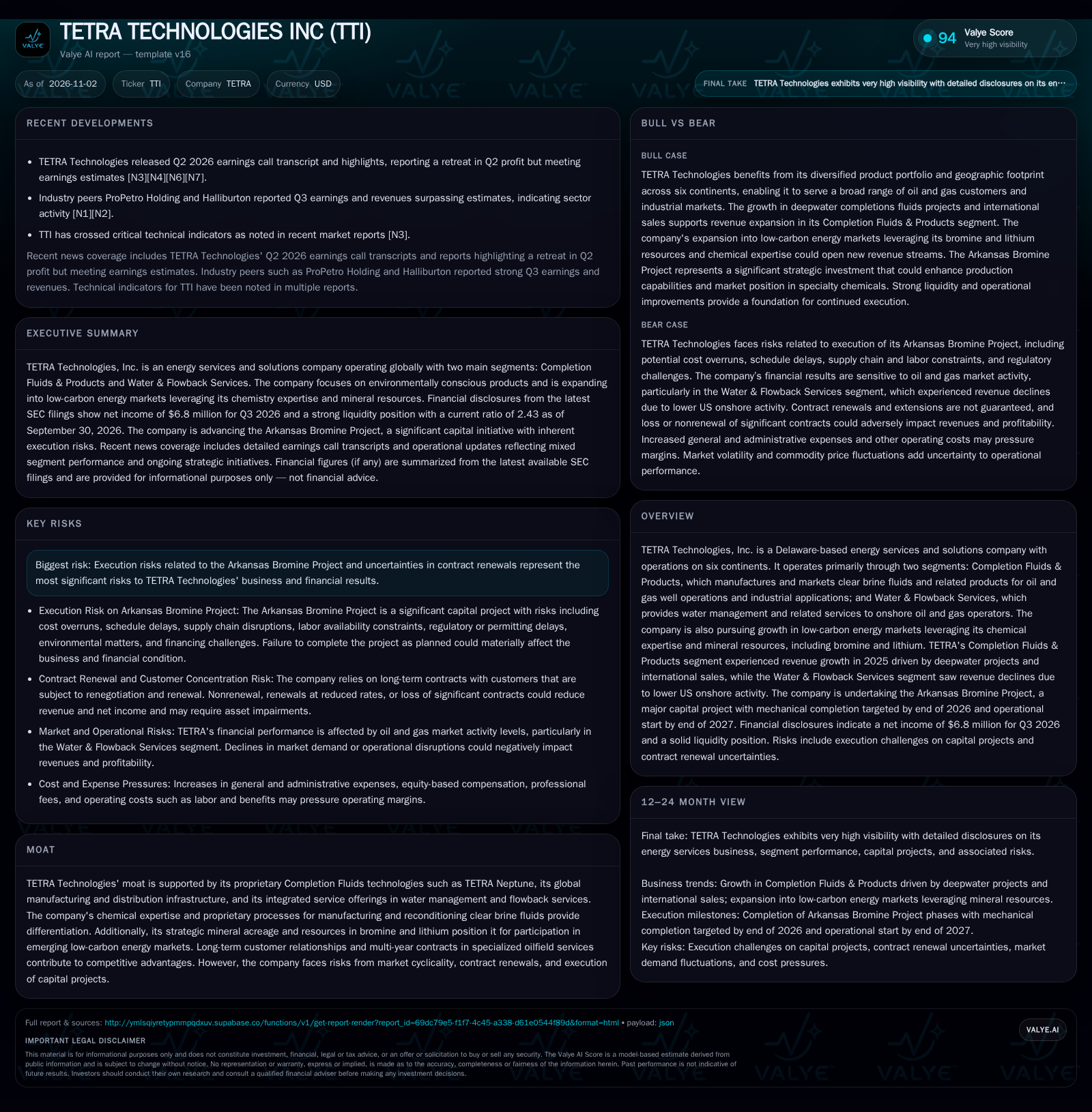
TETRA Technologies’ near-term outlook is defined by strong momentum in its Completion Fluids & Products segment and a strategic expansion into low-carbon energy materials. However, the company’s Arkansas Bromine Project introduces significant execution risk and capital demands, making operational discipline and contract renewal dynamics critical to sustaining and scaling value.
TETRA Technologies is gaining from robust deepwater fluids demand and international expansion but faces headwinds in its Water & Flowback Services segment and must successfully execute the Arkansas Bromine Project to unlock new specialty chemicals growth. [S2]
TETRA Technologies stands at a strategic inflection point: the company’s legacy strengths in specialty oilfield fluids and international reach are driving segment growth, especially in deepwater projects, even as US onshore water services remain pressured by cyclical energy markets. The Arkansas Bromine Project represents a bold move into high-value, low-carbon materials, but its success depends on navigating complex execution risks and securing new demand. [S2]
Recent Performance and Strategic Pivots Define TETRA’s Near-Term Outlook
TETRA Technologies’ Completion Fluids & Products segment posted a 20.9% revenue increase in 2025, propelled by deepwater completion projects—including three Neptune wells in the Gulf of America—and expanding international sales. In contrast, Water & Flowback Services revenue declined 11.6% in 2025, mainly due to lower US onshore activity and the sale of early production facilities in Latin America, partially offset by some US market recovery. The company reported Q3 2026 net income of $6.8 million, with a current ratio of 2.43 and $126 million in combined cash and short-term investments as of September 30, 2026. [S2]
TETRA is also advancing the Arkansas Bromine Project, aiming for mechanical completion by the end of 2026 and production start in early 2028. This initiative seeks to leverage the company’s mineral resources and chemical expertise to address growing demand for bromine—particularly in battery and specialty chemical markets. Execution risks around this capital project, along with ongoing contract renewal uncertainty in oilfield services, are prominent factors shaping the investment case. [S2]
How Segment Economics and Capital Allocation Shape TETRA’s Value Creation
TETRA’s revenue model is anchored in two distinct segments: Completion Fluids & Products, which primarily serves oil and gas well operations and industrial applications, and Water & Flowback Services, catering to onshore oil and gas operators. The Completion Fluids business benefits from proprietary products (such as Neptune clear brine fluids and ultra-pure zinc bromide) that command premium pricing and serve technically demanding, less commoditized projects—particularly deepwater and international wells. This segment’s economics are characterized by relatively high gross margins, but volume is closely tied to the cyclicality and project timing of offshore oil and gas development.
Water & Flowback Services, by contrast, is more exposed to short-cycle, lower-margin, and highly competitive US onshore activity. The business is sensitive to rig counts, well completions, and operator spending, and is vulnerable to rapid demand swings. This segment’s revenue decline in 2025 underscores its volatility and the challenge of maintaining pricing power in a commoditized service environment.
The Arkansas Bromine Project introduces a new capital-intensive dimension. If successfully completed, it could shift TETRA’s mix toward higher-value bromine derivatives for batteries and specialty markets, potentially increasing margin profile and reducing dependence on traditional oilfield cycles. However, this transition requires substantial upfront investment, exposes the company to execution and adoption risks, and could strain balance sheet flexibility if project costs escalate. The company reported cash and liquidity metrics for the period; these figures do not by themselves establish operating runway, investment capacity, financial flexibility, or financing capacity. [S2]
Differentiation in Specialty Fluids and the Risks of Market Shifts
TETRA’s competitive edge in Completion Fluids & Products is rooted in proprietary chemistry (notably Neptune fluids), established manufacturing infrastructure, and long-term relationships with major oil and gas operators. Its global footprint enables access to a diverse set of markets, partially insulating the company from regional downturns. The ability to supply ultra-pure zinc bromide for battery technology companies also positions TETRA at the intersection of energy and emerging low-carbon applications.
However, the Water & Flowback Services segment faces intense competition from larger diversified oilfield service providers and regional specialists. This business is commoditized, with limited switching costs and little pricing power—making volume recovery heavily dependent on broader industry cycles.
TETRA’s push into low-carbon energy materials (bromine and lithium) could open new addressable markets and offer some insulation from oil price volatility. Yet, the specialty chemicals and battery materials space is itself competitive, with established global players, evolving technology requirements, and uncertain customer adoption curves. The company’s ability to translate chemical expertise and mineral resources into durable contracts and premium margins remains to be proven. Contract renewal risk in both legacy and new markets—especially as major oilfield contracts come up for renegotiation—remains a structural vulnerability. [S2]
Strategic Execution Unlocks Specialty Chemicals Growth and Margin Expansion
The most favorable pathway for TETRA involves successful execution of the Arkansas Bromine Project, on-time and on-budget, leading to early 2028 production. If the company can secure long-term offtake or supply agreements with battery and specialty chemical customers, this would validate the commercial thesis for its bromine resources and diversify revenue away from oilfield cyclicality.
Continued strength in deepwater and international completion fluids—supported by proprietary products and high technical barriers—could drive further segment margin expansion. If TETRA can also stabilize or grow Water & Flowback Services through selective market share gains or new service offerings, overall earnings power may rise.
Evidence that would confirm this scenario includes public disclosure of multi-year bromine supply contracts, consistent above-peer margins in the Completion Fluids segment, and demonstrable reduction in segment earnings volatility. Additional signals would be project updates showing Arkansas Bromine Project milestones met without material delays or cost overruns, and external validation of TETRA’s low-carbon products by major battery or specialty chemical customers.
Mixed Segment Trends and Measured Progress on Capital Projects
The most plausible outcome is that TETRA continues to benefit from strong demand in its Completion Fluids & Products segment, particularly from deepwater and select international projects, offset by persistent headwinds in Water & Flowback Services due to ongoing US onshore softness and competitive pressures. The Arkansas Bromine Project proceeds, but encounters modest delays or requires incremental investment beyond initial estimates—typical for complex resource projects.
This scenario implies moderate revenue and earnings growth, with the company’s balance sheet absorbing some capital project variability but not suffering acute stress. Contract renewal cycles remain a periodic source of volatility, especially in legacy oilfield businesses, while new low-carbon revenues from bromine and lithium begin to contribute, but not at scale until after 2028.
Evidence supporting this scenario would include sequential segment margin stability or modest improvement, Arkansas Bromine Project updates noting adjusted but not derailed timelines, and periodic contract wins or renewals in both legacy and emerging business lines. Watchpoints include capital expenditure disclosures, project milestone achievement, and segment revenue trends that mirror global oilfield activity.
Capital Project Stumbles and Contract Churn Threaten Financial Trajectory
A negative trajectory would see the Arkansas Bromine Project beset by significant delays, budget overruns, or regulatory setbacks, straining TETRA’s liquidity and forcing the company to seek dilutive external financing or defer other investments. If major contracts in Completion Fluids or Water & Flowback Services are lost or renewed at lower rates, revenue and margin erosion could be severe—especially if oilfield activity remains muted.
In this scenario, increased general and administrative expenses and other cost pressures would exacerbate margin compression, and the company’s efforts to pivot toward low-carbon materials might not offset legacy business declines. Balance sheet stress could result in covenant breaches or asset impairments, and the company’s strategic repositioning would be called into question.
Confirmation of this scenario would include Arkansas Bromine Project cost/schedule updates indicating material slippage, cash burn accelerating without offsetting cash inflows, disclosure of significant contract losses or pricing concessions, and segment margin contraction. Early warning signs would be working capital deterioration, increased reliance on short-term financing, or missed project milestones.
Milestones That Will Determine the Durability of TETRA’s Strategic Shift
Progress on Arkansas Bromine Project milestones—mechanical completion, regulatory approvals, and initial production timeline adherence—will be critical for validating the low-carbon specialty chemicals thesis.
Disclosure of multi-year supply or offtake agreements for bromine, zinc bromide, or lithium products would help confirm commercial traction in new markets.
Quarterly segment margin trends for Completion Fluids & Products and Water & Flowback Services would clarify whether mix and pricing power are improving or eroding, if disclosed.
Updates on capital expenditure and project financing needs—especially if incremental funding is required—would signal capital discipline and risk of balance sheet strain.
Contract renewal rates and new contract wins in both oilfield and specialty chemical businesses would provide visibility on customer retention and revenue stability.
Evidence of new product adoption or reference customer endorsements in battery materials and low-carbon applications would help test the scalability of TETRA’s diversification.
Any significant changes in regulatory environment or permitting timelines for Arkansas assets would directly impact project risk assessment.
Disclaimer: This is research-only, informational analysis and not investment advice. It may include AI-generated interpretation and general industry context. Always verify important details using primary sources.

Comments