
Indigo Acquisition Corp.: SPAC Structure, Trust Capital, and the Stakes for Value Creation
Indigo Acquisition Corp. stands at the pre-deal phase typical of SPACs, with over $120 million in trust and no operating business, facing a binary outcome: successful business combination or liquidation. The company's flexibility to target any sector or geography, combined with a significant cash pool, sets the stage for value creation—but also concentrates risk around deal execution, shareholder redemptions, and post-merger management.
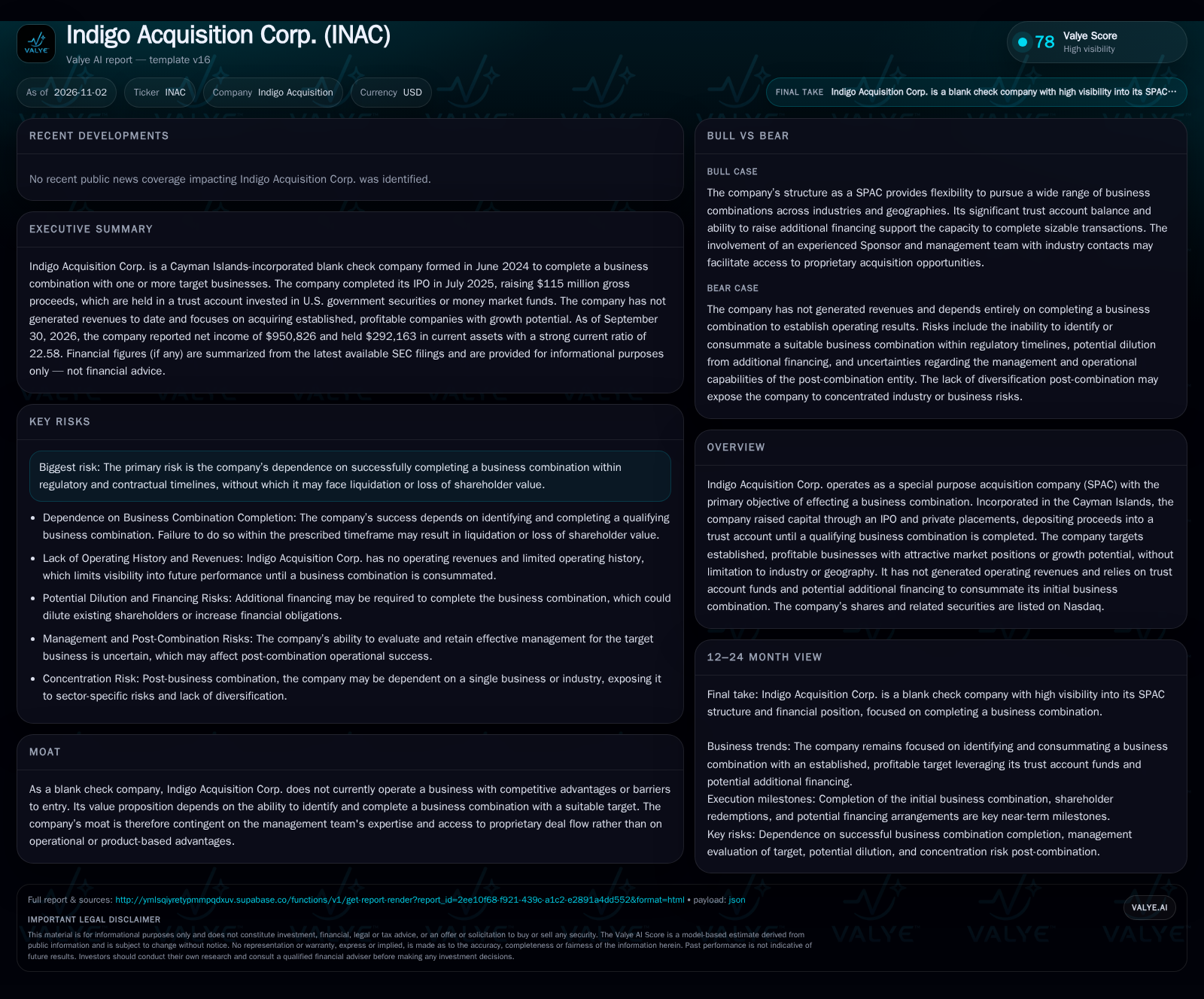
Indigo Acquisition Corp. is a Cayman Islands-based SPAC with $120.5 million in trust and no operating revenues. Its thesis hinges on completing a qualifying business combination within regulatory timelines. The company's value will depend on the quality of the acquisition, shareholder redemptions, and the ability to manage post-merger risks. The main watchpoints are deal progress, trust depletion, potential dilution, and the profile of any announced target. [S2]
Indigo Acquisition Corp. exemplifies the high-stakes, binary nature of the SPAC structure: it has amassed over $120 million in trust through its IPO and private placements, but as of September 2026, it has not executed a business combination or generated operating revenues. The company's future—and that of its shareholders—depends entirely on its ability to source, negotiate, and close a deal with an attractive target, while managing redemption risk and ensuring post-merger operational competence. The absence of an operating business today means that all current valuation and strategic analysis must focus on deal mechanics, capital structure, and the incentives facing sponsors and public holders. [S2]
Where Indigo Stands: Trust Capital, Net Income, and Deal-Driven Uncertainty
As of September 30, 2026, Indigo Acquisition Corp. held approximately $120.5 million in its trust account, representing the principal asset available for a future business combination. The company reported net income of $950,826 for the most recent quarter, which was entirely attributable to interest earned on trust assets rather than any operating activity. Indigo has not identified or announced a target, nor has it generated operating revenues. Its current balance sheet is characterized by a shareholders’ deficit ($3.7 million), typical for SPACs pre-deal, and a current ratio of 22.58, reflecting the presence of trust cash and minimal liabilities. The regulatory clock is ticking: if Indigo does not complete a qualifying business combination within its specified timeframe, it will be required to liquidate and return trust funds to public shareholders. [S2]
SPAC Economics: Trust Account Mechanics, Redemptions, and the Dilution Dilemma
Indigo’s business model—like that of all SPACs—is fundamentally transactional. It raises capital from public investors, places the proceeds in a trust, and then seeks to acquire an operating company. Until a deal is completed, the only sources of income are interest on trust assets; there is no operating revenue, margin, or recurring cash flow. The economics of the future business hinge on the acquisition: purchase price, target quality, capital structure, and the proportion of trust funds that remain after shareholder redemptions. If a large percentage of shareholders opt to redeem their shares at the time of deal announcement, Indigo may need to secure additional financing—often at dilutive terms—to close the transaction. The sponsor typically holds founder shares and warrants, which become valuable only if a deal closes, creating strong incentives to get a transaction done. However, post-merger dilution from sponsor and PIPE (private investment in public equity) investors can erode the value for public holders unless the target company delivers substantial growth and profitability.
The interplay between shareholder redemptions and deal financing forms a critical feedback loop that can materially influence post-merger capital structure and shareholder value. If redemptions are high, the SPAC may face a cash shortfall relative to the acquisition price, necessitating supplemental capital raises often through PIPE deals or debt issuance. These additional financings typically come with dilution or leverage costs, which can constrain the new entity's potential financial flexibility and growth investments. Conversely, low redemption rates preserve trust capital, enabling a cleaner balance sheet and potentially more attractive deal terms. This dynamic creates a tension between investor confidence in the target and the sponsor’s ability to structure an accretive transaction, highlighting the importance of transparent communication and credible target selection prior to shareholder vote.
Deal Flow, Sponsor Networks, and the Challenge of Differentiation in a Crowded SPAC Market
Indigo faces the same structural constraints and opportunities as other SPACs: competition for attractive targets is intense, especially in periods of high SPAC activity or when public market conditions are challenging for de-SPAC transactions. The company’s ability to secure a compelling deal depends on the sponsor team’s network, reputation, and deal-sourcing capabilities. While Indigo’s stated focus is broad—any industry or geography, with a preference for established, profitable businesses—this flexibility is a double-edged sword: it increases the potential pool of targets but also heightens the risk of adverse selection or overpaying in competitive auctions. There are no operational moats at this stage; Indigo’s competitive position is defined entirely by its sponsor’s ability to access proprietary deal flow, move quickly, and structure accretive transactions. Other SPACs, private equity funds, and strategic acquirers are all potential rivals for the same targets.
The broad mandate to pursue targets across industries and geographies, while offering strategic flexibility, also imposes challenges in terms of due diligence depth and sector expertise. Without a focused investment thesis, the sponsor team must rely heavily on external advisors and rapid assessment processes, which can increase execution risk and reduce negotiation leverage. Additionally, the competitive landscape for quality targets often favors strategic buyers or private equity firms with sector specialization and operational experience, potentially pressuring valuations upward. Therefore, the sponsor’s ability to differentiate through proprietary deal flow or unique transaction structures becomes paramount. The timing of deal sourcing relative to market cycles further complicates this, as windows of opportunity for attractive valuations may be narrow and unpredictable.
A Value-Accretive Acquisition: How Indigo Could Unlock Shareholder Returns
The most favorable scenario for Indigo is sourcing a high-quality, established, and profitable target with strong growth prospects at a reasonable valuation. If the deal structure aligns incentives, minimizes dilution, and preserves most trust assets post-redemption, the resulting public company could command a premium to trust value. Evidence that would confirm this scenario includes an announced transaction with a clear, credible growth narrative, limited redemptions from public holders, and PIPE financing on favorable terms (if needed). Post-deal, early evidence of robust operating performance, high-quality management retention, and positive public-market reception would further validate the upside case.
Most Likely Outcome: Deal Execution with Moderate Redemptions and Uncertain Post-Merger Trajectory
The most plausible outcome for Indigo is the successful announcement and completion of a business combination, but with a significant portion of public shareholders opting to redeem their shares, reducing the cash available to the new operating company. The target may be solid but not exceptional, and additional PIPE financing could dilute public holders. The post-merger entity faces the typical de-SPAC headwinds: pressure to meet projections, integration challenges, and scrutiny over corporate governance. Evidence supporting this scenario would include a deal announcement with a moderate-to-high redemption rate, reliance on external financing, and a share price that tracks close to trust value in the months following the transaction.
Deal Failure, Liquidation, or Value Destruction from a Poorly Structured Transaction
In the adverse scenario, Indigo fails to identify or consummate a business combination within the regulatory timeline, triggering liquidation and return of trust funds to public shareholders—leaving sponsor capital at risk and public holders receiving only their pro-rata trust value. Alternatively, if a deal is completed but with excessive dilution, poor target quality, or severe redemptions, public shareholders may face value destruction as the post-merger company struggles operationally or trades below trust value. Confirmation of the downside would be a missed deal deadline, liquidation filings, or a de-SPAC transaction followed by persistent share price weakness and negative operating surprises.
Milestones That Will Define Indigo’s Outcome and Test the SPAC Thesis
Announcement of a definitive business combination agreement, including target identity, industry, and purchase price terms.
Level of public shareholder redemptions at the time of deal approval—a critical metric for available post-merger cash.
Terms, size, and pricing of any PIPE or additional financing required to close the transaction.
Quality, experience, and retention of the proposed post-merger management team (if disclosed).
Pro forma financial projections and guidance provided at deal announcement, including revenue, EBITDA, and growth expectations.
Share price performance relative to trust value before and after the de-SPAC transaction.
Any regulatory or shareholder approval hurdles that could delay or derail the business combination.
Disclosure of post-merger governance arrangements, board composition, and sponsor alignment with public shareholders.
Disclaimer: This is research-only, informational analysis and not investment advice. It may include AI-generated interpretation and general industry context. Always verify important details using primary sources.

Comments