
Cheesecake Factory: Expansion Ambitions, Lease Burden, and the Stakes for Sustained Profitability in a Competitive Restaurant Landscape
Cheesecake Factory’s Q3 2026 results highlight rising income, strong customer traffic, and ambitious 2027 expansion plans.
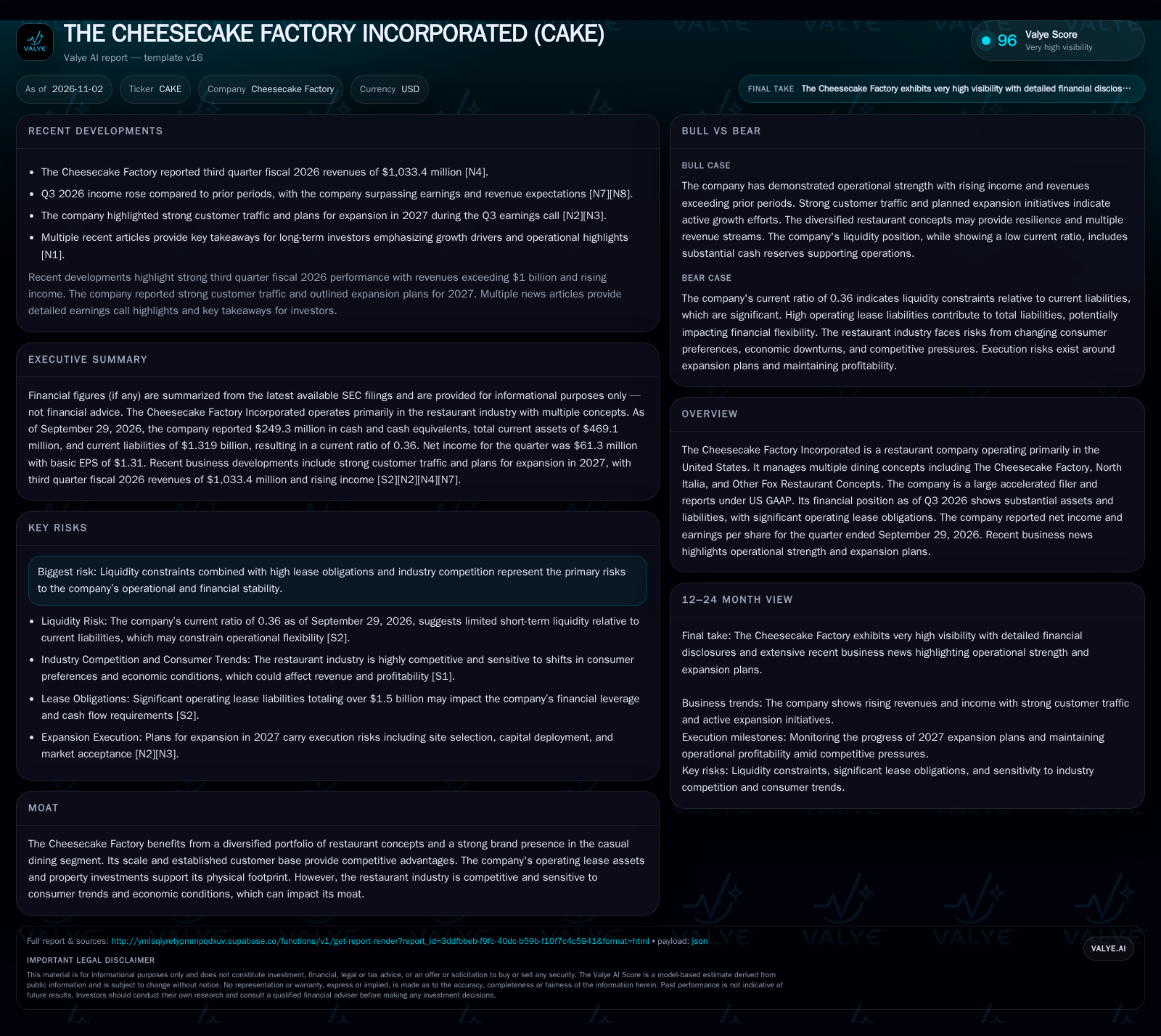
Cheesecake Factory reported Q3 2026 net income of $61.3 million on $1.03 billion in revenue, with traffic momentum and 2027 expansion plans in focus. The company's future will hinge on managing expansion execution, sustaining customer demand, and navigating competitive and macro headwinds. [S2] [N2] [N4]
Cheesecake Factory enters late 2026 with notable momentum: robust Q3 financial results, strong customer traffic, and plans to expand its footprint in 2027. As the casual dining sector contends with shifting consumer preferences and persistent cost pressures, Cheesecake Factory’s ability to convert operational strength into durable value will depend on its execution discipline and adaptability.
Q3 2026 Performance Sets the Stage for Expansion—But Liquidity and Lease Burdens Loom
Cheesecake Factory reported third quarter 2026 revenues of $1,033.4 million and net income of $61.3 million, both exceeding expectations and reflecting increased customer traffic [S2] [N4] [N7] [N8]. These results have emboldened management to signal further expansion in 2027 [N2] [N3]. However, as of September 29, 2026, the company’s current assets were $469.1 million against current liabilities of $1.319 billion, yielding a current ratio of 0.36 and a cash ratio of 0.19 [S2]. Operating lease liabilities stood at $1.58 billion—far outstripping cash reserves. This combination of strong recent performance and constrained liquidity frames the company’s near-term strategic options.
The interplay between Cheesecake Factory’s robust revenue growth and its liquidity constraints underscores a nuanced capital allocation challenge. While strong top-line performance provides operational momentum, the significant imbalance between current liabilities and current assets necessitates careful cash flow management to avoid liquidity shortfalls. The large operating lease obligations, which are largely fixed and non-discretionary, limit the company’s potential financial flexibility, especially in the near term. The company reported cash and liquidity metrics for the period; these figures do not by themselves establish operating runway, investment capacity, financial flexibility, or financing capacity.
Fixed-Cost Intensity and Operating Leverage Define the Model’s Risk-Reward
Cheesecake Factory’s economics are shaped by high fixed costs—particularly from operating leases, labor, and property investments—relative to its variable cost base. The company’s $1.58 billion in operating lease liabilities and $937.2 million in property and equipment reflect a capital-intensive model with significant operating leverage [S2]. When same-store sales and traffic rise, incremental revenue can flow disproportionately to the bottom line, as evidenced by Q3’s profit outperformance. However, this leverage also amplifies downside risk: any sustained decline in traffic or average ticket can rapidly erode margins and cash flow.
Pricing power in casual dining is typically constrained by consumer sensitivity and competitive alternatives. While Cheesecake Factory’s brand and menu breadth may allow modest menu price increases, significant hikes risk demand elasticity. Cost inflation—especially in wages and ingredients—has to be offset either by price, mix, or efficiency gains. Expansion efforts require upfront capital and working capital, further pressuring liquidity when current liabilities substantially exceed current assets.
A critical dimension of Cheesecake Factory’s operating leverage is the sensitivity of its profit margins to fluctuations in consumer traffic and spending patterns. Given the high fixed-cost structure, small percentage changes in average check size or customer visits can translate into outsized impacts on earnings. This creates a scenario where operational efficiency and cost control become paramount, as any inefficiencies disproportionately erode profitability. Furthermore, the company’s ability to innovate menu offerings or optimize labor scheduling can mitigate some fixed-cost pressures, but these levers have limits. The capital-intensive nature of the model also means that returns on new investments must be carefully scrutinized to ensure they contribute positively to overall profitability rather than exacerbating fixed-cost burdens.
Brand Strength, Concept Diversification, and the Limits of Defensibility in Casual Dining
Cheesecake Factory’s primary competitive assets are its brand recognition, large-format experiential model, and a diversified portfolio including North Italia and other Fox Restaurant Concepts [S2]. This multi-concept approach provides some resilience to changing consumer tastes and geographic risks. However, the broader casual dining sector remains intensely competitive, facing constant pressure from fast-casual upstarts, delivery-first platforms, and premium quick-service chains. Consumers have shown a willingness to trade down in economic downturns or shift spend toward convenience and value.
Switching costs for diners are low—repeat visits are driven by habit, perceived value, and experience rather than contractual lock-in. The company’s scale and menu breadth offer some procurement and marketing advantages, but true network effects or proprietary barriers are limited. The question is whether Cheesecake Factory can maintain traffic and relevance as consumer preferences evolve and competitors adapt.
The competitive landscape’s evolution further complicates Cheesecake Factory’s strategic positioning. While the company’s multi-concept approach provides diversification benefits, it also requires effective brand management and resource allocation across different formats, each with unique customer expectations and cost structures. The casual dining segment’s vulnerability to economic cycles and changing consumer priorities means that adaptability is crucial. For example, shifts toward convenience and off-premise dining necessitate investments in digital ordering and delivery capabilities, which may introduce new cost considerations and operational complexities. Maintaining relevance will likely depend on the company’s ability to balance its traditional experiential dining strengths with evolving consumer demands for speed, value, and customization.
If Expansion Delivers and Traffic Momentum Persists, Margin Upside Could Outpace Fixed-Cost Drag
The bullish scenario assumes that Cheesecake Factory’s 2027 expansion proceeds smoothly, with new units ramping quickly and cannibalization remaining minimal. Sustained strong customer traffic—potentially bolstered by menu innovation, digital engagement, or favorable macro trends—could allow the company to leverage its fixed-cost base, driving margin expansion. If management successfully manages cost inflation and maintains or grows average check size without dampening demand, incremental revenue would disproportionately benefit net income.
Confirmation would come from continued same-store sales growth, stable or improving restaurant-level margins, and evidence of profitable new unit economics. Clear signals would include rising traffic metrics, persistent outperformance of consensus earnings estimates, and positive cash flow from expansion units. Conversely, this scenario would be challenged if new store ramp is slow, traffic softens, or cost pressures outpace pricing power.
Growth, Margin Pressures, and Execution Risk Create a Mixed Outlook
The most plausible path is one of continued revenue growth, but with persistent pressure on margins and cash flow due to high fixed costs and competitive intensity.
Evidence for this scenario would include modest same-store sales growth, steady but not accelerating net income, and continued tight liquidity. Watch for management commentary on capital allocation and expansion pacing. Any sign of rising lease or labor costs outstripping revenue growth would reinforce this scenario. A key test will be whether the company can maintain or improve restaurant-level margins despite industry headwinds.
Traffic Weakness or Expansion Missteps Could Expose Financial Fragility
If consumer demand softens—due to economic slowdown, shifts in dining preferences, or competitive incursions—Cheesecake Factory’s high fixed costs and lease obligations could quickly become a burden. Expansion executed into weak demand or at poor locations could exacerbate the issue, with new units failing to generate sufficient returns.
Downside confirmation would be visible in negative same-store sales, declining traffic, margin compression, or any signs of liquidity stress (such as delayed payables or urgent financing moves). Material downward revisions to earnings guidance or pauses in expansion plans would also validate this scenario. The company’s ability to renegotiate leases or reduce fixed costs would be limited in the short term, amplifying the impact of adverse trends.
What Will Determine Whether Cheesecake Factory’s Expansion Pays Off?
Sustained same-store sales and traffic trends—especially through economic or industry volatility—would help test the strength of the brand and concept portfolio.
Restaurant-level margin progression: evidence of operating leverage or, conversely, cost inflation outpacing revenue would clarify the economic trajectory.
Execution milestones for 2027 expansion: new unit openings, ramp speed, and early sales versus internal targets (if disclosed) will be critical.
Ability to offset lease and wage inflation through menu pricing, mix, or productivity gains.
Competitive response: observable changes in market share, customer preference data, or new format launches by peers.
Management commentary on capital allocation, expansion pacing, and risk mitigation in future earnings calls.
Disclaimer: This is research-only, informational analysis and not investment advice. It may include AI-generated interpretation and general industry context. Always verify important details using primary sources.

Comments