
Roper Technologies: Diversification, Decentralization, and the Stakes of Acquisition-Driven Expansion
Roper Technologies’ model of decentralized, acquisition-led growth has delivered solid organic gains and improved outlooks, but the company’s liquidity profile and integration execution remain focal points for investors. As the technology landscape evolves and regulatory complexity mounts, Roper’s ability to convert niche leadership into durable value will be shaped by its operational agility, risk management, and the economics of its evolving portfolio.
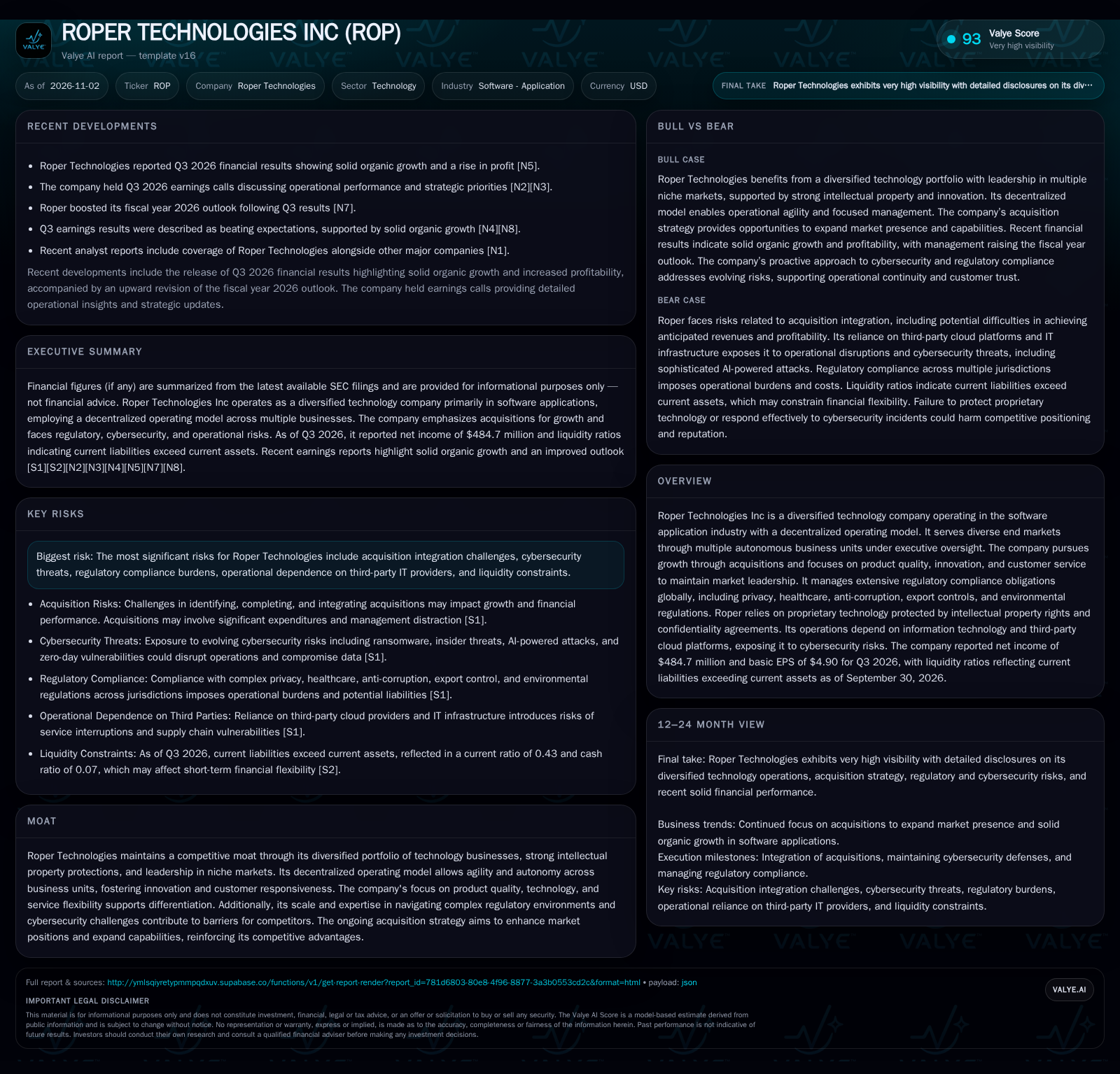
Roper Technologies posted strong organic growth and profit in Q3 2026 while raising its outlook. The company’s decentralized, acquisition-heavy strategy underpins its leadership in diverse technology niches, but current liabilities notably exceed current assets, highlighting the importance of effective integration, risk controls, and cash flow discipline as regulatory and cybersecurity challenges intensify. [S1] [S2] [N2] [N3] [N4] [N5] [N7] [N8]
Roper Technologies has established itself as a diversified technology conglomerate, leveraging a unique combination of decentralized management and aggressive acquisition to build leadership in specialized software and industrial markets. The company’s latest results underscore the strengths of this model, with robust organic growth and an improved outlook for fiscal 2026. However, the persistent gap between current assets and liabilities, and the intricate web of regulatory and cybersecurity exposures, mean that the company’s future hinges not just on buying growth—but on integrating it, defending it, and funding it through cycles of change.
Solid Organic Growth and Upbeat Outlook Define Recent Performance
Roper Technologies reported net income of $484.7 million and basic EPS of $4.90 for Q3 2026, with management raising its fiscal year 2026 outlook on the back of solid organic growth and profit expansion. The company’s approach continues to center on decentralized operations and acquisition-led expansion, with recent earnings calls highlighting operational execution and strategic priorities. [S1] [S2] [N2] [N3] [N4] [N5] [N7] [N8]
How Roper’s Portfolio Model Drives Revenue, Margins, and Capital Needs
Roper’s economics are shaped by its portfolio of autonomous business units, many of which operate in niche software, healthcare, and industrial verticals. The company’s revenue mix likely reflects a blend of high-margin, recurring software streams and more variable hardware or service revenues, though specific segment breakdowns are not provided here. The decentralized model delegates P&L responsibility to business unit leaders, enabling tailored pricing and cost strategies aligned to each market’s competitive and regulatory realities.
Acquisitions typically target established, profitable businesses with defensible market positions, allowing Roper to bolt on earnings and cash flow with relatively limited integration risk compared to roll-up models that chase distressed assets. However, this approach requires ongoing access to capital—both for dealmaking and for funding the working capital needs of acquired entities. The ability to sustain operating leverage, especially amid integration and compliance costs, will be a central determinant of long-term returns.
The capital intensity of Roper’s portfolio varies significantly across its diverse business units, which influences both its investment requirements and risk profile. Software and recurring revenue segments typically demand lower incremental capital expenditures and offer more predictable cash flows, enhancing free cash flow conversion and enabling reinvestment or debt reduction. Conversely, industrial and hardware-focused units may require higher working capital and capital expenditures to maintain operational capacity and meet customer demand, potentially pressuring liquidity during cyclical downturns or integration phases. Understanding the weighted capital intensity across the portfolio would help clarify the company’s aggregate capital efficiency and resilience to economic variability.
Decentralization, Niche Focus, and the Challenge of Defensible Differentiation
Roper’s competitive position is anchored in its leadership across several niche technology and software markets, each with distinct customer bases and regulatory environments. The decentralized structure fosters agility and deep market knowledge, supporting product quality, innovation, and customer service—a formula that has historically allowed Roper’s units to maintain or expand share against both large diversified peers and specialized competitors.
However, this model also introduces complexity. Integration risk rises with each acquisition, especially as Roper moves into markets with higher regulatory scrutiny or faster technology cycles. Substitutes and new entrants in software can erode pricing power, while the company’s reliance on third-party cloud platforms and external vendors creates potential single points of failure. The moat is reinforced by intellectual property, customer relationships, and expertise, but could be tested if integration or cybersecurity missteps erode customer trust or operational continuity.
The decentralized model’s reliance on autonomous business unit leadership can create both strategic flexibility and operational complexity. While local decision-making allows rapid adaptation to customer needs and regulatory changes, it may also lead to inconsistent application of best practices in areas such as cybersecurity, compliance, and integration processes. This heterogeneity can increase the risk of operational gaps or uneven performance across the portfolio. Effective corporate oversight mechanisms and standardized integration playbooks become critical to mitigate these risks, ensuring that decentralized units align with overall corporate risk appetite and governance standards without stifling entrepreneurial agility.
Successful Integration and Cash Flow Conversion Unlock Portfolio Compounding
If Roper continues to integrate acquisitions smoothly and its business units maintain or improve margins, the company could see sustained compound earnings growth.
Confirmation would come from improving or at least stable operating margins post-acquisition, organic revenue growth outpacing peers, and evidence that working capital and debt levels remain manageable despite the current ratio challenge. Additional signs would include continued upward revisions to earnings outlooks and the successful launch or expansion of new products or platforms within acquired businesses. A falsification of this scenario would be persistent margin compression, missed integration targets, or any liquidity-driven cutbacks in acquisition activity.
Ongoing Growth with Periodic Strains from Integration and Capital Demands
The most plausible path is that Roper delivers steady organic and acquired growth, but faces periodic challenges integrating new businesses and managing its capital structure. The decentralized model enables local responsiveness and innovation, but may occasionally result in uneven performance across the portfolio, especially as regulatory and cybersecurity burdens mount.
Evidence supporting this scenario would include continued overall profit growth and generally positive outlooks, but with intermittent spikes in compliance or integration costs, and occasional pressure on liquidity metrics. Watchpoints would be any sustained deterioration in the current ratio, unexpected writedowns or restructuring charges, or public disclosures of operational disruptions tied to acquisition missteps or cybersecurity incidents.
Integration Failures and Liquidity Constraints Threaten Expansion Trajectory
A negative scenario would see Roper struggle to integrate recent acquisitions, resulting in missed synergy targets, cost overruns, or customer losses. If working capital needs or integration expenses outstrip cash generation, the company could be forced to slow or halt its acquisition program, or to seek additional external financing under less favorable terms.
Confirmation of this scenario would include a sustained or worsening current ratio, unexpected increases in debt, margin contraction, or public disclosure of failed integrations or major security breaches. Inability to meet regulatory requirements in high-stakes markets such as healthcare or privacy-sensitive software could result in fines, lost contracts, or reputational damage, further compounding financial strain.
Operational, Integration, and Capital Signals Shaping Roper’s Forward Value Creation
Trends in operating and segment margins post-acquisition, if disclosed, would help test whether integration is delivering anticipated synergies.
Organic versus acquired revenue growth rates, ideally broken out by business unit, would clarify the sustainability of underlying momentum.
Cash conversion cycle and working capital trends, especially as new entities are integrated, would indicate how well the company is managing its short-term obligations.
Disclosures of cybersecurity incidents, regulatory investigations, or operational disruptions would shed light on risk management effectiveness.
Retention rates and customer churn—if disclosed—within key software or healthcare segments would help assess the durability of competitive advantages.
Frequency and size of new acquisitions, as well as any announced pause or change in acquisition strategy, would indicate management confidence and risk appetite.
Updates on regulatory compliance costs or fines, particularly in healthcare and privacy-sensitive markets, would highlight the evolving operational burden.
Disclaimer: This is research-only, informational analysis and not investment advice. It may include AI-generated interpretation and general industry context. Always verify important details using primary sources.

Comments