
Crawford & Co: Segment Divergence, Cost Pressures, and the Economics of Claims Management in a Shifting Insurance Landscape
Crawford & Co’s latest results reveal diverging fortunes across its business segments, with international and Broadspire gains offsetting U.S. Property & Casualty declines. As case volumes rise but revenue slips, the company faces intensifying cost pressures and a competitive, evolving insurance ecosystem.
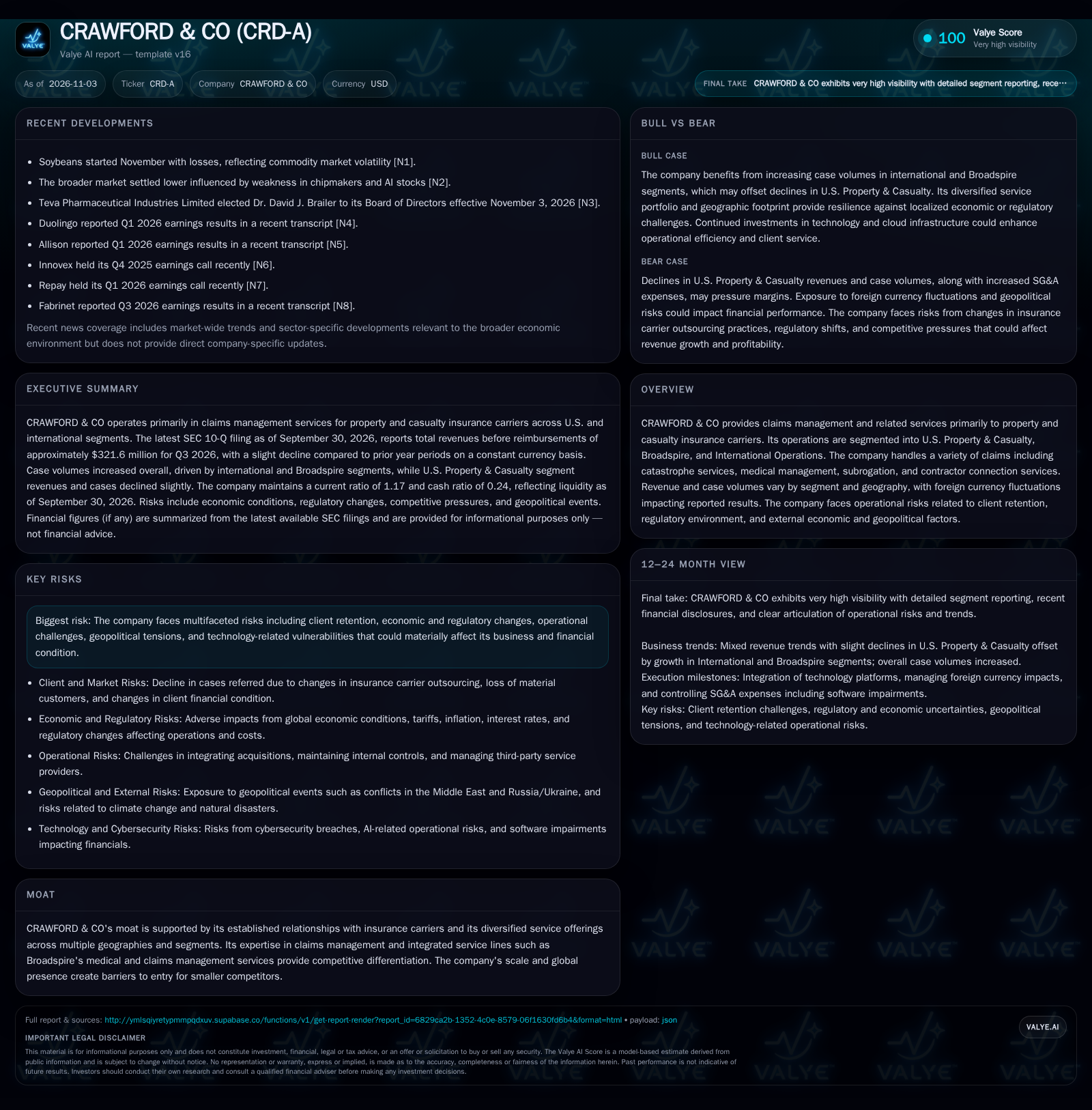
Crawford & Co’s Q3 2026 results show overall revenue contraction despite a rise in case volumes, with U.S. Property & Casualty segment weaknesses offset by growth in international and Broadspire operations. Rising SG&A, software impairments, and segmental divergence highlight operational and strategic questions as the company navigates shifting insurance carrier behaviors and global risk factors. The future hinges on cost discipline, client retention, and the ability to translate volume growth into sustained profitability amid economic and regulatory uncertainty. [S2]
Crawford & Co, a global provider of claims management services, is navigating a period of segmental divergence and cost escalation. While international and Broadspire divisions recorded gains in case volumes, the U.S. Property & Casualty business continued to contract. Rising administrative costs and a recent software impairment have compressed margins at a time when the insurance industry is re-evaluating outsourcing, technology adoption, and risk management in the face of macroeconomic and regulatory headwinds. The company’s ability to convert growing case volumes into sustainable revenue and profit growth, while managing operational complexity, will determine its resilience in an increasingly competitive landscape. [S2]
Segmental Revenue Shifts and Margin Pressures Define the 2026 Snapshot
For the three months ended September 30, 2026, Crawford & Co reported total revenues before reimbursements of approximately $321.6 million—a 0.2% year-over-year decline on a constant currency basis. The nine-month period saw a 0.5% decrease, underscoring persistent top-line headwinds. Segment performance diverged: U.S. Property & Casualty revenues fell by 0.4% in Q3 and 7.5% for the nine months, while Broadspire ticked up 0.2% and International Operations grew 3.2%. Notably, overall case volumes rose 6.0% for the quarter and 2.2% for the nine months, suggesting increased transaction activity even as revenue slipped. [S2]
The company ended Q3 with $79.0 million in cash and cash equivalents, a current ratio of 1.17, and a cash ratio of 0.24. SG&A expenses rose in the third quarter, reflecting higher costs for cloud software, insurance, and bad debt, with a $2.3 million software impairment charge recorded in Q2. Foreign currency exchange rates had a positive impact on reported results. [S2]
These facts highlight a company experiencing operational complexity: while case volumes are up and international diversification is providing some ballast, cost pressures and the decline of its core U.S. segment are compressing margins and testing strategic flexibility.
How Crawford & Co’s Claims Management Model Converts Volume into Value
Crawford & Co’s economics center on fee-based claims management services for insurance carriers, with revenue generated per case or through contractual arrangements that may include fixed fees, transactional pricing, or performance-based elements. The three main segments—U.S. Property & Casualty, Broadspire (medical and claims management), and International Operations—each face different pricing dynamics and cost structures.
The company’s ability to drive profit depends on case volume, mix (higher-value vs. lower-value claims), and operational efficiency. Fixed costs include technology platforms, labor (claims adjusters and management), and administrative infrastructure, while variable costs fluctuate with case load and service complexity. Operating leverage is achievable when incremental case volume can be handled with limited increases in overhead, but recent SG&A escalation—driven by technology investments and insurance costs—suggests that current volumes are not yet translating into margin expansion.
The company reported cash and liquidity metrics for the period; these figures do not by themselves establish operating runway, investment capacity, financial flexibility, or financing capacity. The recent software impairment and rising cloud costs highlight the tradeoff between digital transformation and near-term profit. If the company can shift more of its business toward scalable, tech-enabled platforms, it may improve margins over time, but this transition is not yet evident in the reported results.
Differentiation, Substitution, and the Evolving Insurance Outsourcing Landscape
Crawford & Co competes in a fragmented global market for third-party claims management, facing competition from both large diversified service providers and niche regional players. Its scale, established carrier relationships, and breadth of services—particularly in medical claims management and international operations—provide some differentiation and create switching frictions for incumbent clients.
However, the market is subject to intense price competition, especially in commoditized claims categories. The trend among insurers toward selective insourcing, digital self-service, and automated claims processing threatens traditional fee-for-service models. Technology-first entrants and insurtech platforms can offer lower-cost or more integrated solutions, potentially eroding Crawford’s share unless it can match their efficiency and digital experience.
Regulatory and geographic diversification offer some defense, but also increase complexity and exposure to local economic, legal, and geopolitical disruptions. The company’s competitive position will increasingly depend on its ability to deliver demonstrable cost savings, regulatory compliance, and technology-enabled value to clients. If it fails to do so, client churn or margin compression could accelerate.
Technology-Driven Efficiency and International Expansion Could Reignite Profitable Growth
A favorable scenario for Crawford & Co would see the company successfully leveraging recent investments in cloud software and digital platforms to scale its operations—enabling higher case throughput per employee and reducing unit costs. If technology adoption leads to improved client retention and new customer wins, especially in the faster-growing international and Broadspire segments, the company could offset U.S. weakness and achieve margin expansion.
Key confirming evidence would include a sustained increase in operating margins despite rising case volumes, successful cross-selling of integrated services, and new or expanded contracts with major insurers. If disclosed, a reduction in SG&A as a percentage of revenue and positive commentary on technology ROI would further validate the upside. Conversely, if cloud and software investments fail to yield efficiency gains or are followed by further impairment charges, the scenario would be falsified.
Mixed Segment Performance and Cost Discipline Shape the Most Likely Outcome
The most plausible outcome is that Crawford & Co continues to experience modest growth in international and Broadspire segments, offset by ongoing decline or stagnation in U.S. Property & Casualty. Case volumes may remain stable or grow slightly, but pricing pressure and rising SG&A costs could prevent significant margin expansion. Technology investments may begin to stabilize costs, but near-term returns are likely to be incremental rather than transformative.
This scenario would be confirmed by continued reporting of flat to slightly declining group revenues, stable or modestly improving case volumes, and SG&A growth that matches or exceeds revenue growth. Watch for management commentary on client retention, competitive win rates, and early signs of technology-enabled productivity improvements. If segment declines accelerate or cost control measures prove insufficient, downside risks would become more prominent.
Structural Decline in U.S. Claims Outsourcing and Unchecked Cost Growth Threaten Profitability
In a bearish scenario, U.S. Property & Casualty continues to experience both volume and pricing declines as insurers bring more claims management in-house or shift spend to digital-first competitors. Rising costs—particularly in technology, labor, and bad debt—outpace any volume-driven gains in international and Broadspire operations, leading to shrinking margins and potential operating losses.
This would be confirmed by accelerating revenue and case volume declines in the U.S. segment, persistent or rising SG&A as a percentage of revenue, and additional impairment charges or restructuring costs. Early warning signs would include loss of major clients, negative trends in client retention (if disclosed), or inability to pass on costs through pricing.
What Will Determine Crawford & Co’s Ability to Translate Volume Growth into Profitable Scale?
Quarterly trends in segment-level revenues and case volumes, especially in U.S. Property & Casualty and International Operations, will clarify the persistence of current divergences.
SG&A expenses as a percentage of revenue and the absolute level of technology-related costs will indicate whether operational leverage is improving or eroding.
Disclosure of client retention rates, contract wins/losses, or major renewals would help test the sustainability of the company’s competitive position.
Commentary or disclosure regarding ROI from cloud software and technology investments would provide evidence for or against the efficiency thesis.
Any additional impairment charges, restructuring expenses, or write-downs related to technology initiatives would be early warning signals of execution risk.
Evidence of new service launches, cross-segment integration, or expanded international partnerships would support the case for future growth.
Disclaimer: This is research-only, informational analysis and not investment advice. It may include AI-generated interpretation and general industry context. Always verify important details using primary sources.

Comments