
New Mountain Finance Corp: Navigating Portfolio Headwinds and Capital Discipline in a Shifting BDC Landscape
Recent declines in investment income and significant unrealized portfolio losses underscore the challenges facing New Mountain Finance Corp, even as it maintains regulatory asset coverage and demonstrates capital management through repurchases and distributions. The interplay between portfolio valuation, leverage, and liquidity access will remain central to its performance trajectory.
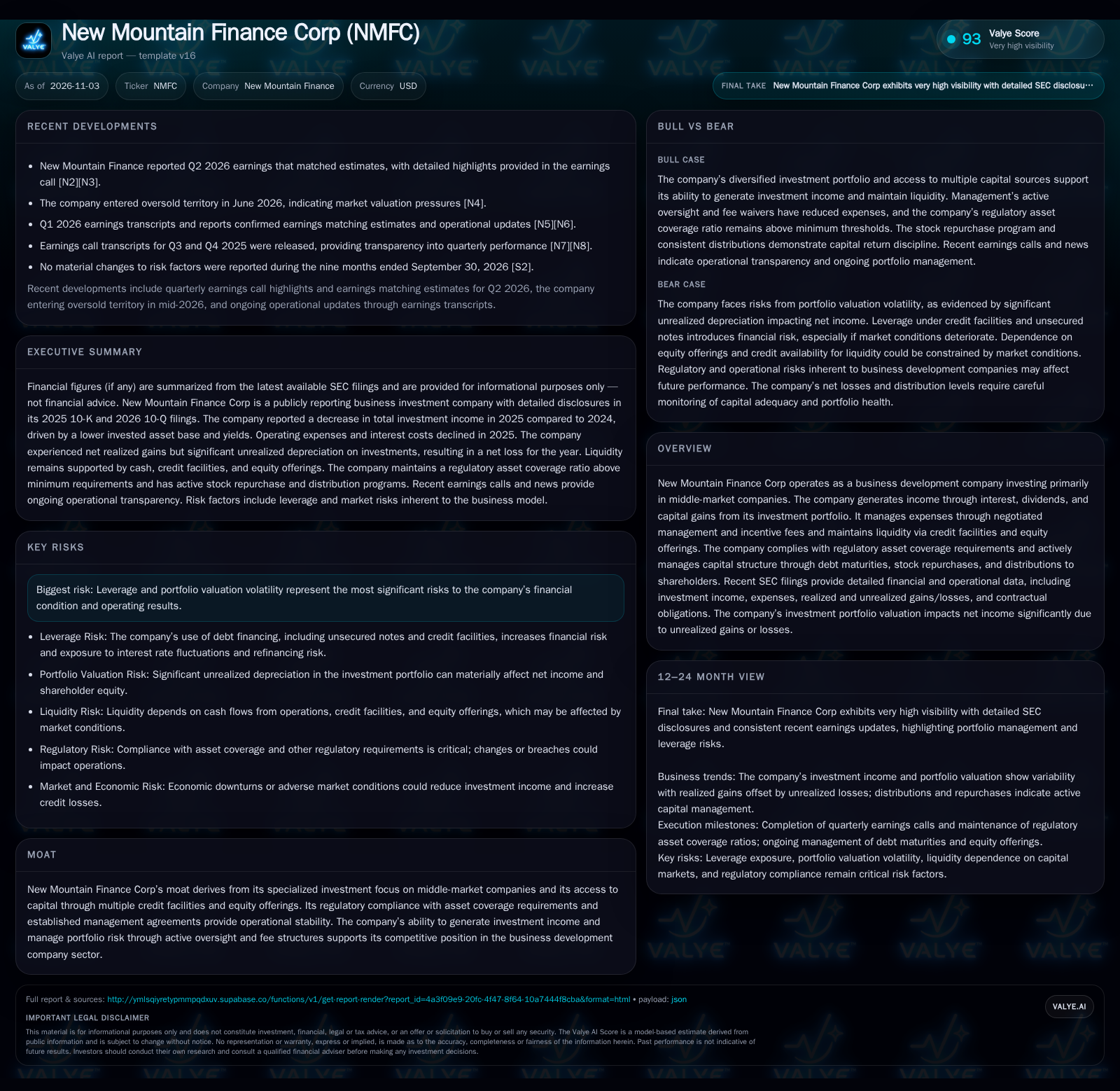
New Mountain Finance Corp reported lower investment income and large unrealized portfolio losses for 2025, despite reducing expenses and achieving realized gains. The company maintains a healthy asset coverage ratio and has continued capital returns via distributions and share repurchases, but faces ongoing risks from leverage and portfolio valuation volatility. [S1] [S2]
New Mountain Finance Corp’s recent results highlight the inherent volatility and balancing act required in the business development company (BDC) model. While the company has maintained regulatory capital cushions and continued to return capital to shareholders, its core investment income has declined, and portfolio valuation swings have driven net losses. Navigating the tension between leverage, portfolio risk, and capital returns will define the next phase for New Mountain Finance.
Recent Portfolio Performance and Capital Management Actions
New Mountain Finance Corp reported a drop in total investment income to $327.1 million for 2025, down from $371.7 million in 2024, reflecting both a shrinking invested asset base and lower yields. This contraction in core income was partially mitigated by a $35 million reduction in operating expenses, largely due to lower management and incentive fees as well as reduced financing costs. Notably, the company achieved net realized gains on investments ($43.2 million), but these were more than offset by $162.6 million in net unrealized depreciation, resulting in a net loss for the year. Despite these portfolio headwinds, the company maintained an asset coverage ratio of 179.20% at year-end—well above the 150% regulatory minimum—and continued its shareholder return programs, distributing $135.7 million and authorizing a $100 million buyback, with $95.1 million still available. As of Q3 2026, liquidity included $41.9 million in cash and equivalents, with additional flexibility from credit facilities and $258 million in available equity issuance capacity. [S1] [S2]
How BDC Economics Shape Returns and Risk
New Mountain Finance Corp’s core business model centers on generating interest and fee income from a portfolio of debt and equity investments in middle-market companies. Income is primarily driven by the size of the invested asset base and the yield achieved on those assets. The company’s revenue is highly sensitive to credit spreads, portfolio credit quality, and the rate environment. Operating leverage is present: management and incentive fees, as well as financing costs, are partially variable and decline with a smaller portfolio, as seen in the $35 million expense reduction in 2025. However, the model is capital-intensive, requiring ongoing access to debt and equity markets to fund investments, manage maturities, and maintain regulatory asset coverage ratios. Capital structure decisions—such as stock repurchases versus new issuance—directly affect available funds for investment and leverage ratios. In periods of unrealized portfolio losses, as seen in 2025, net asset value and earnings per share are compressed, potentially limiting future income and capital flexibility. The balance between stable recurring income from portfolio loans and the volatility introduced by mark-to-market adjustments and credit events is a defining tension for BDC economics.
Positioning in the Middle-Market Lending Ecosystem
New Mountain Finance Corp operates in a crowded segment of the BDC universe, competing with both public and private credit funds, direct lenders, and traditional banks for access to quality middle-market deals. Its specialized focus and established management platform may offer advantages in sourcing and structuring transactions. However, the sector is subject to cyclical pressures: during periods of market stress, competition from non-bank lenders can intensify, and yields can compress when capital is plentiful. Access to multiple funding channels—including credit facilities and ATM equity offerings—provides some flexibility compared to less diversified peers. The company’s ability to maintain regulatory asset coverage and demonstrate capital discipline through distributions and buybacks can support its reputation with investors. However, persistent unrealized portfolio losses or significant credit events could erode competitive standing, particularly if they result in lower distributions or forced asset sales.
Unlocking Value Through Portfolio Recovery and Market Stability
A favorable pathway for New Mountain Finance would involve stabilization or recovery in portfolio valuations, leading to reduced unrealized losses and potential write-ups. If credit conditions in the middle-market segment improve and borrower performance remains strong, realized gains could be sustained or even increase. This would support growth in net asset value and potentially allow for higher distributions, reinforcing the company’s appeal to yield-focused investors. Confirmation of this scenario would come from a reversal of recent unrealized depreciation, improved earnings per share, and continued maintenance or expansion of the asset base. Additionally, successful deployment of available capital—either through new investments or opportunistic share repurchases—could enhance returns. Evidence of rising portfolio yields, stable or improving non-accrual rates (if disclosed), and positive revisions to forward guidance would further support the upside case.
Managing Through Volatility with Disciplined Capital Allocation
The most plausible near-term scenario is one in which New Mountain Finance continues to actively manage its portfolio and capital structure amid ongoing market volatility. Investment income may remain pressured if yields stay subdued and the invested asset base does not materially expand. Operating expenses are likely to remain in check given the lower asset base, but net income could be constrained by continued unrealized portfolio fluctuations. Distributions to shareholders are expected to be maintained at current levels, barring a substantial deterioration in portfolio performance. The asset coverage ratio should remain above regulatory minimums, supported by prudent leverage management. Evidence confirming this scenario would be flat or slightly declining net asset value, stable but modest earnings per share, and continued operational transparency via regular earnings calls and filings. Any significant shift in realized versus unrealized gains, or a material change in distribution policy, would serve as a key test for this base case.
Adverse Credit Events and Liquidity Constraints Pressure the Model
A more negative sequence would be triggered by further deterioration in portfolio valuations, translating into additional unrealized depreciation and potential realized losses if assets must be sold in distressed conditions. Adverse credit events among middle-market borrowers—such as rising defaults or non-accruals—could sharply reduce investment income and erode net asset value. If capital markets tighten, New Mountain Finance could face higher borrowing costs or reduced access to debt and equity funding, constraining its ability to refinance obligations, make new investments, or support distributions. Regulatory asset coverage ratios could come under pressure, potentially forcing defensive actions such as asset sales, dividend cuts, or dilutive equity issuance. Confirmation of this downside would be a marked drop in NAV, earnings per share turning negative, increased credit facility utilization, or changes to distribution policy. Material negative disclosures in future filings or earnings calls would further corroborate this scenario.
What Will Test New Mountain Finance’s Resilience Next?
Quarterly changes in net asset value (NAV) per share: sustained declines would signal ongoing portfolio stress.
Trends in unrealized appreciation/depreciation on the investment portfolio: a reversal or moderation would suggest stabilization.
Level and sustainability of quarterly distributions: cuts or special dividends would indicate shifts in capital management priorities.
Utilization rates and pricing on credit facilities: rising usage or higher spreads could flag emerging liquidity pressures.
Deployment of share repurchase authorization: actual buybacks versus authorization size would reflect management’s confidence and capital flexibility.
Disclosure of non-accrual rates or realized credit losses (if disclosed): rising levels would highlight deteriorating credit quality.
Changes in regulatory asset coverage ratio: movements toward the minimum could presage defensive capital actions.
Size and yield of the invested asset base: expansion or contraction here would drive future income potential.
Disclaimer: This is research-only, informational analysis and not investment advice. It may include AI-generated interpretation and general industry context. Always verify important details using primary sources.

Comments