
i-80 Gold: Nevada Development Ambitions, Project Sequencing, and the Economics of Scaling to Mid-Tier Producer
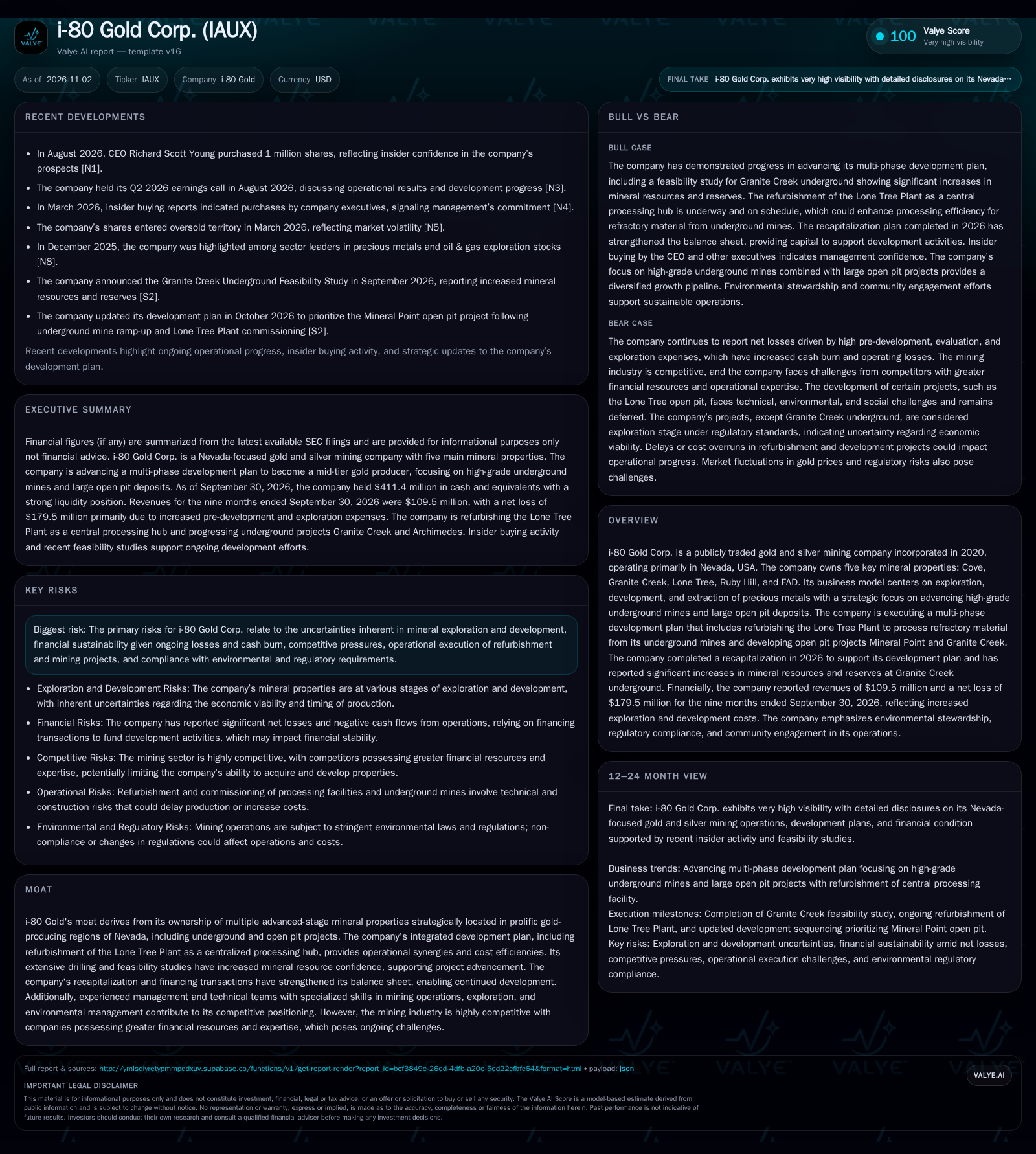
i-80 Gold Corp. is advancing a multi-phase plan to become a mid-tier gold producer, focusing on high-grade underground mines and the refurbishment of its Lone Tree Plant as a central processing hub. The company’s recent recapitalization, prioritized project sequencing, and insider buying underscore management’s commitment, but persistent net losses, execution risks, and competitive pressures create a complex path to sustainable profitability.
i-80 Gold is pursuing a transformation from explorer to mid-tier Nevada gold producer, underpinned by a $787.5 million recapitalization and the phased development of underground and open pit projects.Insider transaction activity was reported in the cited source; this activity does not by itself establish insider confidence. The path to profitability will depend on successful project execution, processing scale-up at Lone Tree, and the ability to manage costs and operational risks amid industry competition and volatile gold prices. [S2] [N1]
i-80 Gold Corp. is in the midst of a high-stakes transformation, aiming to evolve from a Nevada-focused explorer into a mid-tier gold producer with a multi-asset, multi-stage project pipeline. Fresh capital, insider commitment, and recent resource upgrades provide tangible momentum, but the company’s journey is defined by a delicate balance: advancing major development projects while managing persistent losses, technical complexity, and sector competition. The next phase will test whether its project sequencing and processing-hub strategy can deliver sustainable operational and financial leverage.
Recent Financing, Project Milestones, and the Stakes for Execution
As of September 30, 2026, i-80 Gold reported $411.4 million in cash and equivalents following a $787.5 million recapitalization, which included a royalty sale, gold prepayment, and convertible notes. This capital is earmarked for the refurbishment of the Lone Tree Plant—a key processing hub—and the advancement of the Granite Creek and Archimedes underground projects. The Granite Creek underground feasibility study released in September 2026 showed a 229% increase in measured and indicated resources, positioning it as a cornerstone for near-term production. The company updated its development plan in October 2026, sequencing the Mineral Point open pit as the next major project after Lone Tree and the underground mines reach production. Despite these milestones, i-80 Gold posted a net loss of $179.5 million for the first nine months of 2026, reflecting heavy investment in pre-development and exploration.Insider transaction activity was reported in the cited source; this activity does not by itself establish insider confidence. [S2] [N1]
The Economics of Scaling: Processing Leverage, Capital Intensity, and Cost Dynamics
i-80 Gold’s business model hinges on moving from exploration to sustained production by leveraging Nevada’s high-grade deposits and centralized processing. The refurbishment of the Lone Tree Plant as a hub for refractory ore is designed to create economies of scale and lower per-ounce processing costs across the company’s portfolio. If successful, this could yield significant operating leverage as throughput rises and fixed costs are spread over higher volumes. However, the company’s current financials reflect the capital intensity of the mining sector: for the nine months ended September 30, 2026, i-80 Gold generated $109.5 million in revenue against a gross profit of $29.7 million, but heavy pre-development costs resulted in a net loss of $179.5 million. [S2]
The company’s gold production (33,649 ounces) and sales (23,668 ounces at $4,608/oz realized price) are not yet at a scale to offset the surge in development and exploration outlays. The future economics will depend on the pace of production ramp, processing recoveries, and the ability to bring additional ore sources online efficiently. Capital needs remain substantial, and while the recent recapitalization provides runway, further funding could be required if development costs escalate or gold prices weaken. The offtake and royalty agreements with Vox and Orion help monetize future output but could create a drag on realized margins depending on contract terms and market price evolution.
Strategic Advantages and the Weight of Mining Sector Competition
i-80 Gold’s asset base, concentrated in Nevada’s prolific gold belts, gives it geological advantages and proximity to established mining infrastructure. The integrated hub-and-spoke model—centralizing processing at Lone Tree while sourcing ore from multiple high-grade underground and open pit projects—could enable cost efficiencies and operational flexibility that pure-play single-mine operators lack. The company’s focus on both underground (Granite Creek, Archimedes) and open pit (Mineral Point, Ruby Hill) projects diversifies its resource and production profile.
However, the mining sector is marked by intense competition, particularly from larger, better-capitalized peers with deeper technical teams and lower cost of capital. These competitors may outbid i-80 Gold for attractive assets or outspend it on exploration and development. The company’s ability to retain talent, secure permits, and deliver projects on time and on budget will be critical to translating its asset potential into realized value. Regulatory, social, and environmental pressures are also mounting, requiring sustained investment in compliance and community engagement.
How Hub-and-Spoke Execution Could Unlock Cash Flow and Rerating
If i-80 Gold successfully commissions the Lone Tree Plant on time and within budget, and ramps up production at Granite Creek and Archimedes as planned, the company could transition from heavy cash burn to positive operating cash flow. The 229% resource upgrade at Granite Creek supports a robust reserve base for multi-year mining, and the phased sequencing—bringing Mineral Point online after initial ramp-up—may help smooth capital requirements and reduce execution risk. In this scenario, the company could benefit from operating leverage as fixed processing costs are diluted over rising production volumes, lifting margins and improving capital returns.
Confirmation of this scenario would come from evidence of sustained throughput and recovery rates at the Lone Tree Plant, positive cash flow from operations, and timely advancement of the Mineral Point project. Additional upside could be driven by higher gold prices, further resource upgrades, or successful cost containment during ramp-up. Management’s insider buying and the willingness to defer marginal projects in favor of high-return core assets suggest discipline that would support this outcome. [S2] [N1]
Project Phasing and Controlled Ramp-Up Define the Most Likely Trajectory
The most plausible outcome is a gradual transition to scaled production, with periodic setbacks and cost overruns offset by incremental progress at core projects. The Lone Tree Plant is likely to come online in phases, with initial throughput below nameplate capacity as operational kinks are worked out. Granite Creek underground should provide the first meaningful production uplift, but cash flow may remain negative or marginal for several quarters as additional development spend continues and ramp-up is absorbed.
The revised development plan, which prioritizes Mineral Point after Lone Tree and underground mines, allows capital to be allocated sequentially rather than all at once, reducing the risk of financial overreach. However, cost inflation, permitting delays, or technical challenges could periodically disrupt timelines. This scenario would be confirmed by steady increases in production and sales volumes, gross margin stabilization, and a narrowing net loss, but with ongoing reliance on external funding until full project scale is achieved. [S2]
Execution Risks, Cost Overruns, and Sector Headwinds Could Prolong Losses
The adverse scenario sees i-80 Gold encountering material delays or cost overruns in refurbishing Lone Tree or developing its underground mines. Technical setbacks—such as poor ore recoveries, unexpected geological complexity, or equipment failures—could drive up costs and force additional capital raises on less favorable terms. If gold prices weaken, the economics of marginal projects could deteriorate, leading to further deferrals or asset impairments.
Competition from larger miners could intensify, making it harder for i-80 Gold to attract skilled labor or negotiate favorable offtake terms. Environmental or permitting setbacks could also stall project timelines or necessitate costly remediation. This scenario would be confirmed by persistent negative cash flow, rising debt or equity dilution, and a lack of progress in production ramp-up relative to guidance. If insider buying stalls or reverses, or if the company is forced to shelve additional projects, confidence in the multi-phase plan could erode. [S2]
Milestones That Will Shape i-80 Gold’s Transition to Producer Status
Commissioning progress and throughput rates at the Lone Tree Plant, including timing and cost versus plan.
Ramp-up pace and production grades at Granite Creek and Archimedes underground, with a focus on realized ore recoveries and cost per ounce.
Updates on Mineral Point open pit development timing, permitting, and capital allocation.
Quarterly gross profit and net loss trends, especially the trajectory of cash burn and the timing of any inflection to positive cash flow.
Gold sales volumes and realized pricing, which will be sensitive to market conditions and offtake contract terms.
Insider transaction activity was reported in the cited source; this activity does not by itself establish insider confidence.
Progress on environmental permitting and reclamation bonding, given the company’s $137.7 million in surety bonds and regulatory exposure.
If disclosed, updates on contract terms and potential margin implications from royalty and offtake agreements with Vox and Orion.
Disclaimer: This is research-only, informational analysis and not investment advice. It may include AI-generated interpretation and general industry context. Always verify important details using primary sources.

Comments