
Clorox’s Post-GOJO Landscape: B2B Expansion, Operational Overhaul, and the Real Stakes of Margin Resilience
Clorox’s acquisition of GOJO (Purell) in April 2026 significantly expands its B2B and healthcare market exposure, but comes amid macro headwinds, a challenging liquidity position, and the aftermath of a costly ERP transformation.
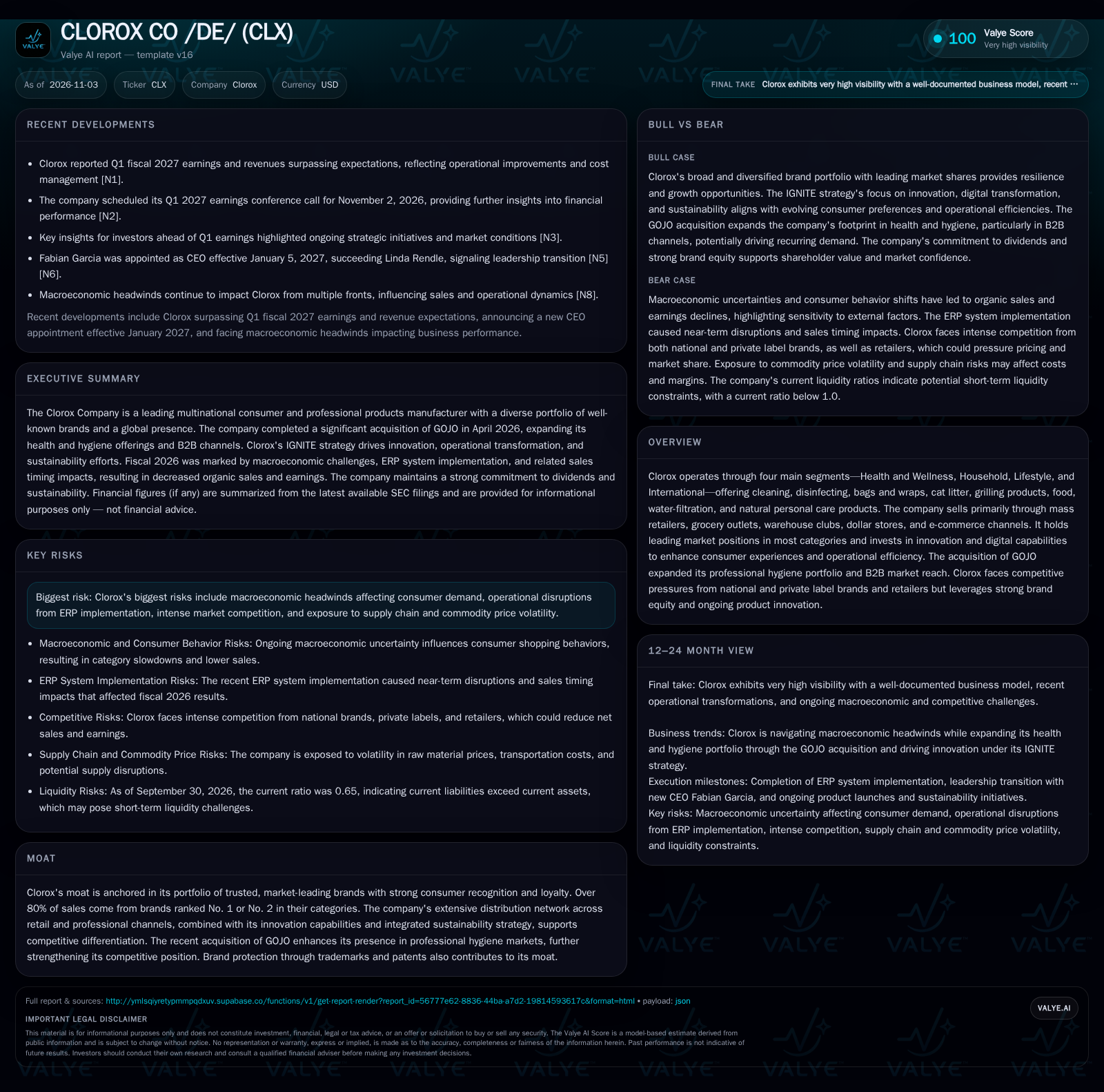
Clorox’s acquisition of GOJO (Purell) in April 2026 significantly expands its B2B and healthcare market exposure, but comes amid macro headwinds, a challenging liquidity position, and the aftermath of a costly ERP transformation. With over 80% of sales from leading brands, Clorox’s IGNITE strategy emphasizes innovation, operational efficiency, and sustainability. [S2] [N5] [N8]
Clorox’s 2026 campaign has been defined by bold moves and systemic challenges. The $2.1 billion acquisition of GOJO, owner of the Purell brand, thrusts Clorox deep into professional hygiene and B2B markets, promising new revenue streams and operational synergies. This strategic expansion coincides with the completion of a costly ERP transformation and ongoing macroeconomic headwinds that are dampening consumer demand and pressuring margins. [S2] [N5] [N8]
GOJO Acquisition, Liquidity Strains, and the End of an ERP Era: Defining 2026 for Clorox
The most consequential recent development for Clorox is its $2.1 billion acquisition of GOJO, adding the Purell brand and expanding its footprint in professional hygiene and B2B channels, particularly healthcare. The deal, closed in April 2026, resulted in $716 million in goodwill and $487 million in trademarks, reflecting expectations for both near- and long-term synergies. The acquisition was financed with new debt and commercial paper, increasing Clorox’s leverage and tightening its liquidity profile. The company also completed a $580 million ERP system overhaul in Q3 2026, intended to drive long-term operational efficiency but which contributed to near-term disruption and investment outflow. Simultaneously, Clorox is preparing for a CEO handover in January 2027, with Fabian Garcia set to succeed Linda Rendle, adding a layer of strategic uncertainty during a critical integration and transformation phase. [S2] [N5] [N6]
How Clorox Makes Money: Brand Leadership, Channel Mix, and the Economics of Transformation
Clorox’s revenue base of $6.7 billion in fiscal 2026 is diversified across four segments: Health and Wellness, Household, Lifestyle, and International. Its economic engine is powered by a portfolio where more than 80% of sales come from brands holding No. 1 or No. 2 positions in their categories, supporting premium pricing, high shelf velocity, and strong retailer pull. The acquisition of GOJO tilts the mix toward institutional and B2B channels, where contracts and recurring demand can offer more predictable revenue—though often at tighter margins and with greater exposure to procurement-driven pricing.
Clorox’s IGNITE strategy aims to drive operating leverage through innovation, product renovation, and digital transformation. However, the $580 million ERP investment, while potentially streamlining SG&A and supply chain costs over time, has increased fixed costs and temporarily disrupted operations. The company’s gross margins remain highly sensitive to input commodity costs (resins, chemicals, packaging, agricultural commodities), freight, and promotional intensity. While long-term contracts and hedging are used to dampen volatility, the ability to pass through cost increases depends on both brand strength and competitive dynamics. The cited source reports dividend-related activity; that disclosure alone does not establish dividend-policy continuity, management confidence, or a material constraint on capital flexibility. [S2]
Defending Leadership Amid Market Shifts: Brand Equity, Private Labels, and B2B Threats
Clorox’s moat rests on brand equity, category leadership, and deep retail relationships, with products ranging from household staples (Clorox bleach, Pine-Sol) to specialty items (Brita, Burt’s Bees). The company’s presence in nearly 95 markets and broad channel access—mass retail, grocery, e-commerce, and now professional hygiene—provide scale and distribution advantages.
However, competition is intensifying on several fronts. National CPG rivals continue to invest heavily in innovation, while large retailers push private label alternatives that often undercut on price. In B2B and healthcare, the GOJO acquisition brings Clorox into more direct competition with specialized hygiene and cleaning solution providers, where switching costs can be low and procurement cycles are long and margin-sensitive. The integration of GOJO’s portfolio and channel relationships will test Clorox’s ability to leverage its existing infrastructure while adapting to different buying behaviors and competitive dynamics. The risk is that the company’s historical brand-driven pricing power may be less durable as institutional customers prioritize total cost and efficacy over consumer brand recognition.
If Integration Delivers: Synergies, Innovation, and Margin Recovery Drive Outperformance
The most favorable scenario for Clorox is one where the GOJO integration is seamless, unlocking meaningful revenue and cost synergies. If Clorox can cross-sell its expanded hygiene and cleaning portfolio into both consumer and professional channels, while leveraging the ERP-enabled operational efficiencies, gross margin could recover even amid input cost volatility. Success here would likely show up as improving operating margins, stable or growing share in core categories, and expanding B2B revenue streams with attractive renewal rates.
Confirmation would require evidence of rising B2B sales (if disclosed), improved margin trajectory post-ERP, successful new product launches in both consumer and institutional lines, and smooth leadership transition with strategic clarity from the new CEO. If Clorox demonstrates sustained pricing power and above-average growth in health and hygiene, the thesis for margin resilience and long-term compounding strengthens.
Sustained Pressure, Gradual Margin Repair: Navigating Headwinds with Defensive Strengths
The most likely near-term outcome is that Clorox’s category leadership and brand strength provide an anchor against severe share erosion, but macroeconomic pressures, input cost volatility, and competitive intensity continue to weigh on margins. The company may achieve modest revenue growth, driven by incremental innovation and the expanded B2B portfolio, but operating margins remain compressed as cost inflation and promotional spending persist.
Evidence would include stable or slightly improving sales, but only gradual progress in margin recovery and continued caution in capital allocation. If consumer demand and input costs stabilize, Clorox’s operational transformation could eventually yield improved efficiency, but upside would be capped by competitive and macro constraints.
If Macro and Integration Risks Compound: Margin Compression, Liquidity Stress, and Strategic Drift
A more adverse scenario would see persistent or worsening macroeconomic headwinds further erode consumer demand and trigger additional category slowdowns. If input costs remain elevated and Clorox is unable to pass through increases due to private label and B2B pricing pressure, gross margins could deteriorate further. Integration missteps with GOJO—such as operational disruption, channel conflict, or failure to realize expected synergies—would exacerbate cost pressures.
Confirmation would be seen in sequential margin declines, negative free cash flow, or working capital stress, as well as any signs of channel destocking, loss of key B2B contracts, or strategic confusion during the CEO transition.
Milestones That Will Determine Whether Clorox’s Expansion and Overhaul Pay Off
The pace and quality of GOJO (Purell) integration, including realized revenue and cost synergies and retention of key B2B customers.
Gross and operating margin trends post-ERP completion, as a test of whether operational transformation is translating into improved efficiency.
Liquidity and working capital metrics, especially current ratio and cash flow from operations, given the tight balance sheet.
B2B and professional channel revenue growth (if disclosed), to determine if Clorox can build a sustainable institutional business alongside its consumer franchise.
Market share trends in core categories versus both national brands and private label alternatives.
Input cost inflation and the company’s ability to pass through price increases without material volume loss.
Clarity and continuity of strategic direction following the CEO transition in January 2027.
Disclaimer: This is research-only, informational analysis and not investment advice. It may include AI-generated interpretation and general industry context. Always verify important details using primary sources.

Comments