
Mistras Group’s Take-Private Inflection: Industrial Services, Integration Stakes, and the Next Phase for Asset Integrity Solutions
Mistras Group’s pending $866 million acquisition by H.I.G. Capital marks a pivotal moment for the technology-enabled asset protection provider, as it balances resilient multi-sector demand with cyclicality, reported liquidity position, and the operational complexities of private equity ownership.
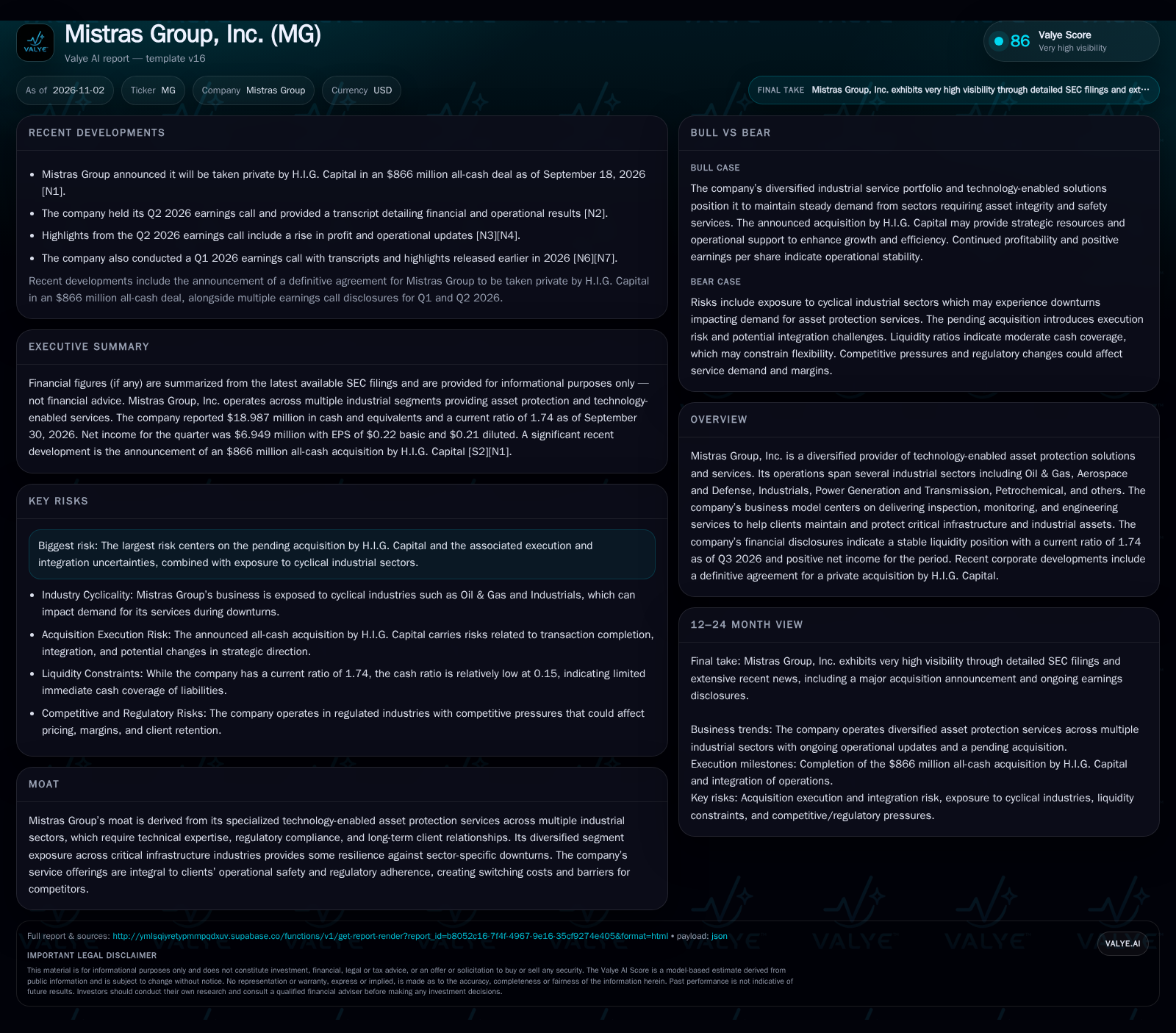
Mistras Group, Inc. is set to be acquired by H.I.G. Capital in an $866 million all-cash deal. The company reported $6.95 million in net income and reported liquidity-ratio trends of 1.74 as of Q3 2026 [S2] [N1]. Its diversified service model spans oil & gas, aerospace, and other industrial sectors, providing technology-driven asset protection.
Mistras Group, Inc., a diversified provider of asset integrity and inspection services, stands at a strategic crossroads as it prepares to transition from public markets to private ownership under H.I.G. Capital. With a portfolio spanning oil & gas, aerospace, and other critical infrastructure sectors, Mistras delivers technology-enabled solutions that are deeply embedded in client operations. The company’s recent financials show modest profitability and reported liquidity position, but the imminent acquisition introduces new variables: private equity oversight, potential operational restructuring, and heightened integration stakes. The next phase will test the resilience of Mistras’s business model against sector cyclicality, cash constraints, and the ability to execute transformative change.
Acquisition by H.I.G. Capital Reshapes Mistras Group’s Strategic Outlook
The most material near-term development for Mistras Group is the definitive agreement to be taken private by H.I.G. Capital in an $866 million all-cash deal announced in September 2026 [N1]. This transaction sets the stage for a significant shift in oversight, capital allocation, and long-term planning. Operationally, Mistras reported $6.95 million in net income for the quarter ended September 30, 2026, reflecting ongoing profitability [S2]. The company reported cash and liquidity metrics for the period; these figures do not by themselves establish operating runway, investment capacity, financial flexibility, or financing capacity. [S2] These facts matter because they frame Mistras as a profitable but moderately liquid enterprise facing both the opportunity and the risk of transformation under private equity ownership.
How Mistras Monetizes Industrial Asset Integrity—and Where Economics Could Shift
Mistras Group generates revenue by providing inspection, monitoring, and engineering services that help customers in asset-intensive sectors maintain operational safety, regulatory compliance, and asset longevity [S2]. Its core business includes non-destructive testing (NDT), real-time condition monitoring, and data-driven integrity management—often delivered as bundled service contracts or multi-year relationships. Pricing power is typically constrained by competitive bidding and the cyclical capital spending patterns of clients, especially in oil & gas and industrials. Revenue mix is influenced by both project-based and recurring work, but the extent of true contractual recurrence is not disclosed; much of the business is likely driven by repeat relationships rather than locked-in long-term contracts.
Mistras’s cost structure features a blend of field labor, technical expertise, and investments in proprietary software and IoT-enabled platforms. While digital solutions and automation may offer opportunities for higher-margin services and operating leverage, the business still relies on a sizable technical workforce and ongoing capital investment in equipment and technology. [S2] Under H.I.G. Capital’s ownership, the business may pursue operational efficiencies, technology upgrades, or reallocation of capital to higher-return segments, but will also face the imperative to service acquisition-related obligations and deliver returns to its new owners.
Where Mistras Stands in the Industrial Services Landscape
Mistras Group operates in a fragmented but highly specialized segment of the industrial services market. Its core advantages stem from technical know-how, regulatory familiarity, and deep integration into clients’ safety-critical workflows. The company’s broad sector exposure—oil & gas, aerospace, power generation, and more—provides a degree of resilience against single-sector downturns and may help smooth volatility across market cycles [S2].
However, Mistras faces several structural counterforces. Many competitors, particularly in NDT and asset integrity, are regional specialists or divisions of larger engineering service firms. The risk of substitution by in-house teams or by more automated, software-centric solutions is real, especially as digital transformation accelerates across industrial end-markets. Pricing competition is intense, and while Mistras’s proprietary platforms and data centralization (such as its OneSuite™ ecosystem) could increase switching costs and stickiness, the extent of these effects is not quantified in current disclosures. Regulatory and compliance complexity offers a partial moat, as clients are often risk-averse and reluctant to switch providers unless cost or service advantages are clear.
Leveraging Private Equity Backing for Digital Expansion and Margin Upside
The most favorable outcome for Mistras post-acquisition would be a successful transformation under H.I.G. Capital’s stewardship, marked by accelerated digital adoption, operational streamlining, and targeted expansion in higher-margin verticals. In this scenario, private ownership enables longer-term investment in proprietary software, IoT-enabled monitoring, and automation—enhancing both customer value and margin structure. If Mistras can deepen its integration in client workflows and shift more revenue toward technology-enabled, recurring solutions, operating leverage could improve and retention could rise.
Evidence of this scenario would include increased R&D or capex in digital platforms, a rising share of revenue from software or data-driven services (if disclosed), and sustained or expanding margins despite sector cyclicality. Additional signs would be new client wins in aerospace, power, or infrastructure where technology differentiation is clear, and post-acquisition disclosures of operational efficiencies or growth initiatives under H.I.G. Capital’s plan.
Continued Multi-Sector Service with Incremental Efficiency Gains
The most plausible outcome is that Mistras continues to operate as a diversified asset protection specialist, serving a broad array of industrial clients with a blend of field services and digital offerings. Under private ownership, the company may pursue moderate operational improvements—process streamlining, selective investment in higher-return segments, and incremental technology upgrades—without radical business model overhaul.
In this scenario, profitability remains positive but subject to fluctuations tied to oil & gas and industrial capital spending cycles, and liquidity stays stable but not abundant. Confirmation would come from steady net income, stable or gradually improving margins, and maintenance of the company’s current sector mix. Falsification could occur if integration challenges, acquisition-related restructuring, or sector shocks lead to margin compression or revenue declines.
Integration Friction and Industrial Downturns Undermine Stability
The adverse scenario is defined by a difficult integration process under H.I.G. Capital, combined with a cyclical downturn in key end-markets like oil & gas or industrials. If the acquisition results in cost-cutting that undermines service quality or technical capacity, Mistras could lose key client relationships. Alternatively, if macroeconomic shocks or geopolitical events further depress capital spending in core sectors, both volumes and pricing could erode.
Downside confirmation would include rising customer attrition (if disclosed), declining revenue or gross margins, restructuring charges, or operational disruptions tied to integration missteps. A material deterioration in liquidity or the need for external refinancing would also be red flags for this scenario.
What Will Determine Mistras Group’s Post-Acquisition Trajectory
Progress toward closing the H.I.G. Capital transaction and any disclosed integration plans or leadership changes.
Trends in net income, margin structure, and segment revenue mix in the first full quarters post-acquisition.
Evidence of increased investment or revenue share from digital platforms, proprietary software, or IoT-enabled services—if disclosed.
Customer retention rates and contract renewal activity, especially in oil & gas and aerospace (a useful metric would be disclosed churn or renewal rates).
Operating cost structure changes or workforce adjustments that signal integration progress or friction.
Liquidity and leverage metrics following the deal, including any new debt arrangements or refinancing needs.
Sector-level capital spending patterns and macroeconomic indicators for industrial and energy markets, which could influence demand for asset protection services.
Disclaimer: This is research-only, informational analysis and not investment advice. It may include AI-generated interpretation and general industry context. Always verify important details using primary sources.

Comments