
DIVERSIFIED HEALTHCARE TRUST: Portfolio Diversification, Profitability Pressures, and the Stakes for Healthcare Real Estate
The cited source reports dividend-related activity; that disclosure alone does not establish dividend-policy continuity, management confidence, or a material constraint on capital flexibility. The company’s ability to navigate sector headwinds, optimize asset performance, and translate scale into sustainable cash flow remains central to its long-term value proposition.
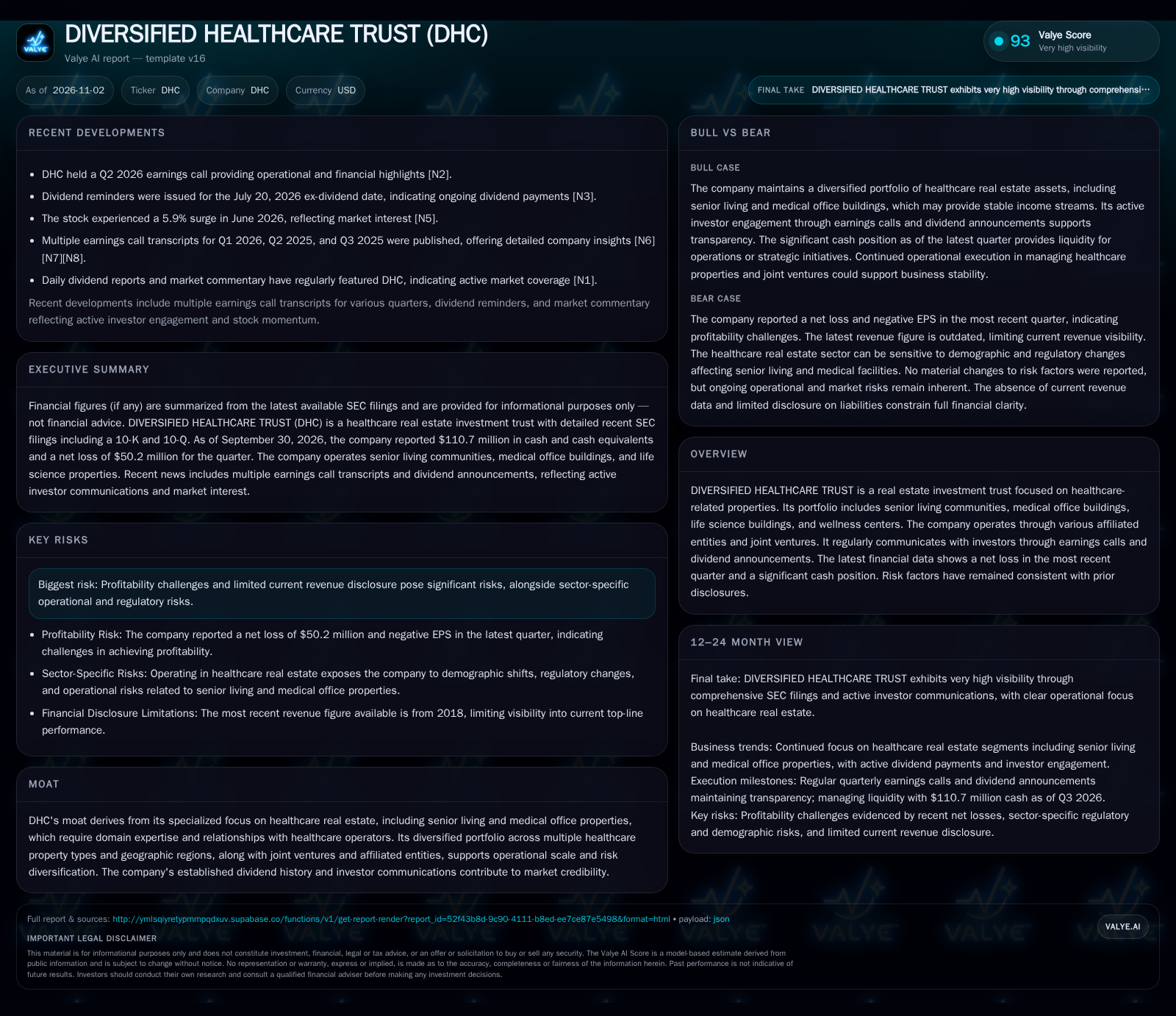
DIVERSIFIED HEALTHCARE TRUST (DHC) operates a broad portfolio spanning senior living, medical office, and life science properties, with recent filings showing a significant cash balance but ongoing net losses. Dividend payments and active investor communications suggest a focus on stakeholder engagement. However, profitability challenges and the absence of current revenue disclosure limit clarity on underlying business momentum. The company’s future hinges on its ability to improve operating performance, manage sector-specific risks, and leverage its property mix for stable, recurring income streams. [S2] [N1] [N3]
DIVERSIFIED HEALTHCARE TRUST (DHC) sits at the intersection of healthcare delivery and real estate investment, deploying capital across a mix of senior living, medical office, and life science properties. Recent filings reveal a company with a substantial reported cash balance and a visible commitment to dividends, yet one grappling with ongoing net losses and a lack of up-to-date revenue data. As healthcare real estate faces demographic tailwinds but also regulatory and operational headwinds, DHC’s next phase will depend on its ability to convert portfolio breadth into durable earnings and cash flow.
Why DHC’s Recent Losses and Cash Position Set the Stage for Strategic Decisions
DHC reported a net loss of $50.2 million for the quarter ended September 30, 2026, translating to basic and diluted EPS of -$0.21. This loss underscores persistent profitability challenges in an environment where healthcare real estate faces both structural demand and cost pressures. The company reported cash and liquidity metrics for the period; these figures do not by themselves establish operating runway, investment capacity, financial flexibility, or financing capacity. Importantly, the most recent revenue figure disclosed dates back to 2018, meaning there is a significant gap in top-line visibility and trending. The cited source reports dividend-related activity; that disclosure alone does not establish dividend-policy continuity, management confidence, or a material constraint on capital flexibility. The cited source reports dividend-related activity; that disclosure alone does not establish dividend-policy continuity, management confidence, or a material constraint on capital flexibility. [S2] [N1] [N3]
Portfolio Structure, Income Streams, and the Challenge of Operating Leverage
DHC’s business model is built on owning and operating a diversified portfolio of healthcare properties, including senior living communities, medical office buildings, life science campuses, and wellness centers. The economics of this model typically rely on long-term leases or management agreements, with rental income and occupancy rates serving as primary revenue drivers. However, the mix of asset types creates different exposure profiles: senior living communities are sensitive to demographic trends and operational costs, while medical office and life science properties may offer more stable, creditworthy tenants but face competitive pressures on lease rates.
Operating leverage is a double-edged sword in healthcare REITs: high fixed costs (debt service, property maintenance, regulatory compliance) can amplify returns in periods of high occupancy and rent growth, but also exacerbate losses when revenues are pressured. Without current revenue or detailed occupancy data, it is difficult to assess whether DHC’s losses are primarily driven by operational underperformance, asset impairments, or external shocks. The reported cash balance could provide a short-term buffer, but recurring net losses suggest that the company may need to improve portfolio efficiency, renegotiate lease structures, or consider asset sales to restore sustainable profitability.
Diversification vs. Specialization: DHC’s Place in the Healthcare Real Estate Landscape
DHC’s competitive positioning is rooted in its broad asset mix and geographic reach within the healthcare real estate sector. This diversification can help mitigate property- or tenant-specific shocks and enables exposure to multiple demand drivers, from aging demographics fueling senior living to the ongoing need for outpatient care and life science innovation. However, diversification alone does not guarantee superior returns: specialized REITs may achieve higher margins or operational efficiency by focusing on a single asset class, while diversified portfolios can dilute management attention and create complexity.
DHC operates through multiple affiliated entities and joint ventures, which may allow it to scale operations or access specialized expertise, but can also introduce governance and coordination challenges. The company faces competition from other healthcare-focused REITs, private equity real estate funds, and institutional investors—all of which seek attractive yields and stable cash flows in a sector characterized by long lease durations but rising operating costs. The absence of current revenue and occupancy disclosure leaves open the question of whether DHC’s diversification is translating into relative outperformance or if it is masking underlying operational weaknesses.
What a Turnaround Would Require: Operational Improvements and Sector Tailwinds
A favorable scenario for DHC would see the company leveraging its diversified portfolio to capture sector tailwinds—such as increased demand for senior living and outpatient medical services driven by population aging and healthcare decentralization. Operational improvements could include optimizing occupancy rates, renegotiating leases to lock in higher rents, and reducing controllable costs through scale efficiencies or better property management.
Plausible confirming evidence would include the disclosure of current revenue and occupancy rates trending upward, a return to positive EPS, and commentary on successful asset repositioning or joint venture performance in upcoming earnings calls.
Stability Amid Sector Headwinds and Gradual Portfolio Rationalization
The most plausible middle path is one in which DHC maintains its current portfolio structure and operational focus, with incremental improvements but no dramatic turnaround. Net losses may persist in the near term, potentially offset by selective asset sales or cost containment measures. The company’s diversified asset base could limit downside from any one property type, but also constrain margin expansion if sector headwinds (such as labor shortages in senior living or oversupply in medical office) remain unresolved.
Evidence supporting this scenario would be continued, albeit modest, net losses, stable or slightly declining cash balances, and ongoing but perhaps cautious investor communications. Marked improvements in revenue, occupancy, or cash flow would challenge this scenario, while a sudden deterioration in liquidity or dividend suspension would tip the balance toward a downside outcome.
Sustained Losses and Liquidity Pressures: When Diversification Fails to Deliver
If sector-specific challenges—such as declining occupancy in senior living, reimbursement pressures, or tenant bankruptcies—converge, the diversified portfolio could prove insufficient to offset aggregate weakness. The company might be compelled to divest core assets at less-than-optimal valuations or seek external capital on unfavorable terms, diluting existing shareholders.
Evidence confirming the downside scenario would include rapid cash depletion, dividend suspension, asset write-downs, or the announcement of strategic reviews focused on liquidity or restructuring. Conversely, stabilization of losses and maintenance of dividend payments from operating cash flow would challenge the severity of this scenario.
Testing DHC’s Value Proposition: Quantitative and Qualitative Markers for the Next Phase
Disclosure of current period revenue and same-property net operating income would help assess underlying business momentum and margin trends.
Occupancy rates by asset class (senior living, medical office, life science) would provide clarity on portfolio health and demand resilience—if disclosed.
Cash flow from operations versus dividend outflows: a critical test of payout sustainability and dependence on asset sales or external financing.
Updates on joint venture and affiliated entity performance would illuminate the effectiveness of DHC’s partnership strategy.
Asset sales, acquisitions, or major lease renewals could signal shifts in portfolio strategy and capital allocation priorities.
New or revised risk factor disclosures in future filings would highlight emerging threats or operational pivots.
Disclaimer: This is research-only, informational analysis and not investment advice. It may include AI-generated interpretation and general industry context. Always verify important details using primary sources.

Comments