
VivoPower PLC: Strategic Pivot to AI Data Centers and Electric Utility Vehicles—Promise, Constraints, and Execution Stakes
VivoPower PLC’s refocus on renewable-powered AI data center infrastructure and capital-light electric vehicle solutions offers a compelling sustainability narrative, but execution risks and thin current revenue highlight the need for strategic clarity and proof of commercial traction.
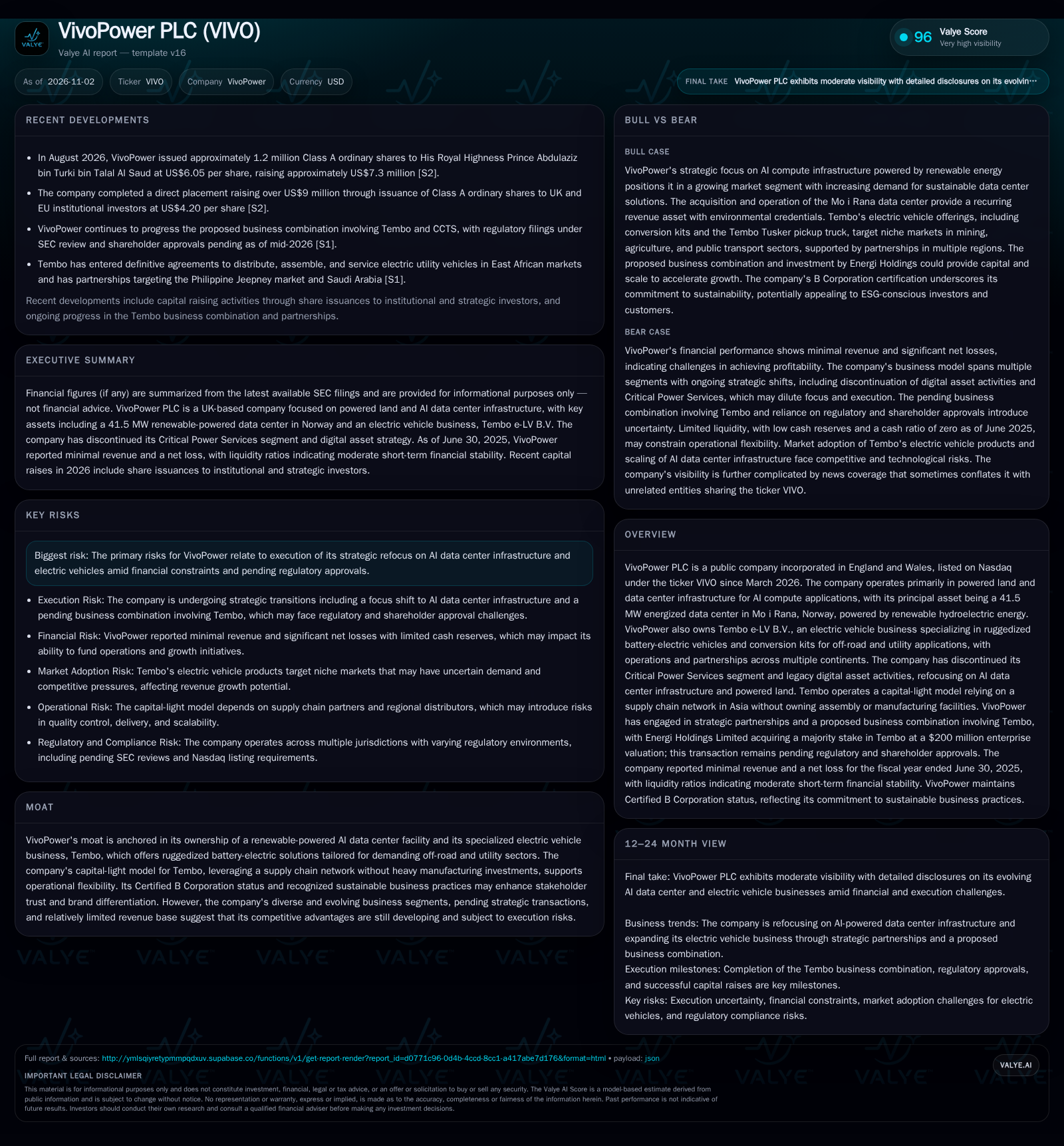
VivoPower PLC owns a 41.5 MW hydro-powered data center in Norway and Tembo, a capital-light electric vehicle business targeting utility and off-road applications. The company reported minimal revenue and a substantial net loss for FY2025, raising new capital in mid-2026 while pursuing a strategic transaction to sell a majority stake in Tembo. The business model emphasizes sustainability and asset-light expansion, but profitability, execution, and regulatory milestones remain key hurdles. [S1] [S2]
VivoPower PLC is attempting to carve out a differentiated niche at the crossroads of renewable-powered AI data center infrastructure and electrified utility vehicles. With its principal asset—a 41.5 MW hydroelectric-powered data center in Norway—and ownership of Tembo, a global electric vehicle conversion business, the company is betting on sustainability and capital-light models to drive future growth. However, recent financials show minimal revenue and persistent losses, and the pending sale of a Tembo majority stake introduces both opportunity and execution risk. Whether VivoPower’s pivot can deliver scalable, profitable growth will depend on its ability to translate its sustainability narrative and asset-light ambitions into tangible commercial wins, all while navigating tight liquidity and regulatory complexity.
Where VivoPower Stands: Portfolio, Capital, and Pending Transactions
VivoPower’s business is now anchored by two core assets: a 41.5 MW energized data center in Norway, powered by renewable hydroelectric energy, and Tembo e-LV B. V., an electric vehicle platform focused on ruggedized battery-electric vehicles and conversion kits for off-road and utility use [S1]. The company reported just $61,000 in revenue against a net loss of $12.8 million for the fiscal year ended June 2025. The company reported cash and liquidity metrics for the period; these figures do not by themselves establish operating runway, investment capacity, financial flexibility, or financing capacity. [S1]
To address capital needs, VivoPower raised approximately $16 million in mid-2026 through share issuances to a Saudi royal investor and institutional investors in the UK and EU [S2]. Additionally, the company is advancing a business combination that would see Energi Holdings Limited acquire a 51% stake in Tembo at a $200 million enterprise valuation, pending regulatory and shareholder approval [S1]. These events signal an urgent need for capital and a strategic realignment around its remaining core businesses.
Economic Model: Asset-Heavy Infrastructure, Asset-Light EVs, and the Search for Scale
VivoPower’s economics are split between a capital-intensive data center asset and the asset-light Tembo EV business. The Norwegian data center, powered by hydroelectricity, is positioned to serve AI compute workloads—a sector with strong demand for high-density, renewable-powered infrastructure. If fully utilized, such facilities can offer high-margin, recurring revenue streams, especially if clients are locked in via multi-year colocation or cloud contracts. However, the current report does not disclose occupancy, pricing, or contract structure, leaving the revenue visibility and monetization pathway unproven.
Tembo operates a capital-light model, relying on a supply chain network in Asia without direct ownership of assembly or manufacturing facilities [S1]. This approach minimizes fixed costs and capital requirements, but exposes the business to supply chain and quality risks. Revenue generation for Tembo is likely to depend on the ability to secure and scale OEM, fleet, or government contracts for conversion kits and purpose-built EVs, with margins contingent on volume, pricing power, and aftersales support. Without disclosed unit economics, it is unclear whether Tembo’s conversion kits or vehicles can deliver positive contribution margins at scale.
The pending partial sale of Tembo, if completed, could provide a non-dilutive capital injection and a clearer focus for VivoPower, but also reduces future upside from the EV segment.
Competitive Positioning: Sustainability, Specialization, and the Challenge of Scale
VivoPower’s renewable-powered data center offers a differentiated sustainability profile at a time when AI compute customers and hyperscalers increasingly prioritize green energy sources—potentially allowing for premium pricing or preferred status in RFPs. However, the European data center landscape is becoming crowded, with established players expanding renewable capacity and hyperscalers considering vertical integration. For VivoPower, the challenge is to secure anchor tenants or strategic partnerships before larger competitors saturate the market.
Tembo’s competitive edge lies in its focus on ruggedized EV solutions for off-road, utility, and public transport applications, targeting geographies and market segments often underserved by mainstream EV manufacturers. Its capital-light model allows for flexible scaling, but may lack the manufacturing control and brand strength of established OEMs or specialized EV startups. Distribution partnerships in Africa, the Middle East, and Asia could provide channel access, but commercial traction remains to be proven.
Both segments benefit from the company’s Certified B Corporation status, which can enhance brand differentiation among ESG-conscious customers and investors. Nonetheless, VivoPower’s relatively small scale, evolving business mix, and limited current revenue make defensibility and sustainable advantage contingent on execution and proof of market fit.
How Success Could Compound: Proof Points for a Scalable Platform
If Tembo’s conversion kits and EVs secure fleet contracts or government adoption in targeted regions, the capital-light model could deliver rapid volume growth and operating leverage, especially if partners shoulder working capital and distribution costs.
The partial sale of Tembo could inject capital to fund further data center development or targeted EV investments, while reducing near-term cash burn. ESG credentials could attract additional institutional capital or strategic partnerships, further accelerating growth. Confirmation of this scenario would require disclosed data center occupancy/pricing trends, signed multi-year customer contracts, and evidence of significant order flow or backlogs for Tembo in multiple regions.
Falsification would come from continued low revenue, poor data center utilization, or weak Tembo order conversion despite new partnerships.
Evolving but Unproven: A Transitional Phase with Execution Hurdles
The most plausible near-term outlook is that VivoPower remains in a transitional phase, with ongoing efforts to convert strategic positioning into revenue. The data center may attract initial AI or cloud customers, but occupancy and pricing may lag optimistic targets due to market competition and the need to establish credibility. Tembo could achieve modest sales through pilot programs or regional distributors, but scaling to meaningful profitability may be hampered by slow adoption cycles and competitive pressures.
The pending Tembo transaction, if completed, would provide balance sheet relief and enable a sharper strategic focus, but could also reduce management attention to the EV segment and limit longer-term upside. Revenue growth is likely to remain lumpy and below potential until the company can demonstrate repeatable wins and operational discipline.
Falsification would occur if the business fails to convert partnerships into revenue, or if regulatory obstacles stall the Tembo transaction and exacerbate liquidity pressures.
What Could Go Wrong: Stalled Commercialization and Capital Constraints
An adverse sequence would involve the Norwegian data center struggling to fill capacity, either due to competitive pricing from larger incumbents or a mismatch between facility capabilities and customer requirements. Without anchor tenants or high utilization, the asset could become a fixed-cost burden, with limited ability to cover operating expenses or service debt (if any is incurred).
Tembo’s capital-light model, while minimizing fixed costs, could falter if supply chain partners or distributors underperform, or if conversion kits and vehicles fail to meet customer expectations in reliability, cost, or aftersales support. Regulatory delays or a failed Tembo sale would leave VivoPower with ongoing cash burn and limited options for funding, potentially forcing asset sales or dilutive equity raises. Confirmation would come from continued minimal revenue, rising operating losses, or abandonment of key partnerships/markets.
Falsification would require evidence of new, recurring revenue streams or a completed, value-accretive Tembo transaction.
Milestones That Will Test VivoPower’s Strategic Pivot
Occupancy and utilization rates at the Mo i Rana data center—if disclosed—would directly signal the commercial traction of the AI compute infrastructure thesis.
Data center contract structure, such as length, pricing terms, and customer concentration, would clarify revenue visibility and margin potential.
Tembo order flow: Announced, signed, or shipped conversion kits and vehicles to fleet, government, or distributor customers would provide tangible evidence of market adoption.
Completion and terms of the Tembo–CCTS–Energi Holdings transaction, including valuation and post-deal capital allocation.
Cash burn and operating expense trends, particularly after the recent capital raise, to assess financial runway and discipline.
New strategic partnerships or anchor tenant announcements for either core segment that demonstrate ecosystem value or market validation.
Evidence of repeat or multi-market orders for Tembo, suggesting scalability beyond initial pilots or partnerships.
Regulatory and shareholder approval milestones for the pending Tembo transaction, as delays or rejections could materially affect the company’s financial outlook.
Disclaimer: This is research-only, informational analysis and not investment advice. It may include AI-generated interpretation and general industry context. Always verify important details using primary sources.

Comments