
SU Group Holdings: Scale-Up Ambitions Meet Profitability Pressures in Safety Solutions Expansion
SU Group Holdings reported FY2025 revenue of $24.7 million and a net loss of $2.4 million.
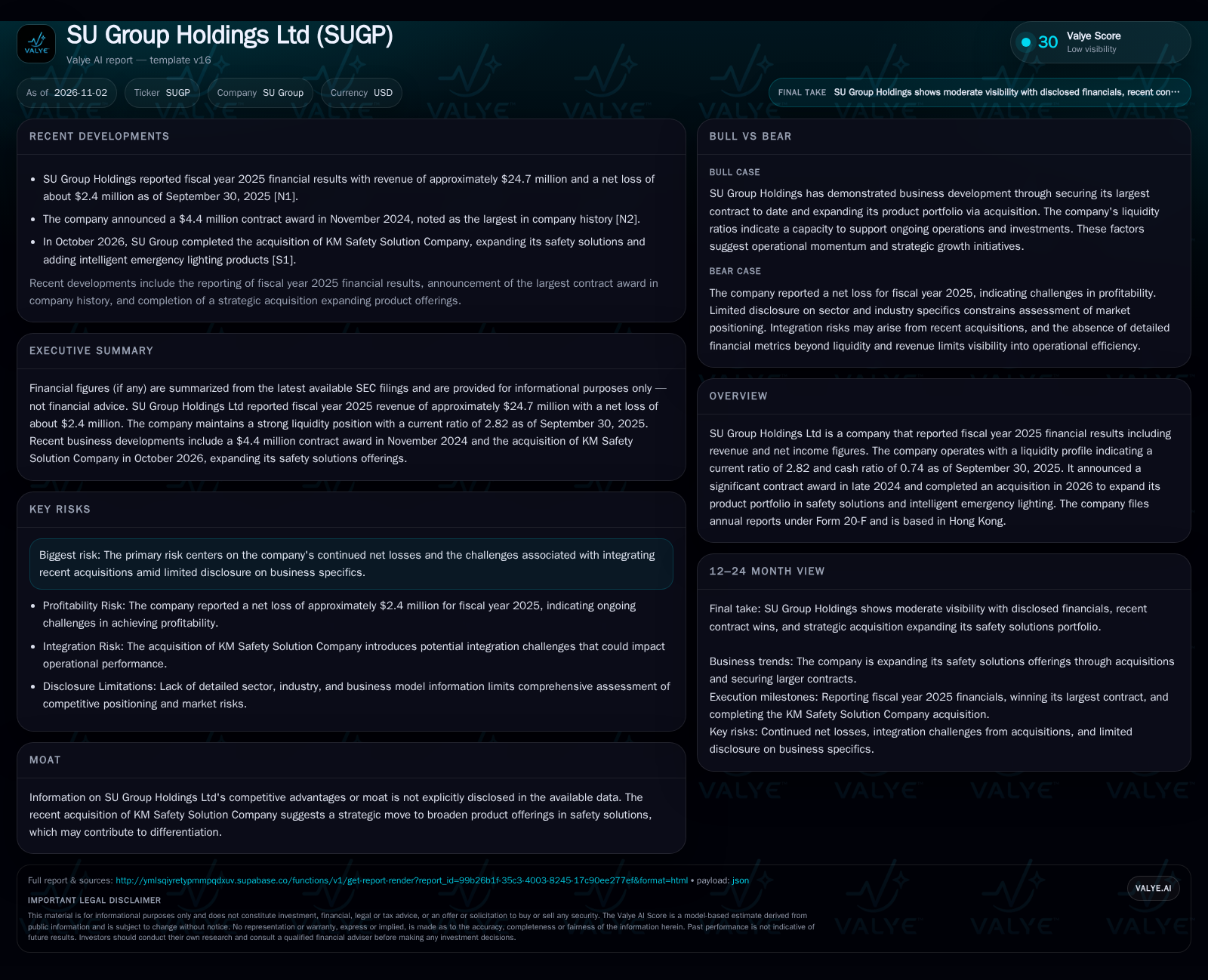
SU Group Holdings reported FY2025 revenue of $24.7 million and a net loss of $2.4 million. The October 2026 acquisition of KM Safety Solution Company expands its safety solutions and intelligent emergency lighting offerings. A record $4.4 million contract win in late 2024 highlights growth ambitions, but profitability challenges and integration risk remain central to the investment case. Liquidity ratios suggest operational headroom, yet sustained margin improvement and smooth portfolio integration are required to unlock value. [S1]
SU Group Holdings is at a strategic crossroads, marked by a record contract win and the transformative acquisition of KM Safety Solution Company, which expands its reach in safety solutions and intelligent emergency lighting. With $24.7 million in revenue for fiscal 2025 but a net loss of $2.4 million, SU Group faces the classic dilemma of scaling in a competitive market while battling for profitability.
Recent Developments Signal Strategic Expansion—But Profitability Lags
SU Group Holdings posted fiscal year 2025 revenue of $24.7 million alongside a net loss of $2.4 million, underscoring persistent challenges in achieving operational profitability. In November 2024, the company secured its largest-ever contract, valued at $4.4 million, suggesting progress in business development or customer acquisition. The October 2026 acquisition of KM Safety Solution Company has expanded SU Group’s product suite to include intelligent emergency lighting, indicating a deliberate push into higher-value or adjacent safety solution markets. These developments collectively set the stage for a period of heightened execution risk and opportunity. [S1]
How SU Group’s Revenue Model and Cost Structure Could Evolve
SU Group's revenue base, at $24.7 million for FY2025, likely reflects a mix of project-based sales, product shipments, and possibly recurring service or maintenance contracts, particularly as the portfolio broadens to intelligent emergency lighting. However, the reported net loss of $2.4 million suggests that either gross margins are compressed, fixed costs remain high relative to scale, or integration and development costs are weighing on near-term profitability. The recent $4.4 million contract win hints at lumpy, project-driven revenue recognition, which can drive quarterly volatility but also provide step-changes in topline if repeatable.
The acquisition of KM Safety Solution Company may introduce higher-margin or more defensible offerings, especially if intelligent emergency lighting is positioned as a premium, compliance-driven solution for commercial or municipal customers. If SU Group can shift its business mix toward products with built-in regulatory or safety requirements, pricing power could improve and recurring revenue streams (such as ongoing system maintenance or software-enabled monitoring) could emerge. However, the lack of detail on contract structure, customer concentration, or service attach rates leaves open questions about underlying unit economics and the degree of operating leverage available at current scale.
A critical factor influencing SU Group's future revenue and cost dynamics will be the extent to which the company can transition from predominantly project-based transactions to a model emphasizing recurring revenue streams. Recurring revenues, such as maintenance contracts, software subscriptions, or monitoring services tied to intelligent emergency lighting systems, typically offer greater revenue visibility and margin stability. However, successfully embedding these offerings requires not only technological capability but also customer willingness to adopt ongoing service relationships, which can vary widely by sector and client size. If SU Group can effectively bundle hardware sales with value-added services, it may enhance customer stickiness and reduce the volatility associated with project-based revenues.
On the cost side, the integration of KM Safety Solution Company introduces both opportunities and risks. Economies of scale in procurement, manufacturing, and distribution could lower unit costs over time, but realizing these benefits depends on effective operational alignment and process harmonization. Moreover, upfront integration expenses—such as systems consolidation, workforce restructuring, and marketing realignment—may continue to pressure margins in the near term. The balance between these integration costs and eventual cost savings will be a key determinant of SU Group’s path to profitability. Monitoring changes in operating leverage as revenue scales will provide insight into whether fixed costs are being efficiently absorbed.
Product Breadth and Integration as Potential Differentiators in a Fragmented Safety Market
The safety solutions sector is typically characterized by a mix of specialized incumbents, regional players, and broader industrial conglomerates offering fire protection, emergency lighting, alarm systems, and related services. SU Group’s acquisition of KM Safety Solution Company suggests a strategy to differentiate through portfolio breadth and technological integration—potentially bundling intelligent emergency lighting with other safety offerings for commercial or institutional clients.
However, the competitive landscape is shaped by several counterforces: price-sensitive procurement cycles, evolving regulatory standards, and the rising importance of digital connectivity and remote monitoring. Larger, more established peers may benefit from scale and long-standing customer relationships, while smaller niche providers can be more agile or locally entrenched.
The question is whether SU Group can leverage its expanded product set to create switching frictions for customers (e.g., through proprietary integration, compliance features, or bundled service contracts) or if it remains vulnerable to price-based competition and low customer lock-in. The ability to demonstrate differentiated value—such as lower total cost of ownership, superior reliability, or regulatory compliance—would be critical to sustaining margin and reducing churn.
If Integration Unlocks Cross-Selling and Margin Expansion, Value Could Compound
A favorable outcome for SU Group would see the successful integration of KM Safety Solution Company, enabling cross-selling of intelligent emergency lighting and legacy safety products across a broader customer base. If the company can convert its largest contract win into a recurring relationship or use it as a reference to win additional large deals, revenue growth could accelerate and become less volatile.
Margin expansion could follow if the mix shifts to higher-value, compliance-driven offerings or if scale efficiencies reduce per-unit costs. Evidence supporting this upside would include repeat contract wins with similar or larger value, improving gross margins, and disclosure of recurring-revenue components or multi-year service contracts.
Incremental Revenue Gains Offset by Margin Pressure and Integration Drag
The most plausible near-term trajectory for SU Group is modest revenue growth driven by the expanded product portfolio and execution of the record contract, offset by ongoing net losses as integration, development, and operational costs remain high.
Confirmation of this scenario would come from continued, but irregular, contract wins, flat or slightly improving revenue, persistent net losses, and stable but not expanding liquidity. Falsification would require either a sharp improvement in gross and operating margins or, conversely, a deterioration in liquidity and growing losses without offsetting topline progress.
Integration Missteps or Margin Erosion Could Trigger a Liquidity Crunch
The adverse scenario would see SU Group struggle to integrate KM Safety Solution Company, leading to operational disruptions, cost overruns, or customer attrition. If the company fails to secure additional large contracts or if pricing pressure intensifies in its core markets, margins could compress further, deepening net losses.
In this environment, cash burn would accelerate, potentially forcing the company to seek external financing on unfavorable terms or curtail investment in growth initiatives. Evidence supporting this scenario would include rising operating expenses without corresponding revenue growth, declining current or cash ratios, and missed execution milestones such as delayed product rollouts or lost customer accounts.
What Will Test SU Group’s Expansion and Profitability Thesis?
Gross margin trends in the wake of the KM Safety Solution Company acquisition—improvement would suggest successful integration and product mix shift; deterioration would indicate cost or pricing pressure.
The proportion and duration of contracts that are recurring or multi-year—if disclosed, this would clarify revenue visibility and customer lock-in.
Liquidity metrics over subsequent quarters—particularly whether the current ratio and cash ratio remain stable as integration costs are absorbed.
Frequency and scale of new contract wins—especially the ability to secure additional large contracts or repeat business from new product lines.
Operating expense trends relative to revenue growth—a widening gap would suggest integration or scaling challenges.
Customer retention rates and churn—if disclosed, would help assess the stickiness of the expanded product suite.
Integration milestones for KM Safety Solution Company—such as product launches, cross-selling achievements, or organizational synergies.
Disclaimer: This is research-only, informational analysis and not investment advice. It may include AI-generated interpretation and general industry context. Always verify important details using primary sources.

Comments