
PSEG’s Regulated Growth Ambitions: Infrastructure Investment, Nuclear Volatility, and the Stakes of Policy Alignment
PSEG’s strategy centers on large-scale regulated capital deployment in New Jersey’s electric and gas infrastructure, but recent profit declines and a key nuclear outage test the durability of its earnings base. With federal policy tailwinds for nuclear and clean energy, the long-term outlook hinges on execution, rate recovery, and the evolving regulatory climate.
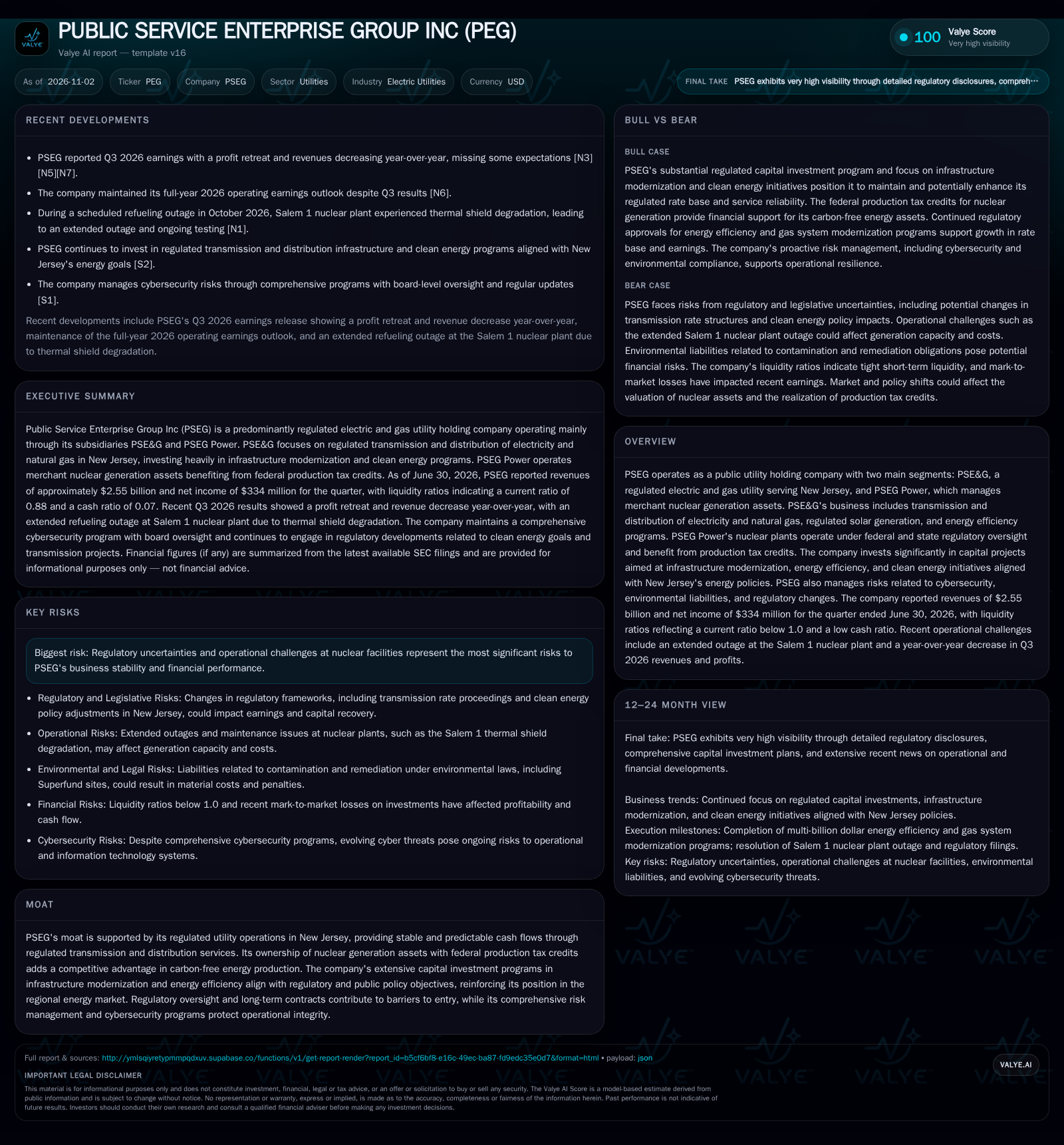
PSEG’s Q3 2026 profit retreat and revenue decline highlight the earnings sensitivity of its merchant nuclear assets and the operational risks of its large regulated utility. Continued capital investment in grid modernization and clean energy remains core, but near-term financials are pressured by outages and mark-to-market losses. The company’s future value depends on successful regulatory navigation, resolution of nuclear issues, and capturing policy-driven growth opportunities in infrastructure and clean energy. [S2] [N1] [N3] [N5] [N7]
Public Service Enterprise Group (PSEG) is at a strategic crossroads. While its core regulated utility in New Jersey is in the midst of an ambitious multi-billion-dollar modernization and clean energy investment cycle, the company’s Q3 2026 results revealed both the strengths and vulnerabilities of its hybrid model. With profit and revenue declines driven by operational setbacks at its nuclear assets and market-driven investment losses, PSEG’s near-term prospects are under pressure. Yet, its long-term value proposition rests on converting policy mandates and regulatory support into sustained rate base and earnings growth—while managing the material risks of nuclear operations, environmental obligations, and evolving utility demands.
Recent Profit Pressures and Nuclear Outage Reshape the Earnings Debate
PSEG reported Q3 2026 revenue of $2.55 billion and net income of $334 million, with earnings and revenue declining year-over-year and missing some market expectations. This setback was partly driven by mark-to-market investment losses and, critically, the extended outage at Salem 1, where thermal shield degradation was discovered during a scheduled refueling in October 2026. The outage reduces merchant nuclear generation at a time when federal production tax credits are a key revenue source for PSEG’s nuclear fleet. Operational disruptions at nuclear units can have disproportionate earnings impacts, especially when combined with lower market gains. The company’s current ratio of 0.88 and cash ratio of 0.07 indicate tight liquidity but not acute distress. PSEG maintained its full-year 2026 operating earnings outlook despite these headwinds, suggesting management confidence in underlying fundamentals or regulatory recovery mechanisms. [S2] [N1] [N3] [N5] [N7]
How PSEG’s Hybrid Model Generates Value—And Where It’s Exposed
PSEG’s business model is anchored in its regulated utility (PSE&G), which delivers stable cash flows through transmission and distribution of electricity and gas under state oversight. The regulated segment benefits from predictable rate recovery on capital investments—PSE&G’s rate base grew from $34 billion in 2024 to $36 billion in 2025, reflecting ongoing infrastructure, energy efficiency, and clean energy deployments. Regulated utilities typically enjoy limited competition and pass-through mechanisms for many costs, but face constraints on returns and require continual regulatory approval for capex recovery.
PSEG Power’s merchant nuclear operations are exposed to market prices but are currently supported by federal production tax credits (PTCs) through 2032, which help stabilize revenues amid volatile power markets. However, these units carry high fixed costs, long refueling cycles, and material operational risks—as demonstrated by the Salem 1 outage. Margins here are highly sensitive to capacity factors and market prices, and PTCs help mitigate—but not eliminate—downside.
PSEG’s $24–28 billion capital investment plan for 2026–2030 is heavily weighted to regulated projects, with $22.5–$25.5 billion allocated to infrastructure, grid modernization, and clean energy initiatives. These investments, if approved for rate recovery, can drive long-term earnings growth via rate base expansion. However, the scale of spending requires ongoing regulatory alignment and prudent balance-sheet management, given the company’s currently tight liquidity and the need to fund both maintenance and growth capex. [S2]
Regulated Monopoly, Nuclear Advantage, and the Challenge of Policy Shifts
PSEG’s main competitive strength lies in its position as a regulated utility monopoly in New Jersey, where barriers to entry are high and returns are supported by regulatory frameworks. Its ownership of nuclear assets, combined with federal PTCs, provides a lower-carbon generation mix and revenue stability relative to merchant peers lacking such support. PSEG’s ability to execute on large-scale capex in transmission, distribution, and clean energy positions it to benefit from public policy trends favoring grid modernization and decarbonization.
However, PSEG faces several counterforces. Regulatory and legislative changes—such as shifts in rate design, cost recovery, or clean energy mandates—could affect allowed returns and capital recovery. The company’s nuclear fleet, while advantaged by PTCs, is also exposed to policy risk should political winds shift or subsidies be re-evaluated. Competition in the wholesale power market is less relevant to the utility segment but can affect merchant generation economics. Finally, environmental liabilities and regulatory scrutiny over reliability, cybersecurity, and affordability remain persistent sources of risk and potential cost pressure.
Policy Tailwinds and Execution Unlock Accelerated Rate Base Growth
In a favorable scenario, PSEG’s regulated capital investment program proceeds smoothly, with state and federal regulators approving rate base expansion and cost recovery at attractive returns. The company successfully completes key infrastructure and clean energy projects—such as gas system modernization and energy efficiency programs—on time and on budget. Nuclear operations remain reliable, with outages minimized and production tax credits fully realized through 2032, providing a stable earnings floor.
Additional upside could come from new transmission projects or competitive solicitations beyond New Jersey, tapping into regional grid upgrades and federal infrastructure incentives. If the regulatory environment remains constructive, PSEG could achieve faster-than-expected rate base and earnings growth, supported by policy-driven demand for grid resilience and clean energy.
Evidence that would confirm this scenario includes: consistent increases in regulated rate base, above-consensus regulated earnings growth, successful resolution of nuclear outages, and new project wins with approved cost recovery. Conversely, delays in regulatory approvals, cost overruns, or further operational setbacks would falsify the strong upside case.
Modest Earnings Growth Amid Regulatory Complexity and Operational Uncertainty
The most plausible path for PSEG is a continuation of steady, regulated rate base growth, punctuated by periodic operational or regulatory challenges. The company’s core utility segment delivers incremental earnings expansion as infrastructure and clean energy investments are gradually incorporated into rates. Nuclear generation remains a source of both opportunity and risk: while PTCs provide a revenue backstop, operational incidents or extended outages periodically weigh on earnings, as seen in 2026.
Mark-to-market swings and environmental remediation costs add noise to quarterly results.
Confirmation of this scenario would include stable or slowly rising regulated earnings, manageable outage durations at nuclear assets, and continued regulatory approvals for capital projects. Evidence of prolonged nuclear downtime, regulatory pushback, or unexpected cost spikes would suggest downside risk.
Nuclear Setbacks, Regulatory Friction, and Funding Constraints Erode Value
A negative outcome could unfold if PSEG experiences further operational challenges at its nuclear fleet—such as extended or repeated outages, unplanned repairs, or safety incidents—that materially reduce generation and earnings despite PTCs. If regulatory or political momentum turns against utility capex or clean energy incentives, PSEG could face delays or disallowances in rate recovery, compressing returns and straining cash flow.
Tight liquidity could become a constraint if cost overruns or environmental liabilities accelerate, forcing asset sales, equity raises, or dividend cuts. Mark-to-market losses on investments or decommissioning trusts could further pressure reported earnings. Environmental or cybersecurity incidents could trigger regulatory penalties or reputational harm.
This scenario would be confirmed by prolonged or repeated nuclear outages, regulatory denials of project approvals or cost recovery, rising debt or equity issuance, and dividend reductions. Conversely, rapid resolution of outages, supportive regulatory orders, and stable funding access would argue against the downside case.
How to Test PSEG’s Thesis: Regulatory, Operational, and Financial Milestones
Progress on the resolution and return-to-service timeline for Salem 1 and any other nuclear outages.
Quarterly and annual changes in PSE&G’s regulated rate base—evidence of capex execution and regulatory approval.
Updates on regulatory proceedings and cost recovery for major capital projects, including transmission, energy efficiency, and clean energy initiatives.
Detailed disclosures on nuclear plant capacity factors, maintenance events, and production tax credit realization—if disclosed.
Liquidity developments: changes in cash, short-term borrowing, and funding sources to support ongoing capex.
Environmental remediation costs, legal developments, or new liabilities related to legacy contamination.
Cybersecurity incident reports or enhancements to risk management frameworks, given the evolving threat landscape.
Disclaimer: This is research-only, informational analysis and not investment advice. It may include AI-generated interpretation and general industry context. Always verify important details using primary sources.

Comments