
Imperial Oil’s Operating Leverage and Oil Sands Focus: Resilience, Risks, and Transition Stakes
Imperial Oil’s robust Q3 2026 results underscore the earnings power of its integrated model and oil sands scale, but also highlight the capital intensity, regulatory scrutiny, and transition risks inherent to its Canadian footprint. Its future will likely hinge on cost discipline, project execution, and the pace of lower-emissions adoption.
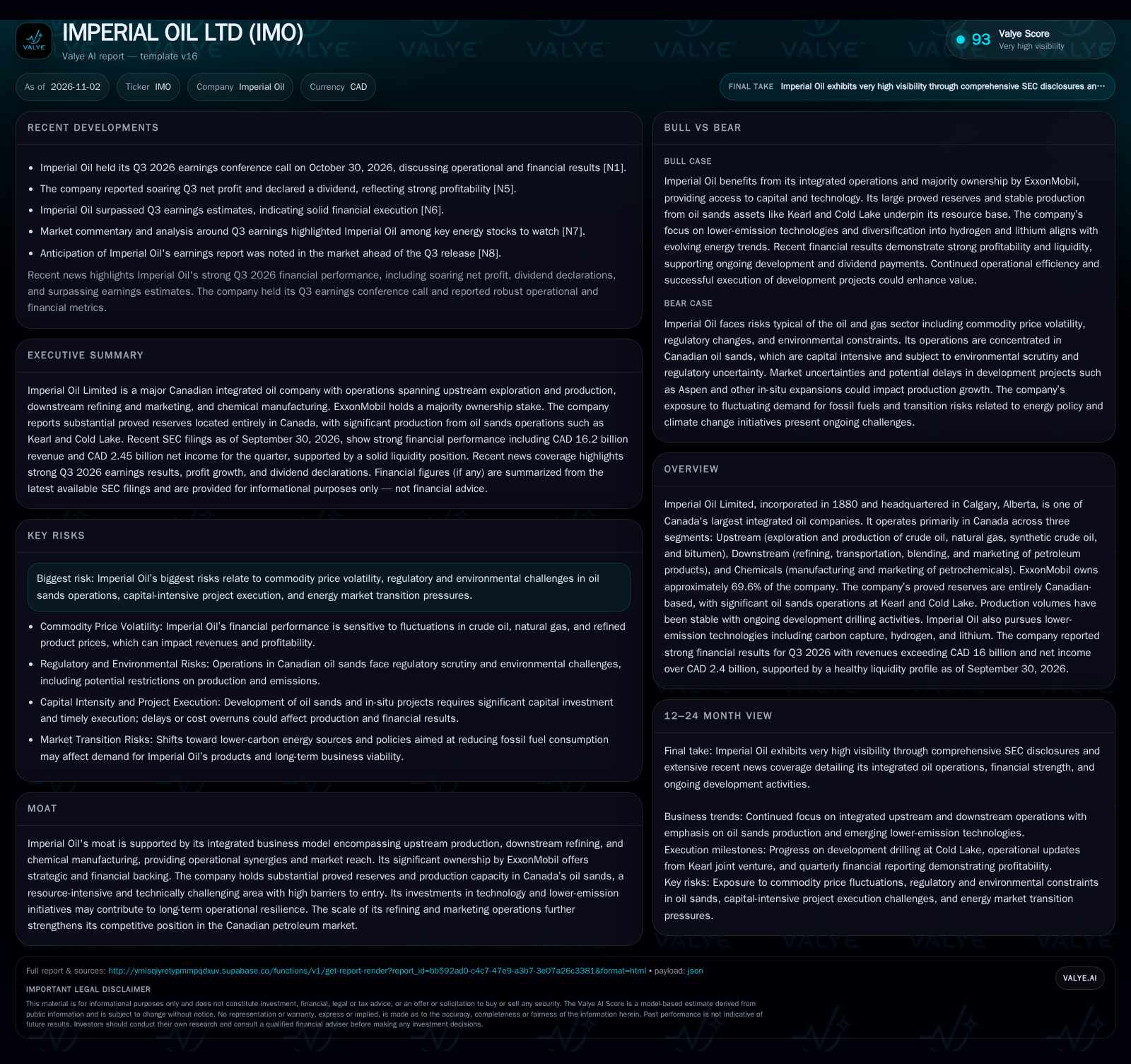
Imperial Oil reported CAD 16.2 billion in Q3 2026 revenue and a net profit surge, backed by stable oil sands production and ExxonMobil’s majority stake. The company’s oil sands-driven economics offer high fixed-cost leverage, but expose it to commodity price swings, regulatory headwinds, and long-term transition pressure. Execution on development drilling and lower-emissions projects will be decisive for value creation and resilience as energy markets evolve. [S2] [N5] [N6]
Imperial Oil’s Q3 2026 results spotlight both the strengths and vulnerabilities of its integrated Canadian oil model. As one of the largest oil sands operators, Imperial delivers substantial cash flow and operating leverage when oil prices are favorable, as evidenced by its recent surge in net profit and strong revenue. However, its heavy concentration in capital-intensive, emissions-intensive oil sands exposes it to regulatory, environmental, and transition risks. The company’s ongoing investment in carbon capture and lower-emission technologies signals adaptation, but the pace and scale of these efforts will be critical in determining whether Imperial can sustain returns as the energy landscape evolves. [S2] [N5] [N6]
Recent Earnings Strength Meets Long-Term Strategic Questions
Imperial Oil reported Q3 2026 revenue of CAD 16.205 billion and net income of CAD 2.454 billion, with basic EPS of CAD 5.13—figures that exceeded market expectations and marked a period of strong profitability. These results were driven by stable production from core oil sands assets, ongoing development drilling at Cold Lake, and supportive commodity prices. The company reported cash and liquidity metrics for the period; these figures do not by themselves establish operating runway, investment capacity, financial flexibility, or financing capacity. ExxonMobil’s 69.6% ownership continues to anchor Imperial’s access to capital and technology, while also shaping its strategic flexibility. [S2] [N5] [N6]
Oil Sands Economics: Fixed-Cost Leverage and Capital Demands
Imperial Oil’s core economic engine is its oil sands production, particularly at Kearl (70.96% owned) and Cold Lake, which together account for the bulk of its 382,000 BOE/d average daily net production in 2025. The oil sands model is characterized by high upfront capital requirements and significant fixed operating costs, but can deliver strong operating leverage when realized prices are high. In 2025, Imperial’s average production costs were CAD 28.85 per barrel for bitumen and CAD 57.25 per barrel for synthetic crude oil, against average sales prices of CAD 67.01 and CAD 88.99, respectively. This spread can create substantial margin volatility depending on commodity cycles.
Downstream refining and chemicals add revenue diversity and margin stability, smoothing some of the volatility inherent to upstream operations. However, the integrated model also means that major capital projects—such as oil sands expansions or refinery upgrades—require sustained investment and disciplined execution. The economics of lower-emission ventures (carbon capture, hydrogen, lithium) are not yet proven at scale and could initially dilute returns unless supported by regulation or incentives. [S1] [S2]
Integrated Scale and Oil Sands Barriers: Moat or Constraint?
Imperial Oil’s competitive position is anchored by its integrated operations—upstream, downstream, and chemicals—and by the sheer scale of its Canadian oil sands reserves. Oil sands assets are difficult to replicate due to capital intensity, technical complexity, and regulatory hurdles, creating high entry barriers. This insulates Imperial from new entrants and affords it economies of scale, particularly in logistics and processing.
However, these same barriers can act as constraints in a rapidly evolving energy market. Oil sands projects are less flexible than conventional oil, making it harder to adjust output quickly or pivot to alternative resources. Environmental scrutiny and regulatory risk are heightened in Canada, especially for oil sands, which are among the most emissions-intensive forms of crude. Imperial’s investments in carbon capture and lower-emission technologies may help mitigate these risks, but their ultimate impact on competitive position will depend on execution, policy developments, and the pace of market transition toward lower-carbon fuels. [S1] [S2]
Cost Discipline, High Prices, and Successful Transition Could Unlock Value
If Imperial Oil continues to execute efficiently on development drilling—particularly at Cold Lake and Kearl—while maintaining cost discipline and capturing favorable commodity price spreads, it could further expand margins and cash flow. A supportive regulatory environment, or successful demonstration of large-scale carbon capture and hydrogen projects, could reduce transition risks and unlock new sources of value.
Upside would be confirmed by sustained high utilization at core oil sands assets, visible progress and cost-sharing on emissions-reduction projects, and evidence of competitive economics in lower-emission businesses (e.g., commercial contracts for hydrogen or carbon capture services). If Imperial can demonstrate that its oil sands assets are viable and profitable even under more stringent emissions policies, investor confidence and valuation could rise. [S2] [N5] [N6]
Stable Oil Sands Output and Incremental Emissions Progress Remain Central
The most plausible path for Imperial Oil is continued stable production from its core oil sands assets, with incremental improvements in cost efficiency and gradual rollout of lower-emission initiatives. Earnings and cash flow would remain sensitive to oil and gas prices, but the integrated model should continue to provide some buffer against volatility. Downstream and chemical operations are likely to support profitability during periods of upstream margin compression.
Progress on carbon capture and hydrogen would remain in pilot or early commercial phases, with limited near-term financial contribution. Regulatory and environmental headwinds would persist, but not fundamentally disrupt operations. Evidence supporting this scenario would include steady production volumes, modest cost improvements, and periodic regulatory approvals for emissions-reduction projects. Falsification would come from major regulatory setbacks, cost overruns, or sustained commodity price declines. [S1] [S2]
Commodity Shocks or Regulatory Clampdown Could Erode Earnings Power
A significant drop in oil or gas prices, or a material increase in production costs, could compress Imperial Oil’s margins and cash flow, given the fixed-cost leverage of oil sands. More severe would be a regulatory clampdown—such as new emissions limits, carbon taxes, or restrictions on oil sands development—which could force asset write-downs, delay projects, or require costly retrofits.
Downside risk would be confirmed by falling utilization rates at Kearl and Cold Lake, material cost overruns or project delays, adverse regulatory rulings, or a sharp increase in capital outlays for compliance. Persistent underperformance in lower-emission ventures, or evidence that these cannot be scaled economically, would further undermine the company’s long-term transition narrative. [S2] [N5]
Milestones That Will Clarify Imperial’s Oil Sands Resilience and Transition Trajectory
Production volumes and utilization rates at Kearl and Cold Lake—sustained output or operational disruptions would be highly material. [S2]
Average realized prices and production costs for bitumen and synthetic crude—margin compression or expansion will signal earnings power. [S1] [S2]
Progress, scale, and cost structure of carbon capture and hydrogen projects—commercialization milestones or large-scale partnerships would be validating.
Regulatory changes affecting oil sands emissions, taxes, or development approvals—new mandates or constraints could alter capital allocation and asset value.
Capital spending discipline and project execution—cost overruns or delays in key projects would indicate operational risk.
Downstream and chemical segment profitability—if disclosed, segment-level trends would help assess the resilience of the integrated model.
Market or policy developments accelerating the energy transition in Canada—carbon pricing, fuel standards, or demand shifts would test the adaptability of Imperial’s strategy.
Disclaimer: This is research-only, informational analysis and not investment advice. It may include AI-generated interpretation and general industry context. Always verify important details using primary sources.

Comments