
Cipher Mining’s Transition: From Bitcoin Roots to the Front Lines of AI-Driven Data Center Infrastructure
Cipher Mining, now Cipher Digital, is leveraging its expertise in large-scale power and site management to pivot from volatile bitcoin mining toward industrial-scale data center leasing for hyperscaler and HPC tenants. Its vast development pipeline, regulatory hurdles, and capital intensity will determine whether it can capitalize on AI-driven compute demand or become constrained by debt and permitting delays.
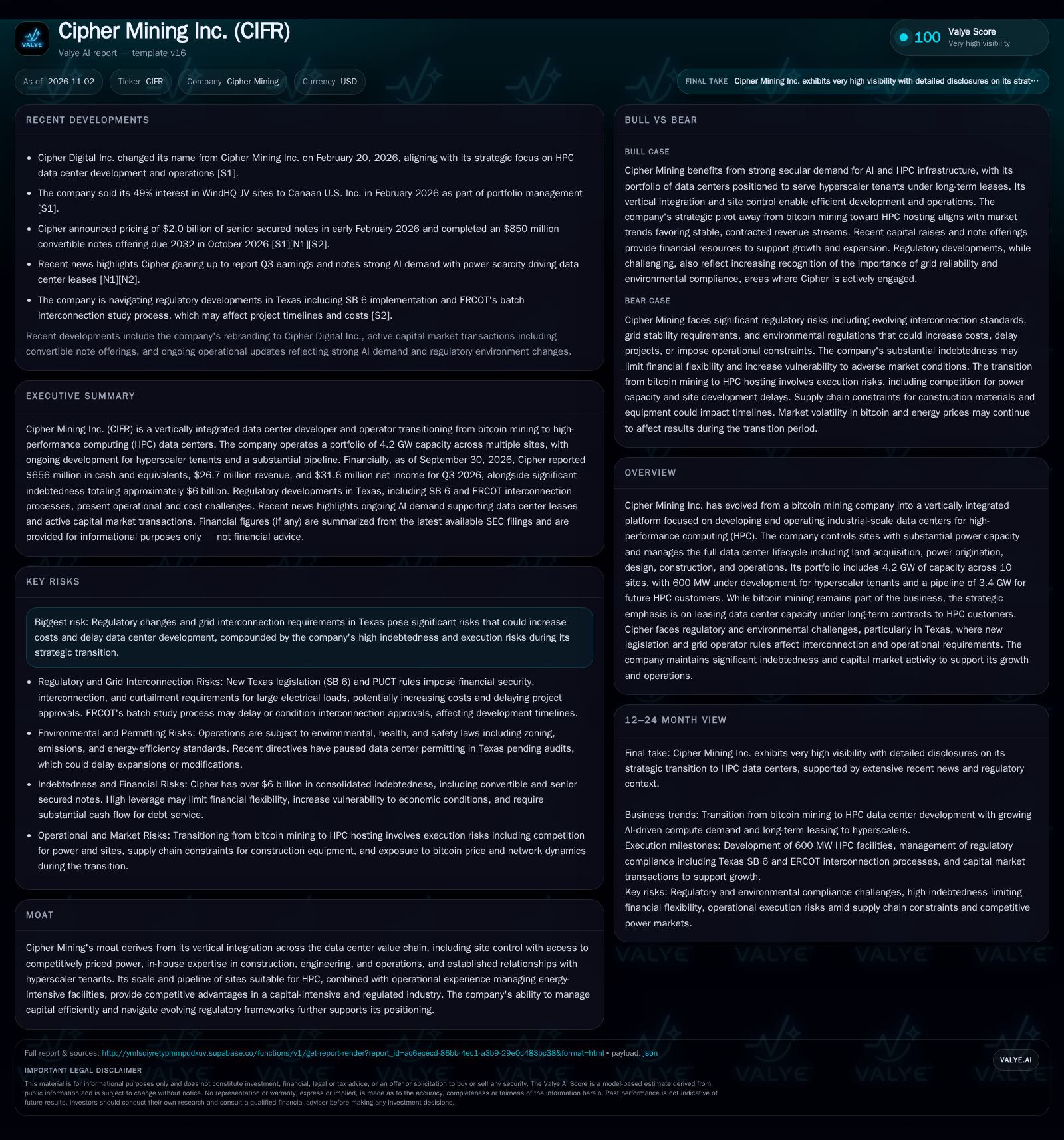
Cipher Mining (Cipher Digital) is rapidly shifting from bitcoin mining to developing and operating hyperscale data centers for AI and high-performance computing customers. The company controls 4.2 GW in capacity across 10 sites, with a major 600 MW under development for hyperscalers and a 3.4 GW pipeline. While recent quarters show positive net income and significant cash, Cipher’s $6 billion in debt and Texas-centric regulatory headwinds inject execution and financial risk. Its ability to secure long-term leases and navigate grid and permitting hurdles will shape the outcome of its high-stakes transformation. [S1] [S2]
Cipher Mining’s evolution into Cipher Digital marks a bold bet on the future of AI and high-performance computing infrastructure. Once a pure-play bitcoin miner, the company is now positioning itself as a vertically integrated developer, owner, and operator of industrial-scale data centers. With over 4 GW of capacity under control and a multibillion-dollar pipeline, Cipher aims to capture demand from hyperscalers starved for power and compute in an era of AI-driven digital transformation. Yet, this pivot brings new capital and regulatory complexities—especially in Texas, where grid rules and permitting can make or break project economics. The company’s financial leverage and execution on long-term leases will be the ultimate test of its reinvention. [S1] [S2]
Cipher’s Strategic Pivot: Financial and Operational Snapshot as of Late 2026
Cipher Mining, now operating as Cipher Digital, has completed a strategic pivot by rebranding and shifting its business focus from bitcoin mining to the development and operation of high-performance computing (HPC) data centers. As of September 30, 2026, the company reported $656 million in cash and cash equivalents, current assets of $2.49 billion, and current liabilities of $1.47 billion, resulting in a current ratio of 1.69. Total indebtedness stands at approximately $6.02 billion, including recent large-scale note offerings, with a revolving credit facility undrawn. [S2]
Operationally, Cipher controls 4.2 GW of capacity across 10 sites, with 600 MW under development for hyperscaler tenants and about 207 MW still dedicated to bitcoin mining. Most of its future growth is aimed at a 3.4 GW pipeline targeting HPC customers, mainly in Texas and Ohio. [S1]
The regulatory environment is evolving rapidly: Texas legislation (SB 6) and new grid interconnection rules (ERCOT batch studies) are increasing the complexity and timeline for bringing new data center capacity online. [S2]
Cipher’s recent sale of its WindHQ JV stake and active capital market transactions reflect a company in the midst of portfolio optimization and heavy reinvestment. [S1]
Shifting Revenue Streams: From Bitcoin Volatility to Contracted Data Center Income
Historically, Cipher’s economics were dominated by bitcoin mining—directly exposed to cryptocurrency price swings, network difficulty, and energy costs. Revenue was largely transactional, coming from block rewards and transaction fees, with cost structure heavily weighted toward electricity and mining equipment depreciation.
The company’s new business model seeks to capture more stable, long-duration revenues by leasing power-dense data center capacity to hyperscaler and HPC customers. This model typically involves multi-year contracts, with pricing driven by power availability, site readiness, and the premium placed on low-latency, high-reliability compute environments. If Cipher can successfully execute on long-term leases, it could achieve higher revenue visibility and margin stability compared to pure bitcoin mining.
The capital intensity of the business remains extremely high. Securing, interconnecting, and developing industrial-scale sites with hundreds of megawatts requires substantial up-front investment, often funded by debt and equity raises. Fixed costs (land, substations, construction) are significant, but once sites are operational and leased, operating leverage can be strong—incremental margins on additional tenants are typically high, provided utilization rates are robust.
However, the transition phase is cash-hungry: debt service costs on $6 billion of obligations will require substantial, predictable cash flows, and any mismatch between capital deployment and lease-up could create liquidity pressure. [S2]
Can Vertical Integration and Site Control Offset Intense Data Center Competition?
Cipher’s value proposition is built on vertical integration: it controls the full lifecycle from site selection and power origination to construction, engineering, and operations. In an environment where power availability is the gating factor for data center expansion, site control and utility relationships are critical potential advantages.
The shift to serving hyperscaler and HPC tenants puts Cipher in direct competition with established data center REITs, independent developers, and energy-focused infrastructure players. Key competitive factors include ability to secure grid interconnections, speed and cost of development, and relationships with large cloud/AI customers.
Texas offers large-scale power at attractive rates but is also the epicenter of new regulatory and environmental scrutiny. This creates both barriers to entry (for less sophisticated competitors) and risk of project delays or cost overruns. If Cipher can consistently deliver sites that meet hyperscaler requirements for power density, reliability, and environmental compliance, its scale and in-house expertise could provide a moat. But the capital markets’ willingness to fund this expansion, and tenants’ willingness to sign long-term leases in a rapidly evolving tech landscape, remain open questions.
If AI Demand Remains Relentless and Cipher Delivers on Lease-Up
The most favorable outcome for Cipher is a scenario where AI-driven demand for compute infrastructure continues to outpace supply, particularly in power-constrained regions like Texas. In this case, hyperscaler and HPC tenants could be willing to sign long-term, premium-priced leases for access to large, ready-to-operate sites.
If Cipher succeeds in securing grid interconnections and timely permitting for its 600 MW under development and the larger 3.4 GW pipeline, it could quickly ramp contracted revenue, achieve high utilization, and generate strong operating leverage. The conversion of development pipeline into leased, income-producing assets would validate the business model, support debt service, and potentially unlock additional capital market appetite for further expansion.
Evidence that would confirm this scenario includes the announcement of multi-year, large-scale lease agreements with major hyperscalers, consistently high utilization rates at new facilities, and successful navigation of Texas regulatory hurdles without major delays or cost overruns. A reduction in exposure to bitcoin mining revenue would also signal successful transition.
Execution and Regulatory Friction Define the Likely Outcome
The most plausible near-term scenario is a mixed picture: AI/HPC demand remains robust, but Cipher’s pace of development and lease-up is periodically constrained by Texas regulatory friction, permitting delays, and the operational complexities of scaling multiple large sites.
Cipher may secure some large tenant agreements, supporting a gradual shift of revenue mix toward contracted leases, but the timing of lease commencements and cash flows is likely to be uneven. Debt service costs will remain a drag on free cash generation, and the company may need further capital market activity to bridge gaps between investment and stabilized cash flows.
This scenario would be confirmed by a steady, if lumpy, cadence of lease signings and site activations, offset by periodic delays or cost increases tied to local permitting or ERCOT interconnection rules. Continued disclosure of bitcoin mining as a material revenue contributor would indicate a slower transition. Watch for management commentary on project timelines, lease negotiations, and regulatory compliance as real-time barometers.
When Power, Permitting, or Leases Don’t Materialize: The Leverage Trap
The adverse scenario for Cipher is a combination of regulatory bottlenecks and capital market fatigue. If ERCOT’s batch studies or Texas permitting audits significantly delay new capacity, Cipher could face extended periods of underutilized assets, delayed revenue, and rising interest costs on its $6 billion debt load.
If AI/HPC demand softens, competitive supply increases, or hyperscalers slow their pace of new leasing, Cipher may struggle to fill new capacity at attractive terms. In this case, debt service could crowd out growth investment or force asset sales at unfavorable prices.
Evidence that would confirm this scenario includes a pattern of missed project milestones, limited or no disclosure of major lease agreements, rising financing costs, or a return to outsized reliance on volatile bitcoin mining revenue. Regulatory setbacks, such as failed or delayed interconnections, would also be red flags. Material equity dilution or distressed asset sales would further indicate that the business model is under stress.
Testing Cipher’s Transformation: Concrete Milestones for the Next 12-24 Months
The pace and scale of new long-term lease signings with hyperscaler and HPC customers—announcements of multi-year, multi-megawatt agreements would validate demand and revenue transition.
Achievement of grid interconnection and permitting milestones for the 600 MW under development and progress on the 3.4 GW pipeline—delays or cost overruns here would undercut the growth thesis.
Utilization rates and occupancy levels at newly activated data center sites—if disclosed, these would measure Cipher’s ability to translate capacity into revenue.
Revenue mix evolution: the proportion of total revenue from contracted data center leases versus bitcoin mining—clear progress here would signal successful execution.
Debt service coverage ratio and free cash flow trends, especially as new projects come online—sustained negative free cash flow or rising leverage would signal financial strain.
Updates on regulatory and permitting actions in Texas—new requirements, delays, or curtailments could materially impact project delivery.
Management disclosures on capital allocation, further asset sales, or additional capital market activity—these would indicate whether growth is self-funding or increasingly reliant on external financing.
Disclaimer: This is research-only, informational analysis and not investment advice. It may include AI-generated interpretation and general industry context. Always verify important details using primary sources.

Comments