
Entergy Texas: Regulatory Leverage, Market Complexity, and the Stakes of Cost Recovery in a Shifting Utility Landscape
Entergy Texas’s core value proposition remains anchored in its regulated utility model, with recent financial performance underscoring the stability of cost-of-service frameworks. Yet, regulatory timing, evolving MISO market constructs, and the growing influence of large-scale data center loads introduce new layers of uncertainty and potential upside. The company’s ability to navigate rate proceedings, manage fuel cost volatility, and adapt to changing grid dynamics will determine whether its high barriers to entry translate into durable earnings power.
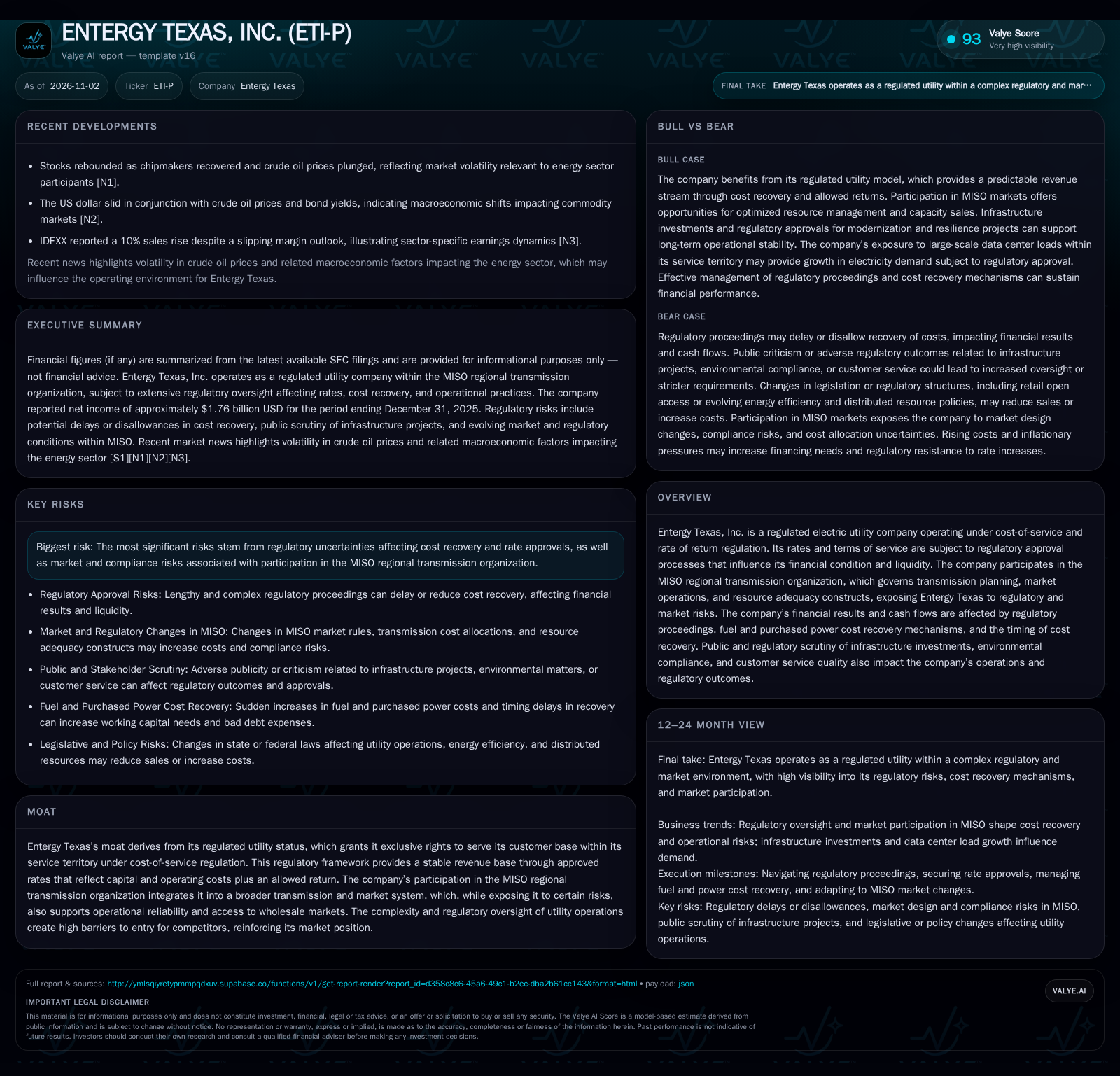
Entergy Texas reported net income of approximately $1.76 billion for 2025, reflecting the relative earnings predictability of a regulated utility. The company’s financial outcomes hinge on regulatory approval of rates, cost recovery for fuel and purchased power, and the evolving landscape of the MISO market. Growth opportunities from data center demand, if realized and approved, could shift the demand curve, but regulatory lag and public scrutiny remain persistent risks [S1].
Entergy Texas, Inc. exemplifies the dynamics of a modern regulated electric utility: strong earnings visibility rooted in cost-of-service regulation, but operational and financial results subject to the unpredictable tides of regulatory oversight and market evolution. With 2025 net income of $1.76 billion, the company’s performance highlights the resilience of the utility model—yet also points to the persistent influence of rate case timing, fuel cost pass-throughs, and the increasing complexity of operating within the MISO regional transmission organization. As Texas’s grid faces new demands from infrastructure investments and the rise of large-scale data centers, Entergy Texas’s future will hinge on its regulatory strategy, its ability to secure timely cost recovery, and its adaptability to shifting market constructs [S1].
Recent Earnings, Regulatory Anchors, and the Shifting Demand Landscape
Entergy Texas reported net income of approximately $1.76 billion for the period ending December 31, 2025, underscoring the core stability of its regulated utility model [S1]. The company’s rates and terms of service are dictated by state and federal regulatory commissions through cost-of-service and rate-of-return proceedings, which remain the central determinant of profitability. However, these regulatory processes can be lengthy, subject to appeal, and may delay or disallow full cost recovery, directly impacting financial results and liquidity. The company’s participation in the MISO regional transmission organization adds another layer of complexity, exposing it to market design changes, transmission cost allocations, and resource adequacy rules—all of which could affect both operational flexibility and future returns. Emerging demand from large-scale data centers in its territory, if approved and integrated, could become a material growth vector, but remains subject to regulatory scrutiny and infrastructure investment requirements.
How Regulated Returns and Cost Recovery Shape Entergy Texas’s Profit Engine
Entergy Texas’s revenue model is fundamentally tied to cost-of-service regulation: the company is allowed to recover prudently incurred capital and operating costs, plus a regulated return on invested capital, through rates set by regulatory commissions. This model typically produces highly predictable cash flows and low credit risk, provided regulatory lag is minimized. The economics are dominated by capital expenditures on generation, transmission, and distribution infrastructure—costs that are only recoverable once incorporated into rate base via regulatory approval. Operating leverage is muted: while fixed costs are high, the ability to pass through many variable costs (such as fuel and purchased power) to customers via rate mechanisms limits margin volatility. However, if regulators delay or disallow cost recovery, Entergy Texas may face increased working capital or borrowing needs, as seen in cases where fuel costs or storm restoration expenses spike before rate adjustments are approved. Large new loads, such as data centers, could offer incremental revenue and asset base growth, but only if the company secures timely regulatory approval to invest and recover associated costs.
Barriers to Entry, Regulatory Moats, and the Risks of Market Evolution
As a regulated utility, Entergy Texas enjoys exclusive rights to serve its defined territory, with competitors effectively barred by law and regulatory structure. The complexity and capital intensity of utility operations, coupled with the requirement for regulatory approval of rates, make direct competition unlikely. However, the landscape is not static: potential substitutes include distributed energy resources, energy efficiency mandates, and, over the long term, policy shifts toward retail open access. Within the MISO regional transmission organization, Entergy Texas interacts with a broader pool of utilities and independent power producers, introducing both operational synergies and exposure to shared transmission costs, market structure changes, and evolving resource adequacy constructs. Public scrutiny—especially regarding infrastructure projects, storm preparedness, and environmental compliance—can influence regulatory outcomes, making stakeholder management a potentially leading component of competitive positioning.
Unlocking Growth: Data Center Demand and Regulatory Efficiency as Catalysts
A favorable scenario emerges if Entergy Texas successfully navigates regulatory proceedings to approve substantial infrastructure investments tied to new large-scale data center loads. If regulators grant timely cost recovery and allow the company to expand its rate base, Entergy Texas could see above-trend earnings growth, supported by increased demand and higher capital deployment. Participation in MISO could further optimize resource utilization and capacity sales, adding incremental margin if market rules remain favorable. Evidence confirming this scenario would include expedited regulatory approvals for major capital projects, public announcements of new data center interconnections backed by approved rate mechanisms, and sustained growth in allowed rate base and net income. Conversely, a lack of regulatory support or protracted approval timelines would quickly falsify this outcome.
Steady-State Returns Amid Regulatory and Market Uncertainties
The most plausible near-term scenario is continued earnings stability anchored in cost-of-service regulation, with modest growth driven by incremental infrastructure investments and gradual demand increases. Regulatory proceedings are likely to remain lengthy and occasionally contentious, leading to periodic delays in cost recovery but not widespread disallowances. Participation in MISO will continue to present both opportunities and risks, but will not fundamentally disrupt the company’s revenue model. Evidence supporting this scenario would be ongoing net income in line with historical averages, approval of routine rate cases, and the absence of major adverse regulatory or market design changes. Signs of increasing regulatory lag, material cost disallowances, or volatility in fuel recovery could challenge this base case.
When Regulatory Lag, Public Scrutiny, and Market Shifts Collide
A negative outcome would materialize if Entergy Texas encounters prolonged regulatory delays, significant cost disallowances, or heightened public opposition to infrastructure projects—resulting in unrecovered costs, compressed returns, and increased borrowing needs. Adverse shifts in MISO market rules or transmission cost allocations could further erode profitability, especially if the company is unable to pass through rising costs to customers. Evidence that would confirm this scenario includes regulatory orders denying or deferring recovery of major expenses, escalating working capital or short-term debt balances linked to unrecovered costs, and negative outcomes from MISO market changes. Concrete examples could include public controversies over storm response or environmental compliance leading to adverse rate decisions, or legislative moves toward retail competition or aggressive distributed energy mandates.
Thesis-Defining Developments to Track for Entergy Texas
The timing, size, and outcome of major regulatory rate cases—especially those tied to new infrastructure or large load interconnections—would provide direct evidence of the company's ability to recover costs and grow its rate base.
Approval processes and public communications regarding data center interconnections: Announcements of new large-scale loads, along with regulatory filings and decisions, will clarify potential upside.
Trends in fuel and purchased power cost recovery: Delays, disallowances, or large unrecovered balances would signal increased risk to earnings and liquidity.
Changes in MISO market rules, transmission cost allocations, or resource adequacy constructs: Regulatory filings and market notices would help assess incremental risks or opportunities.
Evidence of public or stakeholder opposition to major capital projects, including media coverage or regulatory interventions, could foreshadow future cost recovery challenges.
Shifts in working capital or short-term debt balances, if disclosed, may indicate regulatory lag or cost recovery timing mismatches.
New legislation or regulatory initiatives affecting utility regulation, distributed energy resources, or retail competition in Texas would be material to the long-term outlook.
Disclaimer: This is research-only, informational analysis and not investment advice. It may include AI-generated interpretation and general industry context. Always verify important details using primary sources.

Comments