
Fox Corp’s Media Model: Cash Strength, Earnings Power, and the Stakes of Industry Evolution
The company’s next phase will hinge on its ability to leverage brand assets, navigate regulatory uncertainty, and extract value from changing advertiser and viewer dynamics.
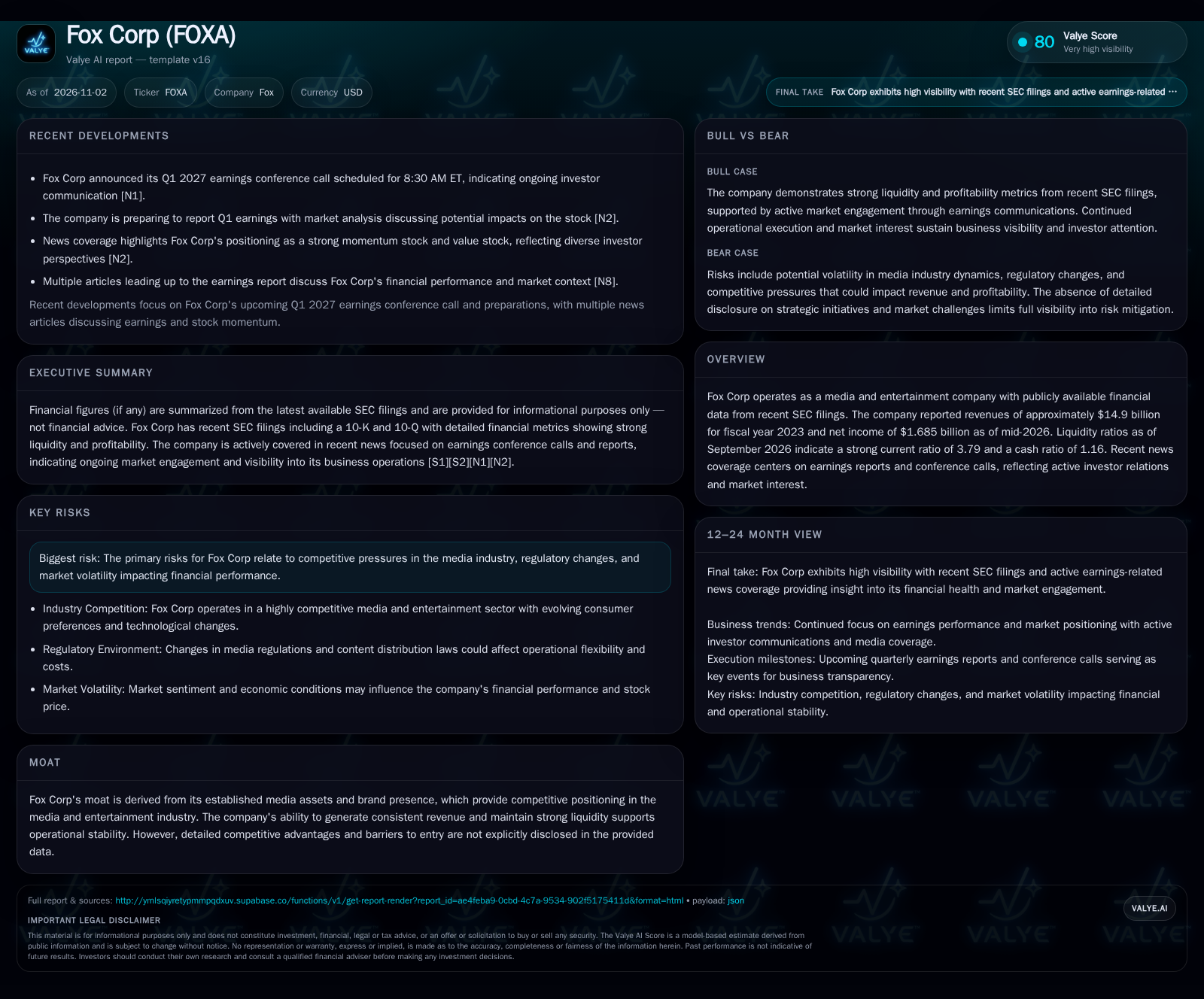
Fox Corp reported $14.9 billion in revenue for fiscal 2023 and $1.685 billion in net income as of mid-2026, with a reported current ratio of 3.79 and a cash ratio of 1.16. Upcoming earnings and strategic disclosures will clarify whether Fox can sustain or expand its profit base amid secular pressures.
Fox Corp enters late 2026 with a formidable combination of cash reserves, liquidity, and ongoing profitability, as evidenced by its most recent quarterly and annual filings. The company’s $14.9 billion revenue base and nearly $1.7 billion in net income reflect the enduring strength of its core media assets. However, Fox’s future will depend less on balance sheet health and more on its ability to navigate the shifting sands of media distribution, advertising economics, and regulatory frameworks. Investors and analysts are watching closely as Fox prepares for its next earnings release, seeking clarity on whether operational momentum can be sustained as the broader media landscape undergoes rapid change.
Earnings Power and Liquidity Define Fox Corp’s 2026 Starting Point
Fox Corp reported net income of $1.685 billion as of June 2026, and a revenue base of $14.913 billion for the fiscal year ending June 2023 [S2]. The company’s current assets stood at $9.202 billion against $2.429 billion in current liabilities as of September 2026, resulting in a current ratio of 3.79 and a cash ratio of 1.16 [S2]. These metrics confirm that Fox maintains a substantial liquidity buffer and remains solidly profitable. With earnings per share of $2.24 (basic) and $2.20 (diluted) for the September 2026 quarter [S2], the company demonstrates ongoing earnings momentum. However, as Fox approaches its next earnings release, the market’s focus is shifting towards the sustainability of these figures and the company’s ability to defend or grow its profit base amid intensifying industry change [N2] [N8].
How Fox’s Media Economics Could Shift with Industry Disruption
Fox Corp’s business model relies on a mix of advertising revenue, affiliate fees from cable and satellite providers, and content licensing. Historically, the economics of this model have depended on scale—leveraging fixed costs across a large audience base and extracting high-margin revenue from premium live content (notably news and sports). This structure provides inherent operating leverage: as ratings and ad sales rise, incremental revenues fall disproportionately to the bottom line. However, secular declines in linear TV viewership and the migration of advertising dollars to digital platforms pose long-term risks to both the pricing power and volume of Fox’s traditional revenue streams.
On the cost side, Fox faces a relatively high fixed-cost base, particularly for marquee content acquisition (sports rights, talent contracts) and distribution infrastructure. While this can amplify margins in periods of revenue growth, it also exposes the company to margin compression if revenues stall or contract. The company reported cash and liquidity metrics for the period; these figures do not by themselves establish operating runway, investment capacity, financial flexibility, or financing capacity. [S2] The company’s ability to adapt will depend on its agility in reallocating capital towards growth segments—such as direct-to-consumer streaming or digital ad tech—without eroding the economics of its core franchises.
If Fox can successfully transition more of its content to digital platforms and extract recurring revenue from subscriptions or next-gen ad formats, margin profiles could improve over time. Conversely, failure to offset linear TV declines with digital growth could result in negative operating leverage, especially if fixed costs remain sticky.
Defending Brand Assets Amid Evolving Media Competition
Fox’s primary competitive advantages rest in its established brand, portfolio of premium live content, and longstanding relationships with advertisers and distributors. In the U.S. market, Fox’s position as a leading provider of news and sports content offers some insulation from pure-play streaming competitors, as these genres remain among the most valuable for both advertisers and pay-TV distributors.
However, the competitive landscape is shifting. Digital-native platforms, big tech entrants, and vertically integrated media conglomerates are capturing a growing share of both audience attention and advertising budgets. Subscription video-on-demand (SVOD) and ad-supported streaming services offer consumers more flexibility, often at lower cost, eroding the traditional pay-TV bundle that long underpinned Fox’s affiliate revenue. Additionally, regulatory scrutiny of media concentration and content standards could constrain Fox’s strategic maneuvering or increase compliance costs.
The question is whether Fox’s content portfolio and brand affinity will be enough to sustain pricing power and advertiser demand as media consumption fragments. Partnerships, exclusive content rights, and investments in digital distribution may become increasingly important to defend market share and profitability.
Leveraging Live Content and Digital Expansion to Outperform
In a favorable scenario, Fox capitalizes on its strength in live news and sports to maintain premium ad pricing and secure advantageous affiliate deals, even as the pay-TV universe contracts. If Fox accelerates its pivot to digital—either by launching or scaling proprietary streaming platforms, integrating advanced ad tech, or monetizing content through new licensing partnerships—it could capture a disproportionate share of the industry’s shift to digital video and advertising.
Success would likely be confirmed by evidence of growing digital revenue as a share of the total, stabilization or growth in affiliate fees despite pay-TV erosion, and margin expansion as digital operating leverage kicks in. Additional confirming evidence would include consistent ratings strength in live programming, new content rights acquisitions, and management disclosures about digital subscriber growth or advertiser demand shifting to Fox’s owned-and-operated platforms.
Falsification would be signaled by persistent declines in total revenue, margin compression outpacing peers, or evidence that digital initiatives are failing to offset linear revenue headwinds.
Navigating a Plateau: Stable Profits but Limited Growth
The most plausible trajectory is that Fox’s core earnings remain stable or grow modestly over the next 12–24 months. The company reported profitability for the period. However, secular headwinds—linear TV cord-cutting, digital competition, and potential regulatory changes—are likely to cap top-line growth and limit margin expansion.
Evidence supporting this scenario would include relatively stable annual revenues, modest EPS growth, and maintenance of current liquidity ratios [S2]. Fox may announce incremental digital initiatives and partnerships, but these are unlikely to fundamentally transform its revenue mix in the near term. Falsification would be signaled by either a sharp deterioration in financials (suggesting loss of pricing power or competitive relevance) or a breakthrough in digital monetization that materially accelerates growth.
Erosion of Legacy Economics and Weak Digital Transition
In an adverse scenario, Fox experiences accelerating declines in its core linear TV revenues, driven by cord-cutting and advertiser migration to digital platforms. If the company is unable to build scale in digital distribution or capture meaningful share of digital ad spend, fixed costs associated with premium content and regulatory compliance could pressure margins and ultimately profitability.
Additional red flags would include ratings declines in core franchises, loss of major affiliate agreements, or regulatory actions that restrict content or distribution flexibility.
A failure to articulate or execute a credible digital strategy would further heighten risk, especially if competitors demonstrate stronger digital growth or innovation.
Milestones That Will Clarify Fox’s Resilience and Adaptation
The growth trajectory of digital and streaming revenue as a share of total company revenue, if disclosed, will be a critical test of Fox’s adaptation to new media consumption patterns.
Affiliate fee trends—both rates and aggregate volume—will reveal whether Fox can maintain pricing power in a shrinking pay-TV universe.
Advertising revenue mix and CPMs for live content versus digital inventory would help clarify the company’s ability to defend or grow ad economics.
Ratings and audience share for flagship live programming (news, sports) remain crucial indicators of brand strength and advertiser appeal.
Any major acquisitions, joint ventures, or technology partnerships aimed at digital expansion should be scrutinized for strategic fit and incremental value.
Management commentary and disclosures regarding regulatory risks and compliance costs could foreshadow future margin pressures or operational constraints.
A useful metric would be digital subscriber count and engagement rates for any owned-and-operated streaming platforms, as this would indicate progress in building direct-to-consumer relationships.
Disclaimer: This is research-only, informational analysis and not investment advice. It may include AI-generated interpretation and general industry context. Always verify important details using primary sources.

Comments