
Marriott International: Fee-Driven Growth, Capital-Light Expansion, and the Stakes of Partner Reliance
Marriott’s scaled global platform and brand architecture yield robust fee-based earnings with minimal property ownership—yet its model faces real-world tests from owner-dependence, liquidity structure, and the evolving economics of lodging demand.
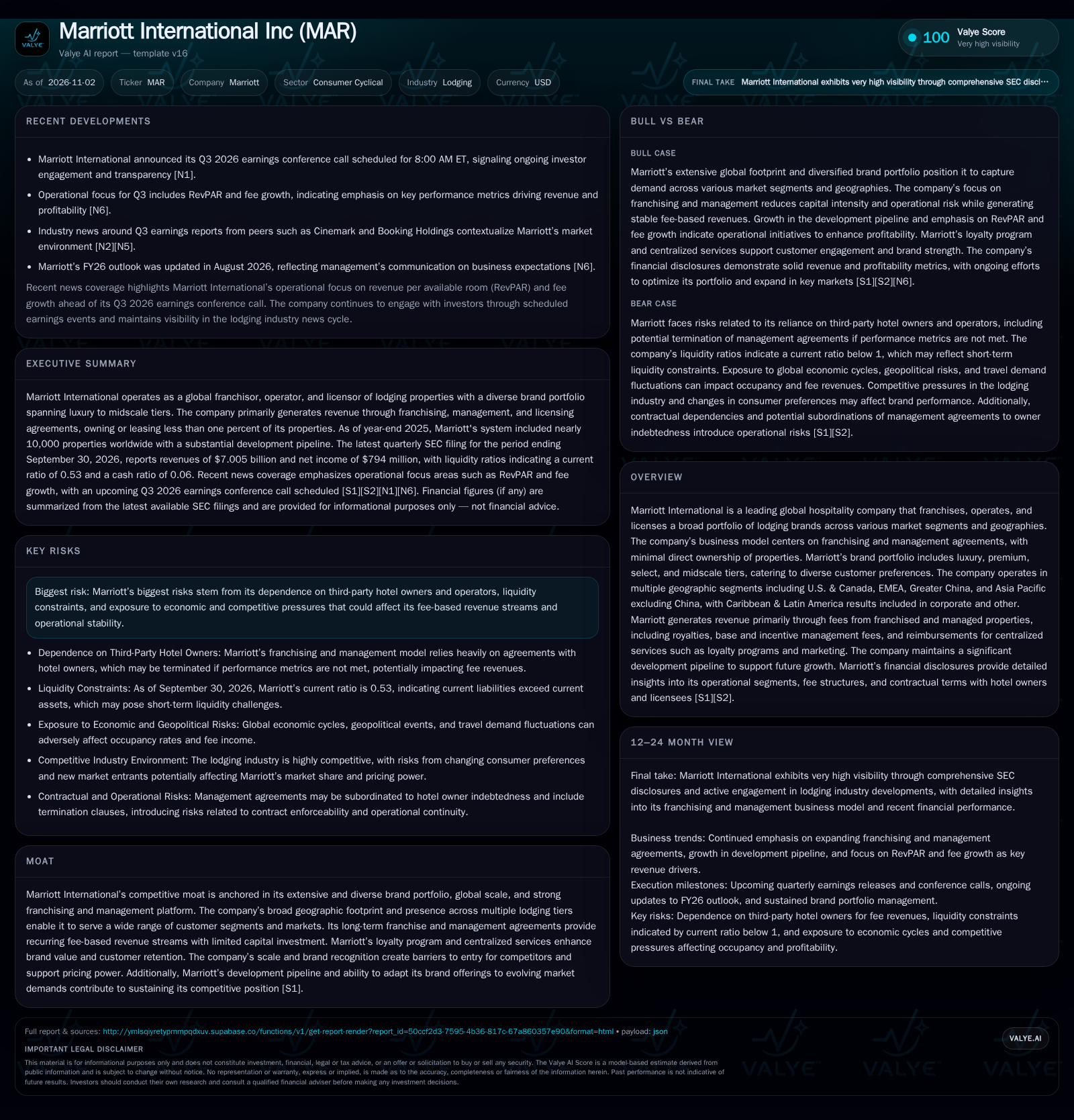
Marriott’s latest results highlight the durability and global reach of its capital-light, fee-centric model. With nearly 10,000 properties under its system and a major development pipeline, the company’s revenue and profitability remain underpinned by long-term franchising and management contracts. However, a current ratio well below 1 and reliance on third-party owners introduce operational and financial watchpoints. The core thesis is whether Marriott’s scale, brand strength, and service integration can offset the risks of partner leverage, contractual churn, and cyclical shocks as the lodging landscape evolves. [S1] [S2]
Marriott International stands at the intersection of scale-driven hospitality and a capital-light, partner-dependent business model. With nearly 10,000 properties worldwide but less than one percent directly owned, Marriott’s economics revolve around franchising and management fees rather than real estate risk. Understanding Marriott’s outlook means grappling with both the power and the constraints of its platform approach.
Fee Streams and Global Reach: Marriott’s Latest Operating Snapshot
As of year-end 2025, Marriott’s system encompassed 9,805 properties with 1,779,936 rooms across 145 countries and territories, supported by a robust development pipeline of approximately 4,100 additional properties [S1]. The company’s Q3 2026 results reported $7.005 billion in revenue and $794 million in net income, with EPS of $3.05 (basic) and $3.04 (diluted) [S2]. The company reported cash and liquidity metrics for the period; these figures do not by themselves establish operating runway, investment capacity, financial flexibility, or financing capacity. [S2] Operational priorities for Q3 centered on driving RevPAR (revenue per available room) and fee growth, both essential for sustaining profitability within Marriott’s capital-light, fee-based model [N6].
How Marriott Makes Money: The Logic of Franchising, Fees, and Scale
Marriott’s financial engine is built on long-term franchising and management agreements, with less than one percent of properties owned or leased directly [S1]. Franchise contracts typically include upfront application fees and ongoing royalty fees ranging from 4% to 7% of room revenues, plus additional fees on food and beverage revenue for certain brands [S1]. These arrangements also entail reimbursements from property owners for centralized marketing, loyalty programs, and reservation systems. Management agreements, meanwhile, combine base fees (a percentage of hotel revenues) with incentive fees tied to property profits—often subject to contractual performance thresholds and renewal options extending for a decade or more [S1].
This model dramatically limits Marriott’s capital expenditure needs and asset risk, allowing for high operating leverage as the system expands. The company’s principal costs are associated with brand support, marketing, loyalty program administration, and corporate infrastructure. Variable costs scale with system size, but most direct operational expenses are borne by franchisees and property owners. The key to margin expansion lies in growing systemwide RevPAR, increasing the fee pool, and expanding into new geographies and market tiers.
Scale, Brand Architecture, and the Realities of Lodging Competition
Marriott’s moat is rooted in its scale, portfolio breadth, and global reach. The company’s array of brands—spanning luxury, premium, select, and midscale tiers—enables it to address a wide range of traveler segments and price points, from international business travelers to budget-conscious families [S1]. Its loyalty program and centralized services reinforce customer stickiness and create switching frictions for both guests and property owners. The company’s ability to offer global distribution, marketing, and technology platforms is a competitive draw for property developers and owners.
However, the lodging industry remains intensely competitive. Marriott faces pressure from other global hospitality giants, regional chains, and increasingly, alternative accommodation platforms. Franchisees and property owners may renegotiate or terminate agreements if performance metrics are not met, while new entrants and asset-light upstarts can target specific niches or disrupt pricing structures. Furthermore, the company’s brand proliferation strategy—while offering flexibility—risks internal cannibalization and complexity, potentially diluting the value proposition for both customers and owners if not carefully managed.
What Could Drive Outperformance: If Fee Growth Outpaces Owner Churn
The most favorable scenario for Marriott is one in which global travel demand continues to rebound and expand, allowing the company to leverage its development pipeline and brand power to grow systemwide RevPAR and, by extension, fee revenues. If property owners remain financially healthy and committed, the development pipeline could convert to operating properties without significant contract churn or terminations. Successful execution would be reflected in sustained or accelerating growth in franchise and management fee income, rising incentive fees, and stable or improving occupancy and average daily rate (ADR) metrics across key geographies.
Confirmation of this scenario would include evidence of rising RevPAR outpacing industry averages, increasing conversion of pipeline properties, renewal and extension of major management contracts, and resilience in loyalty program engagement. Falsification would be seen if property churn rates rise, pipeline conversions stall, or economic shocks lead to widespread owner distress and contract renegotiation.
Platform Stability with Selective Turbulence: The Most Likely Trajectory
The most plausible near-term outlook is for Marriott to maintain steady revenue growth driven by modest increases in global travel and disciplined expansion of its property system. Fee-based revenues should continue to dominate, with incremental gains as new properties open and existing contracts renew at favorable terms. However, regional fluctuations—such as variable demand in China or EMEA, or owner distress in select markets—are likely to periodically challenge fee growth and contract stability.
This scenario would be confirmed by stable or slightly improving RevPAR, continued pipeline conversions, and renewal of major contracts with minimal owner attrition. Evidence against this baseline would involve a material decline in fee income, increased contract terminations, or visible stress in owner/operator relationships in key markets.
If Owner Reliance and Liquidity Structure Become Vulnerabilities
The primary downside risk is that a global or regional economic downturn, or a sharp shift in travel patterns, triggers owner distress and a cascade of contract terminations or renegotiations. [S2]
If a significant portion of the development pipeline fails to convert, or if franchisees default or exit en masse, Marriott’s fee pool could shrink, undermining profitability and threatening its capital-light thesis. Early warning signs would include a spike in management contract terminations, pipeline attrition, or reports of owner/operator financial distress. Falsification of the downside would be the absence of such stress signals despite macro volatility.
Testing the Thesis: Where Marriott’s Model Will Be Proved or Challenged Next
The pace and rate of conversion for the 4,100-property development pipeline: a useful metric would be the quarterly number of new system openings and the percentage of pipeline projects delayed or cancelled, if disclosed.
Systemwide RevPAR and ADR trends by major geography—particularly in EMEA, Greater China, and APEC—as leading indicators of fee pool health and pricing power.
Renewal, extension, or termination rates for major franchise and management agreements; disclosures on contract churn would help test the resilience of owner relationships.
Centralized services cost recovery and loyalty program engagement metrics, as these affect both brand strength and operating leverage.
Changes in the composition of current liabilities and any shift in short-term borrowing or working capital financing, as a way to monitor liquidity constraints.
Owner/operator financial health in core markets—if available, trends in owner defaults, payment delays, or requests for contract renegotiation.
Evidence of brand cannibalization or dilution, particularly if new brand launches or repositionings fail to attract incremental demand or lead to confusion among owners and guests.
Disclaimer: This is research-only, informational analysis and not investment advice. It may include AI-generated interpretation and general industry context. Always verify important details using primary sources.

Comments