
Sinda Ltd.: Net Losses, Substantial Cash, and the Search for a Sustainable Business Model
Sinda Ltd. holds an unusually large cash reserve and boasts a reported current ratio, but persistent quarterly net losses and a lack of disclosed revenue or industry details leave its core business viability and strategic direction unclear.
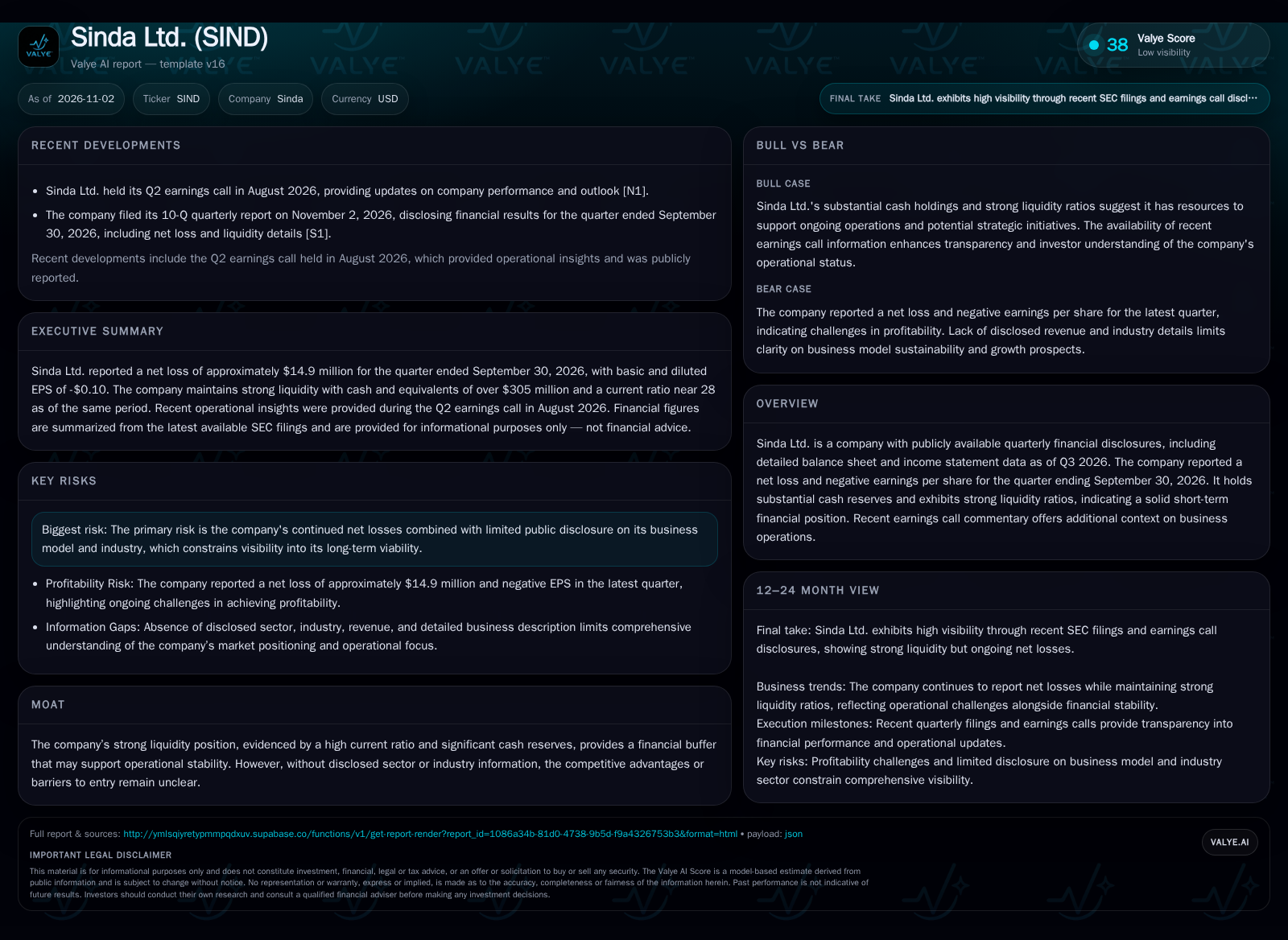
Sinda Ltd. reported a net loss of nearly $14.9 million and negative EPS for Q3 2026, but maintains over $305 million in cash and a current ratio of 27.92. Ongoing losses highlight the need for a path to profitability or value-creating investment.
Sinda Ltd. presents a paradoxical financial profile: it sits on a large cash pile and boasts one of the highest current ratios seen among public filers, yet it continues to post significant quarterly net losses with no disclosed revenue or industry context. This disconnect signals a business at a strategic crossroads—well-capitalized for now, but facing mounting questions about its ability to generate sustainable value. The lack of transparency around its core business activities and future plans means that investors and analysts are left to focus on balance-sheet strength while the company’s underlying economics remain opaque. The next chapter for Sinda will depend less on liquidity, and more on its ability to articulate and execute a viable, profitable growth strategy.
Net Losses Offset by Exceptional Liquidity—But Strategic Direction Remains Opaque
For the quarter ended September 30, 2026, Sinda Ltd. reported a net loss of $14,886,673 and earnings per share of -$0.10 [S1]. Despite this, the company held $305,582,739 in cash and cash equivalents, with current assets of $307,613,461 against current liabilities of just $11,018,246—yielding a current ratio of 27.92 and a cash ratio of 27.73 [S1]. These metrics suggest Sinda has reported liquidity position to weather operational losses in the near term. However, the absence of reported revenue, sector, or business model details in recent filings leaves the sustainability of its operations and the rationale for such a large cash reserve unclear. The Q2 2026 earnings call reportedly provided operational context, but no substantive new disclosures about revenue streams or business focus have been published [N1].
How Sinda Could Create Value: The Missing Links in Revenue, Margin, and Cost Structure
The company’s economic engine is impossible to evaluate in detail without disclosed revenue, gross margin, or expense breakdowns. The persistent net losses imply that either operating costs substantially exceed any revenue, or that the company is pre-revenue and in a prolonged investment phase. The exceptionally high liquidity could reflect proceeds from a recent capital raise, asset sale, or retained cash from earlier business pivots. If Sinda is pre-revenue, its burn rate (as inferred from quarterly net losses) suggests a multi-year runway to fund development, acquisition, or market entry initiatives. If it is generating revenue, the lack of disclosure raises questions about business line stability, pricing power, and customer adoption.
Fixed versus variable cost structure, capital requirements, and operating leverage cannot be determined from available filings. If Sinda is pursuing a capital-intensive model—such as hardware, infrastructure, or regulated industries—its cash reserves may be earmarked for large-scale investments or acquisitions. If it is a software or services business, the net loss could reflect high upfront R&D or customer acquisition spending. The current facts do not establish any of these mechanics, leaving investors to speculate on the company’s true economic model.
Assessing Sinda’s Market Standing: Opaque Differentiation and Unclear Barriers
With no disclosed industry, product, or customer base, Sinda’s competitive dynamics are entirely ambiguous. The company reported cash and liquidity metrics for the period; these figures do not by themselves establish operating runway, investment capacity, financial flexibility, or financing capacity. However, the absence of detail on sector or value proposition means there is no evidence of a defensible moat, unique technology, or established customer relationships.
If Sinda operates in a sector with entrenched incumbents or rapid technological change, it may face significant barriers to entry or risk of obsolescence. Conversely, if it occupies a niche with high switching costs or network effects, its liquidity could be leveraged for durable competitive advantage. Until the company discloses its core activities or strategic priorities, its competitive position is essentially a blank slate.
Unlocking Value Through Deployment of Cash: What a Bullish Turn Would Require
The most plausible bullish scenario is that Sinda leverages its substantial cash reserves to launch or acquire a business with strong revenue growth potential and positive unit economics. This could include deploying capital into high-growth sectors, funding the commercialization of proprietary technology, or executing strategic M&A to accelerate scale or market entry. Confirmation of this scenario would require explicit disclosure of new business lines, revenue generation, or major partnerships—preferably with evidence of early customer traction or contract wins.
Investors should look for announcements regarding a pivot to a cash-generating business model, the launch of a differentiated product, or the closing of an accretive acquisition. Success would be validated by a reversal of quarterly net losses, improved gross margins (if disclosed), and clear progress toward positive operating cash flow. Conversely, continued opacity or further net losses without operational clarity would falsify the bullish thesis.
Sinda’s Status Quo: Sustained Losses and Strategic Ambiguity Persist
The most plausible near-term scenario is continued net losses supported by a gradual drawdown of cash reserves, with no meaningful new disclosures on business focus or revenue. Under this path, Sinda remains a company with reported liquidity position but enduring questions about its core operations and long-term prospects. If the burn rate remains consistent with the latest quarter, the company could fund operations for several years, but the absence of strategic clarity or progress toward profitability would weigh on investor confidence.
Confirmation of this scenario would come from future filings showing similar patterns—high liquidity, ongoing losses, and no substantive change in business description or revenue disclosure. A deviation would require either a significant reduction in losses (suggesting operational improvement or cost-cutting) or new transparency around business strategy and revenue streams.
When Liquidity Alone Isn’t Enough: The Risks of Prolonged Opacity and Losses
The adverse scenario is that Sinda continues to post significant net losses without ever articulating a viable business model or pathway to revenue.
This scenario would be confirmed by persistent or worsening losses, further quarters without revenue disclosure, and lack of new business development or capital deployment initiatives. External risks—such as regulatory changes, market downturns, or capital market inaccessibility—could amplify downside pressure, especially if the company’s cash burn accelerates or unexpected liabilities arise.
What Will Determine Sinda’s Trajectory: Transparency, Execution, and Capital Deployment
Disclosure of revenue, customer contracts, or business line details—any evidence of commercial operations would help test the company’s ability to generate value beyond cash preservation.
Updates on product launches, M&A activity, or strategic partnerships—would signal a shift from capital preservation to value creation.
Quarterly trends in net loss and cash burn rate—if disclosed, would clarify the sustainability of current operations and the urgency of pivoting to profitability.
Gross margin and operating expense breakdowns—would illuminate cost structure and potential for operating leverage, if disclosed.
Management commentary on capital allocation priorities—guidance on whether cash will be used for organic growth, acquisitions, or returned to shareholders.
Announcements of sector focus or competitive positioning—would help gauge the durability of any potential moat or differentiation.
Board or insider activity—such as significant share purchases, sales, or changes in executive leadership, if reported, could signal confidence or concern regarding future direction.
Disclaimer: This is research-only, informational analysis and not investment advice. It may include AI-generated interpretation and general industry context. Always verify important details using primary sources.

Comments