
COHU INC in 2026: AI-Driven Demand, Recurring Revenue, and the Stakes of Semiconductor Test Innovation
COHU INC's Q3 2026 profitability rebound and strong recurring revenue base highlight its role as a key enabler of semiconductor test automation and AI-era complexity. As the industry pivots to high-bandwidth memory and AI processors, the company’s success hinges on its ability to leverage R&D, scale analytics, and defend against cyclical and competitive pressures.
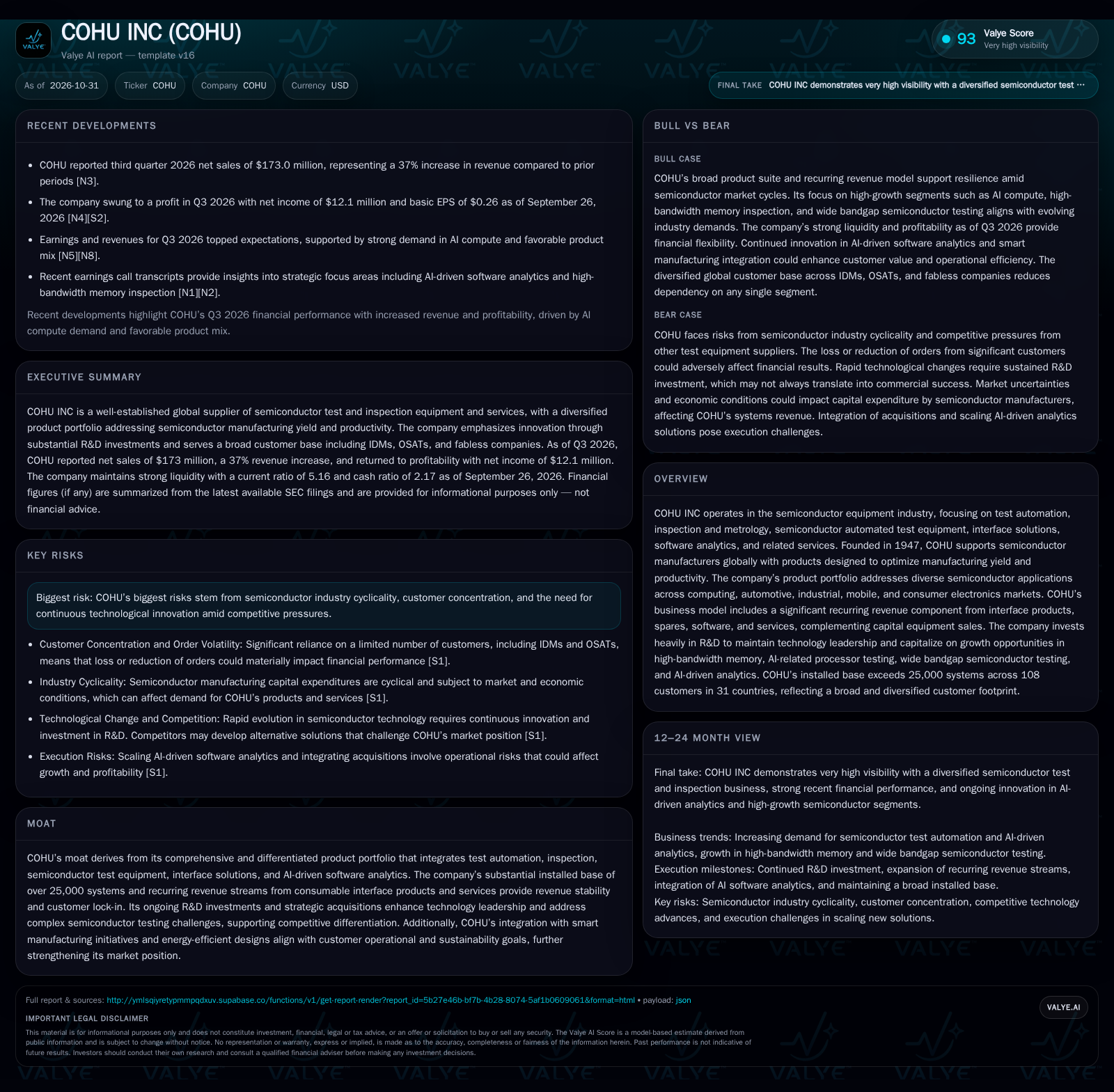
COHU’s swing to profitability in Q3 2026, with net income of $12.1 million, was driven by robust AI-compute demand and an improved product mix. Recurring revenues now make up 60% of net sales, providing stability amid semiconductor market cycles. The company’s heavy R&D investment targets growth in AI processor and high-bandwidth memory testing, but exposure to customer concentration and industry cyclicality remains significant. Execution on software analytics and integration of smart manufacturing solutions will likely determine the next phase of growth and resilience. [S2] [N4] [N5] [N8]
COHU INC’s sharp rebound to profitability in Q3 2026, driven by AI compute demand and a favorable product mix, spotlights the company’s evolving role in the semiconductor test equipment landscape. With 60% of revenue now coming from recurring sources and R&D investment targeting the sector’s fastest-growing niches, COHU appears well-positioned to benefit from the industry’s pivot toward high-complexity, AI-enabled devices. However, its fortunes remain tightly linked to cyclical capital spending and the ability to execute on software analytics and smart manufacturing integration.
Profitability Rebounds on AI Compute Surge and Recurring Revenue Mix
COHU INC returned to profitability in Q3 2026, reporting net income of $12.1 million and basic EPS of $0.26, following a period of market-driven volatility [S2] [N4]. This turnaround was supported by stronger-than-expected demand for AI compute and a shift toward higher-margin product lines, as noted in recent earnings calls [N1] [N5] [N8]. Recurring revenue sources—including services, consumables, and software—accounted for 60% of net sales in 2025, providing a stabilizing counterweight to the cyclical nature of capital equipment sales [S1]. The company reported cash and liquidity metrics for the period; these figures do not by themselves establish operating runway, investment capacity, financial flexibility, or financing capacity. These developments matter because they reveal both COHU’s exposure to secular AI-driven tailwinds and its reliance on execution in high-value recurring revenue streams.
How COHU Monetizes Complexity: Revenue Streams and Cost Structure Dynamics
COHU’s business model blends large, lumpy systems sales with a substantial base of recurring revenues from services, consumables, upgrades, and software analytics [S1]. The company’s installed base of over 25,000 systems anchors a steady aftermarket, as customers require ongoing support, replacement parts, and performance enhancements. This recurring component, now 60% of net sales, reduces revenue volatility and improves cash flow visibility compared to pure-play capital equipment peers.
Pricing power in this sector is typically driven by the technical sophistication of test and inspection solutions, especially as device architectures become more complex (e.g., for AI processors, high-bandwidth memory, and wide bandgap semiconductors). However, pricing is also subject to competitive bidding and customer negotiating leverage, particularly with large IDMs and OSATs. Volume is closely tied to industry capital expenditure cycles—when chipmakers invest in new fabs or upgrade lines, system sales spike, but downturns can be abrupt and deep.
COHU’s heavy R&D outlays ($92.2 million in 2025) are necessary to stay ahead of rapid technology shifts, but this also creates high fixed costs and operating leverage: when demand is strong, incremental margins can expand rapidly, but in downturns, the cost base is less flexible. The company’s ability to scale software analytics and AI-driven digital twin offerings could, if successful, enhance gross margins and reduce dependence on hardware cycles by embedding COHU deeper into customer workflows.
Defending Share in a Fragmented, Innovation-Intensive Market
COHU operates in a fiercely competitive landscape against other semiconductor test and inspection equipment suppliers, as well as emerging software and automation entrants. Its moat rests on a broad, integrated product suite—spanning test automation, inspection, interface solutions, and AI-driven software analytics—and a large installed base that makes switching costly and logistically complex for customers [S1].
However, the sector is characterized by rapid technological obsolescence and intense price competition, particularly as customers consolidate purchasing power and demand integrated, future-proof solutions. Substitutes may emerge not only from traditional rivals but also from in-house solutions developed by leading semiconductor manufacturers or from disruptive software platforms that automate or virtualize parts of the testing process.
The company’s focus on high-growth verticals (AI compute, high-bandwidth memory, wide bandgap semiconductors) and integration with smart manufacturing initiatives may offer differentiation, but sustained leadership will require continuous R&D investment and the ability to demonstrate quantifiable customer ROI from analytics and automation features.
Unlocking AI and Analytics Upside: When Innovation Yields Stickier Revenue
A favorable scenario for COHU would involve sustained AI compute and high-bandwidth memory investment cycles driving robust demand for both capital equipment and high-margin, recurring revenue products. If COHU’s R&D investments in AI-driven analytics and digital twin platforms gain traction, the company could achieve deeper integration into customer processes—potentially increasing switching costs and expanding software-driven margins.
Confirmation of this scenario would come from sequential growth in recurring revenue as a proportion of total sales, customer wins in AI and high-bandwidth memory test markets, and disclosures of multi-year software or analytics contracts (if disclosed). Additionally, a visible shift in earnings mix toward software and services, along with rising gross margins and reduced earnings volatility, would support the bull case.
Falsification would occur if analytics offerings fail to gain customer adoption, if recurring revenue stagnates, or if new entrants erode COHU’s share in target verticals.
Balancing Cyclical Headwinds with Recurring Revenue Stability
The most plausible trajectory is one where COHU experiences moderate growth, with recurring revenue and a diversified customer base cushioning the impact of semiconductor capital expenditure cycles. Systems sales may fluctuate with broader industry investment, but the installed base and aftermarket streams provide a stabilizing foundation.
R&D investment is likely to remain elevated as the company seeks to maintain relevance in fast-evolving test and analytics domains. Earnings could remain volatile quarter-to-quarter, especially if macro or industry shocks curtail chipmaker spending, but the company’s financial position and product breadth should support operational continuity.
Evidence for this scenario would include steady recurring revenue ratios, stable or gradually rising gross margins, and continued product launches in AI and memory test. It would be challenged by unexpected customer concentration shocks, margin erosion, or execution missteps in scaling new analytics offerings.
When Cyclicality, Customer Concentration, and Execution Risks Converge
The principal threat to COHU is a synchronized downturn in semiconductor capital spending—whether from macroeconomic shocks, inventory corrections, or a pause in AI infrastructure buildouts—combined with order volatility from large customers. Given the company’s dependence on a small set of major IDMs and OSATs, the loss or delay of a single program could have outsized impact [S1].
If COHU’s recurring revenue streams prove less sticky than anticipated, or if new analytics and automation solutions fail to deliver customer ROI, recurring sales could decline alongside capital equipment revenue, exposing the company to severe margin compression. Competitive threats—whether from traditional rivals, disruptive software entrants, or customer insourcing—could accelerate share loss or force price concessions.
Downside confirmation would be visible in sharp declines in both systems and recurring revenues, rising customer concentration, missed product development milestones, or evidence of stalled adoption for analytics platforms.
Testing the Thesis: Revenue Mix, Analytics Adoption, and Customer Resilience
Recurring revenue as a percentage of total sales—especially any sequential changes and mix shift toward software/services (if disclosed).
Gross margin trends, particularly as analytics and AI-driven solutions scale or if product mix shifts toward lower-margin hardware.
Customer concentration metrics and changes in the top five customer contribution to total revenue (if disclosed).
Adoption rates for new analytics, digital twin, and automation solutions—including customer wins, contract duration, and renewal rates (if disclosed).
R&D spending as a percentage of net sales and evidence of successful commercialization of new test/inspection platforms.
Semiconductor capital expenditure cycles and broader industry demand indicators, especially in AI compute and memory.
Execution milestones for integration with smart manufacturing initiatives and expansion of the installed base.
Disclaimer: This is research-only, informational analysis and not investment advice. It may include AI-generated interpretation and general industry context. Always verify important details using primary sources.

Comments