
Kymera Therapeutics: Pioneering Oral Targeted Protein Degradation in Immunology
Kymera Therapeutics’ clinical advances in targeted protein degradation signal the potential for oral therapies to disrupt entrenched biologics in immunology, but the company’s early-stage status, capital requirements, and path to commercialization remain central variables for investors.
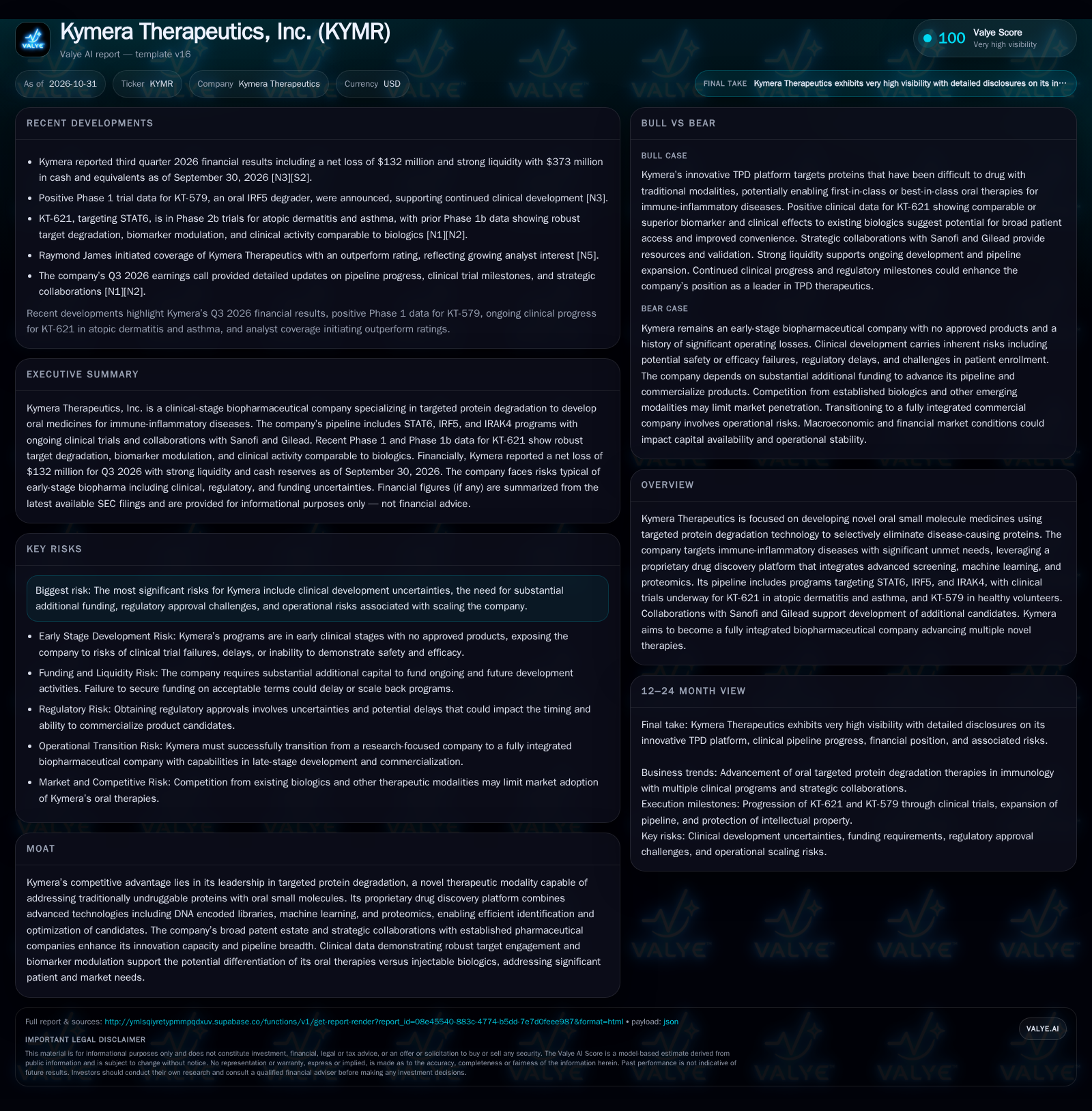
Kymera Therapeutics is advancing a pipeline of oral small molecules using targeted protein degradation (TPD), with KT-621 showing clinical activity comparable to leading biologics in atopic dermatitis and asthma. Reported liquidity position supports continued R&D, while partnerships with Sanofi and Gilead provide external validation. However, the company remains pre-commercial, faces continued operating losses, and must navigate execution, funding, and regulatory risks before realizing commercial potential. Key inflection points in clinical data and regulatory progress will be critical over the next 12–24 months. [S1] [S2] [N1] [N2] [N3]
Kymera Therapeutics is at the forefront of developing oral small molecule therapies based on targeted protein degradation (TPD), aiming to address diseases with high unmet need in immunology. With KT-621 showing compelling early-stage data that rivals leading biologics and a pipeline supported by reported liquidity position and strategic partnerships, Kymera has positioned itself as a potential disruptor in immune-inflammatory therapeutics. Yet, the company’s pre-commercial status, history of operating losses, and the inherent risks of drug development mean that clinical, regulatory, and funding milestones will determine whether Kymera can translate its scientific promise into commercial success. [S1] [S2] [N1] [N2] [N3]
Recent Clinical and Financial Milestones Set the Stage for Kymera’s Next Phase
[S2] [N3] This balance sheet strength is notable given the company’s commitment to advancing a broad pipeline in immunology and the capital requirements of late-stage clinical execution.
In the clinic, KT-621 (a STAT6 degrader) is in Phase 2b trials for atopic dermatitis and asthma, having previously shown robust target degradation, biomarker modulation, and clinical activity on par with or exceeding biologics such as dupilumab. [S1] [N1] [N2] KT-579 (IRF5 degrader) also demonstrated positive Phase 1 data, supporting continued progression. [N3] Collaborations with Sanofi (IRAK4) and Gilead (CDK2) add external validation and pipeline breadth. [S1]
Together, these developments establish Kymera as a key innovator in TPD and set up critical clinical and regulatory inflection points over the next 12–24 months.
The Economics of Oral TPD: Pathways to Value Creation and Capital Demands
Kymera’s business model centers on developing oral small molecule drugs that degrade disease-driving proteins, aiming for best-in-class efficacy with the convenience of oral administration. If successful, this could unlock significant pricing power and patient volume, particularly in chronic immune-inflammatory conditions where injectable biologics are the current standard.
The economics of this model hinge on several factors: the ability to achieve large-scale adoption (volume), the potential for premium pricing versus existing biologics (pricing), and the mix of indications targeted. Chronic immunology markets—such as atopic dermatitis and asthma—are sizable, but penetration depends on demonstrating at least non-inferior efficacy and safety relative to entrenched biologics.
On the cost side, Kymera’s R&D spend is high and will remain so as it advances multiple assets through mid- and late-stage trials. The capital-intensive nature of drug development—before any commercial revenue is realized—means the company will likely require additional equity or partnership financing unless it can secure non-dilutive funding or achieve near-term out-licensing milestones.
If Kymera can eventually commercialize an oral TPD therapy with broad label and payer acceptance, operating leverage could be substantial: manufacturing costs for small molecules are typically lower than for biologics, and oral delivery reduces distribution complexity. However, this scenario depends on successful clinical outcomes, regulatory approval, and market uptake.
Positioning Against Biologics and TPD Rivals: Where Kymera Could Win or Lose
Kymera’s core competition comes from established biologic therapies (e.g., monoclonal antibodies like dupilumab) and emerging modalities targeting similar immune-inflammatory pathways. Biologics have set a high efficacy bar, but their injectable administration and cost create unmet needs that oral TPDs could address—if Kymera can match or exceed clinical outcomes.
The TPD field is attracting increasing investment, with both large pharma and biotech peers developing E3 ligase-based and molecular glue degraders. Kymera’s potential edge lies in its proprietary discovery platform, integrating DNA encoded libraries, machine learning, and proteomics to identify and optimize small molecule degraders. Its broad patent estate and clinical progress could provide a first-mover or best-in-class advantage, particularly if KT-621’s efficacy and safety are confirmed in larger trials.
Collaborations with Sanofi and Gilead provide both funding and external validation, but also introduce potential competition should those partners develop overlapping assets. Ultimately, Kymera’s differentiation will depend on the clinical profile of its drugs, IP protection, and its ability to scale commercial operations against well-capitalized biologic incumbents and other TPD entrants.
How Clinical Validation Could Unlock a New Standard in Immunology
The most bullish scenario for Kymera hinges on KT-621 and/or KT-579 demonstrating clear superiority or meaningful parity to leading biologics in Phase 2b/3 trials—on both efficacy and safety—while retaining the convenience of oral dosing. If this is achieved, Kymera could capture significant share from current standards of care, especially among patients preferring oral therapy or those inadequately controlled on injectables.
Confirmation of this scenario would require: (1) robust, peer-reviewed Phase 2b/3 data showing non-inferior or superior clinical endpoints (e.g., EASI, pruritus, SCORAD in atopic dermatitis); (2) durable safety signals; (3) regulatory alignment for broad label; and (4) payer willingness to reimburse at competitive rates versus biologics.
Additional upside could come from expanding indications (e.g., other inflammatory or autoimmune diseases), successful commercialization of partnered assets (e.g., IRAK4 with Sanofi), and out-licensing or milestone revenue that extends runway without excessive dilution. Realization of these milestones would support a thesis of Kymera as a platform leader in oral TPD therapeutics.
What Steady Clinical Progress and Prudent Capital Use Would Mean for Kymera
The most realistic scenario is one in which Kymera advances KT-621 and KT-579 through mid-stage trials with results that are competitive but not dramatically superior to leading biologics. This would still allow the company to pursue registration studies and potential niche positioning—such as for patients who cannot tolerate injectables or for second-line use.
In this scenario, Kymera would continue to incur significant operating losses and require additional capital, but could leverage its cash reserves and partnerships to avoid excessive dilution. Pipeline breadth and new clinical candidates (e.g., IRAK4, CDK2) would support long-term optionality.
Confirmation would come from steady clinical enrollment, achievement of prespecified endpoints, manageable safety profiles, and the ability to secure additional funding or non-dilutive capital. Falsification would occur if clinical data show clear inferiority, major safety concerns, or regulatory pushback that delays or narrows potential market access.
When Clinical or Funding Setbacks Could Derail the TPD Thesis
The bear case for Kymera involves clinical trial setbacks—such as failure to meet efficacy endpoints, unexpected safety issues, or difficulty enrolling or retaining patients—resulting in pipeline delays or discontinuations. In this scenario, the company’s lack of commercial revenue and high cash burn would force it to seek additional funding under adverse conditions, potentially leading to significant shareholder dilution or program scale-backs.
Further downside could result from regulatory hurdles, such as requests for additional studies, or from competitive advances by biologics or rival TPD developers that erode Kymera’s differentiation. Loss of key partnerships or inability to secure new collaborations would compound financial and strategic pressures.
This scenario would be confirmed by negative or inconclusive Phase 2/3 data, adverse safety signals, missed clinical milestones, or material capital raises at depressed valuations. Falsification would require clear demonstration of clinical benefit and continued funding access.
Milestones and Metrics That Will Shape Kymera’s Disruption Potential
Progression of KT-621 through Phase 2b and into Phase 3, with particular attention to efficacy endpoints (EASI, pruritus, SCORAD) and safety data relative to biologics.
Clarity on regulatory interactions and guidance for KT-621 and KT-579—especially any signals around approvability, trial design, or required endpoints.
Updates on the depth and breadth of the pipeline, including advancement of IRAK4 (Sanofi partnership), KT-579, and preclinical candidates into clinical development.
Cash burn rate and financing strategy—especially the timing and terms of additional capital raises or non-dilutive funding events.
Evidence of payer and physician interest in oral TPDs for immune-inflammatory diseases, if disclosed.
Development of commercial capabilities and leadership hires, signaling readiness for potential launch or partnership negotiations.
Ongoing intellectual property developments, including granted patents and freedom-to-operate analyses, to protect platform and lead assets.
Announcements of new or expanded strategic collaborations, which could bring additional funding or validation.
Disclaimer: This is research-only, informational analysis and not investment advice. It may include AI-generated interpretation and general industry context. Always verify important details using primary sources.

Comments