
PBF Energy: Refining Performance, Financial Engineering, and the Stakes of Shareholder Returns
PBF Energy’s latest results highlight robust operational profits, a disciplined approach to capital returns, and increasingly complex capital structure maneuvers.
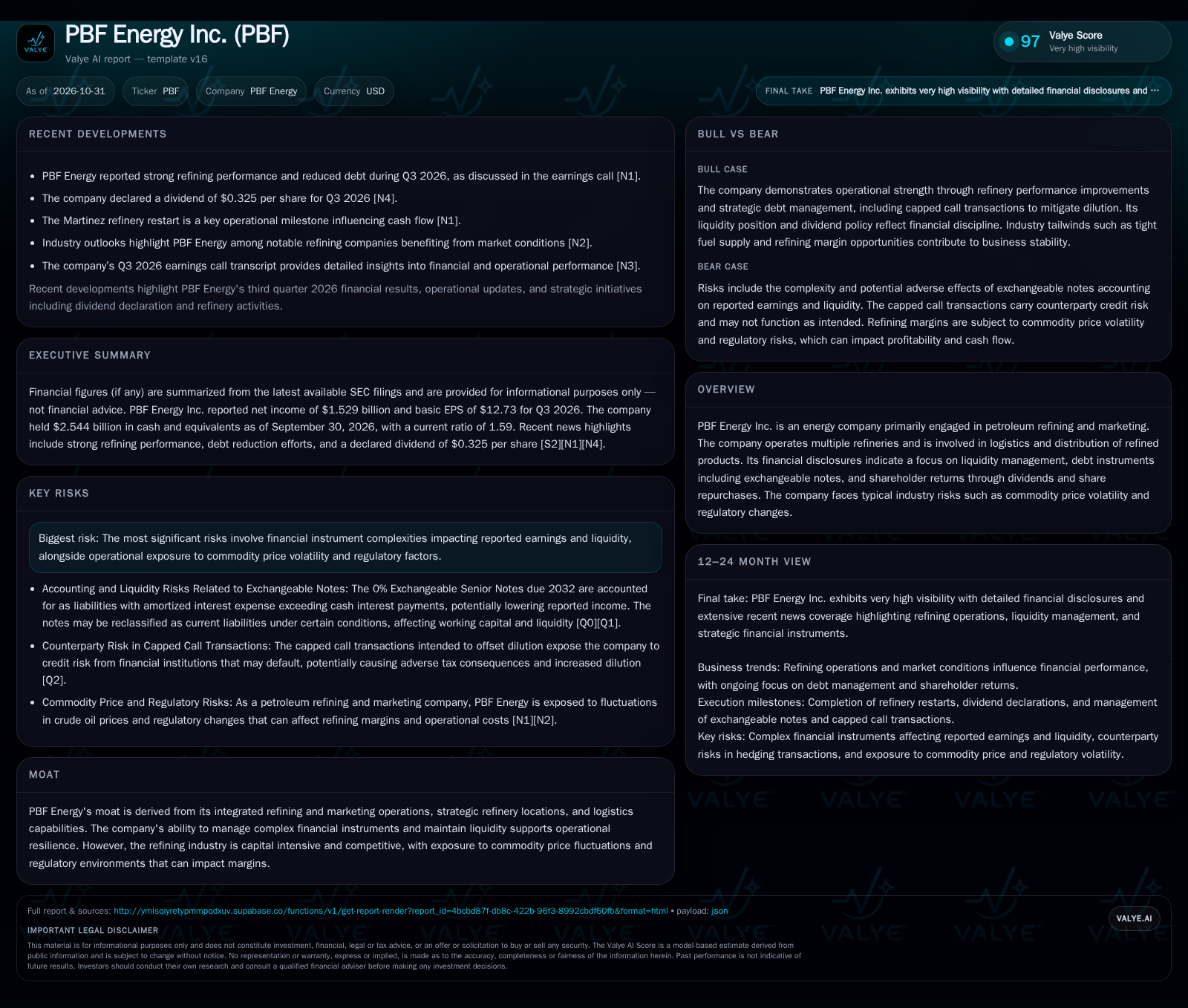
PBF Energy reported $1.529 billion in Q3 2026 net income, declared a $0.325 dividend, and maintains a $2.544 billion reported cash balance. Operational gains, share buybacks, and sophisticated exchangeable debt structures set the stage for both upside and potential pitfalls, as the company navigates volatile refining markets and the risks of financial engineering [S2] [N4].
PBF Energy enters the final quarter of 2026 with strong reported earnings and a reported liquidity position, underscored by $1.529 billion in net income and a balance sheet featuring over $2.5 billion in cash. The company continues to reward shareholders through dividends and repurchases while leveraging complex financing instruments—namely, 0% exchangeable notes and associated capped call transactions—to manage dilution and optimize capital structure. As refining economics remain favorable, PBF’s ability to sustain performance amid market volatility and the operational risks embedded in its financial engineering will shape its next phase.
Recent Performance and Capital Allocation Define PBF’s 2026 Backdrop
PBF Energy reported net income of $1.529 billion for Q3 2026, translating to basic earnings per share of $12.73 and diluted EPS of $12.54 [S2]. This result reflects both strong refining margins and operational execution during a period of favorable market conditions. The company’s liquidity position is notable, with $2.544 billion in cash and cash equivalents and a current ratio of 1.59 as of September 30, 2026 [S2]. PBF also declared a dividend of $0.325 per share for the quarter and has approximately $732 million remaining on its $1.75 billion share repurchase program [S2] [N4]. In parallel, the company has implemented 0% Exchangeable Senior Notes due 2032, paired with capped call transactions designed to offset dilution and manage cash obligations [S2]. These facts illustrate a business with strong recent profitability, active capital return, and growing complexity in its capital structure.
Refining Margins, Capital Returns, and the Leverage of Financial Structure
PBF Energy’s core economics are driven by the spread between crude oil feedstock costs and the selling prices of refined petroleum products—a dynamic that is inherently cyclical and sensitive to both global supply-demand imbalances and regional transportation constraints. The company’s recent earnings surge suggests that crack spreads have remained wide, likely due to tight product inventories and robust demand. Operating leverage is significant in refining: once fixed costs are covered, incremental gross margin flows disproportionately to the bottom line. This amplifies both upside in strong markets and downside during contractions.
On the capital allocation front, PBF’s dividend and share repurchase activity signal a willingness to return cash to shareholders, but the ultimate sustainability of these returns depends on volatile underlying cash flows. The introduction of 0% Exchangeable Senior Notes and capped call overlays adds a layer of financial engineering that could reduce future dilution if the stock appreciates, but also imposes complex accounting—such as amortized interest expense exceeding cash interest paid—and exposes the company to counterparty risk on the hedges. The trade-off is between immediate cash savings and potential future dilution or liquidity strain if market or counterparty assumptions break down.
Refinery operations are capital-intensive, and periodic maintenance or environmental upgrades can require significant outlays. The company reported cash and liquidity metrics for the period; these figures do not by themselves establish operating runway, investment capacity, financial flexibility, or financing capacity.
Integrated Operations and Geographic Reach: Defending Profit Pools in a Crowded Sector
PBF Energy’s competitive position hinges on its portfolio of strategically located refineries, integrated logistics, and marketing capabilities. In the U.S. refining sector, advantages accrue to operators with scale, access to advantaged feedstocks, and the ability to optimize product mix across regional markets. PBF’s operational breadth may confer a degree of resilience against localized disruptions or regulatory changes.
However, the sector remains intensely competitive, with peers ranging from independent refiners to integrated oil majors. Margin pressure can emerge from overcapacity, regulatory tightening (such as renewable fuel standards), or new entrants exploiting alternative fuels and electrification trends. Substitutability risk is present as transportation electrification gradually erodes gasoline and diesel demand, though the adoption curve remains gradual. PBF’s ability to maintain utilization rates and optimize logistics will be central to defending its margin pool.
Sustained Margins and Debt Optimization Unlock Further Shareholder Value
If refining margins remain robust—buoyed by constrained global capacity, disciplined supply, or persistent demand for transportation fuels—PBF could continue generating outsized cash flows. The capped call transactions could function as intended, minimizing dilution from the exchangeable notes and preserving equity value for shareholders.
Confirmation of this scenario would come from continued high net income, stable or rising refining utilization rates, and evidence that the company is able to renew or extend hedging structures without adverse cost or counterparty issues. Additionally, updates indicating successful operational execution at key facilities—such as the Martinez refinery restart—would support the thesis of sustained operational momentum.
Falsification would involve a sharp contraction in crack spreads, an inability to execute buybacks or dividends due to cash flow constraints, or negative surprises related to the accounting or liquidity impact of the exchangeable notes.
Navigating Cyclical Volatility with Conservative Capital Management
The most plausible trajectory is that PBF Energy continues to generate positive, but potentially volatile, free cash flow as refining margins normalize from current highs. The company is likely to maintain a conservative capital allocation stance—balancing shareholder returns with the need to reinvest in refinery maintenance and regulatory compliance. Share repurchases and dividends may continue, but at a pace calibrated to market conditions.
The exchangeable notes and capped call transactions will likely introduce some earnings volatility and require ongoing management attention, but are not expected to cause acute distress unless market or counterparty disruptions occur.
Evidence for this scenario would include a gradual moderation in net income, steady but not aggressive capital returns, and ongoing disclosures that clarify the impact of financial instruments without major negative adjustments. A sharp deviation from this pattern—such as regulatory shocks, refinery incidents, or financial market dysfunction—would challenge the base case.
Margin Compression, Counterparty Failures, or Regulatory Shocks Disrupt the Thesis
An adverse scenario could unfold if global refining margins contract sharply—whether due to new capacity additions, demand destruction from accelerated electrification, or macroeconomic slowdown. PBF’s operating leverage would amplify the impact, with cash flows falling faster than revenue. If this coincides with substantial maintenance capex or unplanned outages, liquidity could tighten and force reductions in dividends or buybacks.
Further downside could emerge from the financial structure: if counterparties to the capped call transactions default or the instruments fail to offset dilution as planned, PBF could face unexpected equity dilution or cash outflows. Additionally, adverse reclassification of exchangeable notes as current liabilities could pressure working capital and restrict potential financial flexibility.
Confirmation of this scenario would include a rapid collapse in reported net income, suspension of shareholder returns, or disclosures of financial distress related to hedging counterparties or debt covenants. Conversely, evidence of stable or improving financial performance, even in a tougher margin environment, would falsify the downside case.
Milestones and Metrics That Will Shape PBF Energy’s Strategic Outcome
Quarterly refining margin trends and crack spread data: Persistent strength would support the upside scenario, while rapid compression would test resilience.
Refinery utilization rates and operational uptime: High, stable utilization would indicate operational discipline; major outages or slippage would be warning signs.
Size and pace of share repurchases versus authorized limits: Acceleration or suspension of activity could signal shifts in cash flow or outlook.
Updates on the accounting treatment and liability classification of exchangeable notes: Reclassification as current liabilities or unexpected charges would be material.
Counterparty disclosures related to capped call transactions: Defaults or renegotiations would raise dilution and liquidity risks.
Major regulatory developments affecting U.S. refining economics: Shifts in fuel standards, carbon pricing, or environmental mandates could materially alter cost structures.
If disclosed, capex guidance for refinery maintenance or upgrades: Increases would affect free cash flow and capital allocation flexibility.
Disclaimer: This is research-only, informational analysis and not investment advice. It may include AI-generated interpretation and general industry context. Always verify important details using primary sources.

Comments