
Bridgewater Bancshares in 2026: Lending Concentration, Deposit Dynamics, and the Stakes of Regional Growth
The interplay between deposit stability, credit quality, and capital requirements will shape its next phase.
The company’s ability to manage credit quality, attract stable funding, and adapt to regulatory and interest rate shifts will be critical for sustaining growth and profitability over the next 12-24 months. [S2]
Bridgewater Bancshares enters late 2026 with reported profitability and a robust cash balance, but the company’s future trajectory is tightly linked to its concentrated depositor base and focus on real estate lending. While recent earnings underscore operational execution, the underlying risks from borrower credit, deposit outflows, and regulatory requirements could amplify volatility if market conditions shift. Investors and management alike must navigate the tension between growth ambitions and the structural vulnerabilities inherent in Bridgewater’s business model.
Quarterly Earnings, Liquidity, and Depositor Concentration Define the Current Landscape
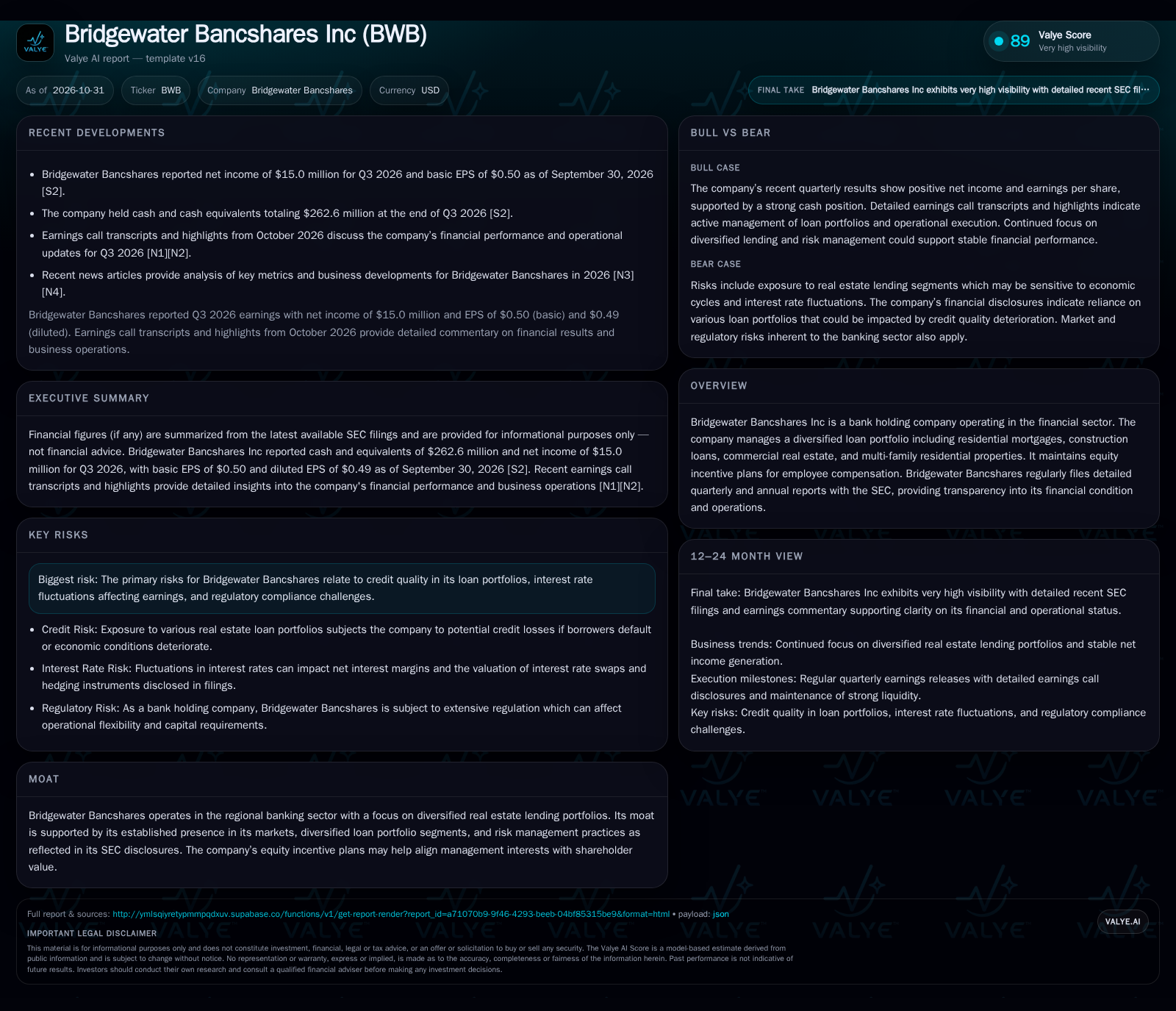
Bridgewater Bancshares reported net income of $15.0 million for Q3 2026, translating to basic earnings per share of $0.50 and diluted EPS of $0.49. The company’s cash and equivalents stood at $262.6 million as of September 30, 2026, providing a liquidity snapshot as it enters the final quarter of the year [S2]. However, the bank’s deposit structure is notably concentrated: as of December 31, 2025, its ten largest depositor relationships comprised 16.2% of total deposits—a level that heightens the risk of sudden liquidity outflows should even one major client withdraw funds [S1]. Bridgewater’s loan portfolio remains heavily centered on real estate, spanning one-to-four family mortgages, construction loans, commercial real estate, and multi-family residential properties [S2]. This blend of steady earnings, high depositor concentration, and sectoral lending focus sets the stage for both potential growth and pronounced exposure to credit and funding shocks.
How Lending Mix, Deposit Costs, and Funding Access Shape Profits
Bridgewater’s core profitability mechanism is the net interest margin (NIM) generated by lending at rates higher than its cost of funding. Its focus on real estate loans offers opportunities for above-average yields, especially in construction and commercial segments, but also exposes the bank to cyclical downturns and potential credit losses if property values decline or delinquencies rise. The large-customer deposit concentration may allow for initially lower funding costs, but it increases the risk that a sudden withdrawal will force the bank to tap higher-cost wholesale or brokered funding, compressing margins and potentially eroding profitability.
Operating leverage in this model arises as growth in loans and deposits enables the company to spread fixed expenses—such as compliance, systems, and personnel—across a larger balance sheet. However, the bank’s ability to maintain or grow its loan book depends on both steady inflows of attractively priced deposits and continued access to collateralized borrowings, primarily from the Federal Home Loan Bank (FHLB) and Federal Reserve (Fed). If credit quality deteriorates or regulatory capital requirements tighten, Bridgewater may have to hold more capital against riskier assets or raise external equity, diluting returns. The company’s disclosed equity incentive plans aim to align management with shareholder value, but ultimately, the sustainability of its economics hinges on prudent risk management, stable funding, and the discipline to avoid chasing yield at the expense of credit quality.
Regional Bank Dynamics: Balancing Local Relationships and Sectoral Risk
Bridgewater’s competitive position is rooted in its regional focus and longstanding relationships with both borrowers and large depositors. By specializing in real estate-related lending, the bank can leverage local market knowledge and underwriting expertise to compete against larger national banks and direct non-bank lenders. However, this specialization also creates vulnerability to local economic downturns, property market corrections, and shifts in interest rates. Competitor categories include other regional and community banks, credit unions, and increasingly fintechs or alternative lenders targeting real estate or small business borrowers.
A relative advantage for Bridgewater may be its ability to offer customized lending solutions and responsive service, which can help maintain customer loyalty. Yet, the bank’s reliance on a narrow segment for both lending and deposits means it may lack the diversification that larger or more retail-oriented peers enjoy. If competitors offer more attractive deposit rates or digital convenience, especially in a rising-rate environment, Bridgewater could face both outflows and margin pressure. The question is whether its established relationships and risk management processes can offset these structural disadvantages over time.
What Sustained Credit Quality and Deposit Stability Could Unlock
If Bridgewater successfully maintains credit quality in its real estate loan book and avoids significant depositor attrition, the company could continue to deliver steady net interest income and profitability. In this scenario, stable or improving property markets would limit loan losses, while the bank’s core depositors remain loyal, allowing funding costs to stay low. Access to FHLB and Fed liquidity would provide additional flexibility to support loan growth or manage short-term shocks. Operational discipline—such as careful underwriting, active portfolio monitoring, and prudent expense control—would reinforce earnings momentum.
Confirmation of this scenario would come from continued low nonperforming loan ratios, stable or growing deposit balances (especially among the largest clients), and maintenance of a healthy net interest margin even as market rates fluctuate. Additional evidence would include the ability to grow loans without materially increasing charge-offs or needing to access expensive wholesale funding. Conversely, a spike in credit losses, rapid deposit outflows, or a sharp decline in NIM would challenge this thesis.
Managing Through Moderate Credit Cycles and Incremental Regulatory Demands
The most plausible outcome for Bridgewater is a continuation of moderate growth, punctuated by periodic credit pressures and incremental regulatory headwinds. Under this scenario, the bank’s real estate portfolio faces occasional stress—such as localized property downturns or isolated borrower defaults—but overall credit quality remains manageable. Deposit concentration persists, but is offset by proactive relationship management and occasional reliance on collateralized borrowings to navigate short-term funding gaps.
Earnings may fluctuate around current levels, with net income and EPS showing some sensitivity to changes in net interest margin and loan provisioning. Regulatory capital requirements may gradually increase, prompting the bank to retain more earnings or consider modest capital raises. Confirmation of this scenario would include relatively stable quarterly earnings, manageable loan loss provisions, and periodic but not persistent reliance on wholesale funding. Evidence to the contrary would be a sudden, outsized provision expense, regulatory intervention, or a material loss of major depositors.
How Credit Deterioration or Major Deposit Outflows Could Trigger a Funding Squeeze
Adverse conditions could emerge if a downturn in real estate markets leads to a spike in nonperforming assets or if one or more of Bridgewater’s largest depositors withdraw significant funds. Either event could force the bank to replace lost deposits with more expensive or less stable wholesale funding, compressing margins and potentially requiring asset sales at unfavorable prices. If credit losses mount, loan loss provisions would rise, eroding earnings and potentially threatening regulatory capital ratios.
In an extreme scenario, deteriorating asset quality could limit Bridgewater’s ability to pledge collateral for FHLB or Fed borrowings, further constraining liquidity. Regulatory scrutiny could intensify, leading to restrictions on lending or dividend payments, and the bank might need to raise dilutive equity capital to restore compliance. Confirmation of this downside would include a sharp increase in nonperforming loans, large sequential deposit outflows (especially among top clients), and a material decline in quarterly profitability.
Tracking the Pressures and Proof Points for Bridgewater’s Next Chapter
Trends in nonperforming assets and net charge-offs, especially within the real estate loan portfolio, would help test the sustainability of credit quality.
Sequential changes in total deposits and, if disclosed, the proportion held by the top 10 depositors, are critical for gauging funding risk.
Quarterly net interest margin (NIM) performance, especially as market rates shift, will indicate the bank’s ability to manage funding costs and lending yields.
Utilization of FHLB and Federal Reserve borrowing lines—frequency, amounts, and terms—would signal the health of core funding and collateral capacity.
Updates on regulatory capital ratios, including CET1 and total risk-based capital, are essential for assessing resilience to shocks and future growth potential.
Loan growth rates by segment (commercial real estate, construction, residential) would clarify demand trends and risk appetite.
Expense trends, particularly in compliance and technology, may reflect the bank’s response to evolving regulatory and data security requirements.
If disclosed, retention rates or relationship depth among major depositors would provide early warning of potential funding volatility.
Disclaimer: This is research-only, informational analysis and not investment advice. It may include AI-generated interpretation and general industry context. Always verify important details using primary sources.

Comments